 Edit
Trump rejects quick end to Iran war as oil surges, tankers strand amid escalating Gulf tensions
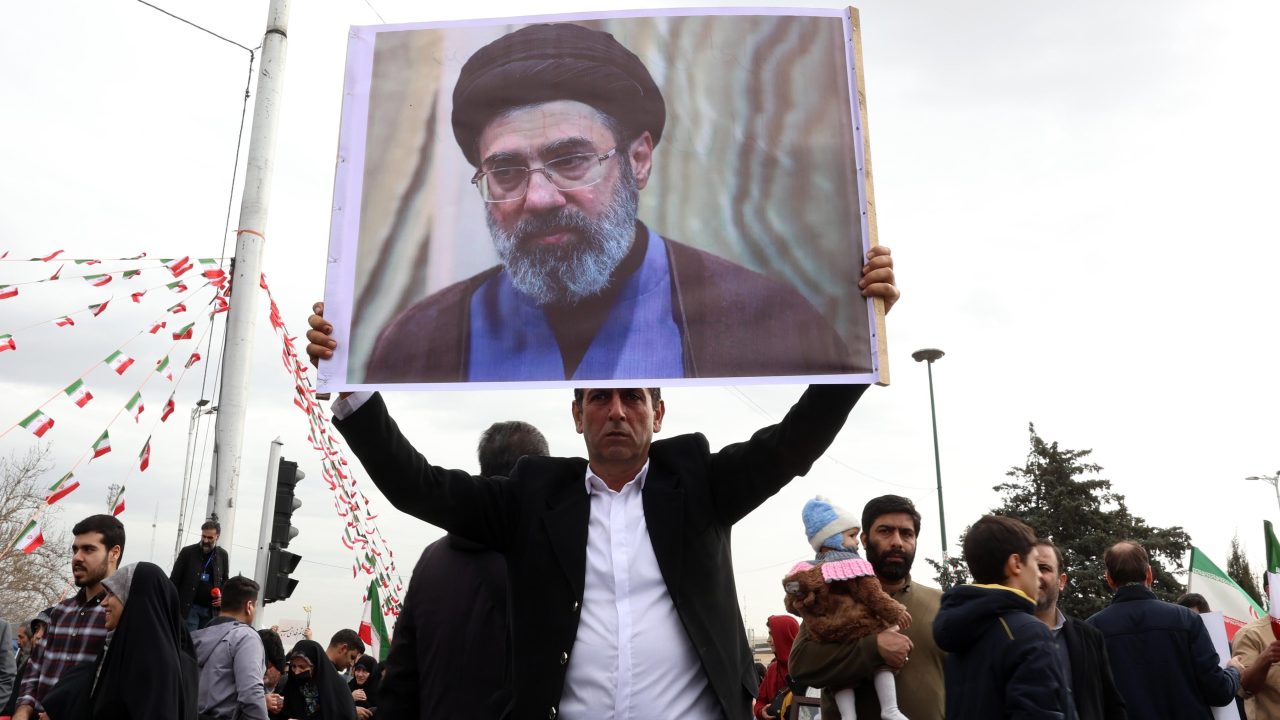
Iran's Assembly of Experts named Mojtaba Khamenei, son of the slain supreme leader Ali Khamenei, as the new supreme leader
As Iran’s Assembly of Experts named Mojtaba Khamenei, son of the slain supreme leader Ali Khamenei, as the new supreme leader on Monday, signalling unbroken hardline control amid the intensifying U.S.-Israeli war, global oil prices breached $100 a barrel for the first time since 2022.
The appointment, coupled with ongoing disruptions in the Strait of Hormuz, has left hundreds of oil tankers stranded on both sides of the vital waterway, exacerbating economic fallout while persistent Iranian attacks on Gulf states raise fears of a broader “water war” targeting desalination facilities critical to the arid region’s survival.
Mojtaba Khamenei, a cleric deeply embedded in Iran’s security apparatus and economic networks, emerged as the frontrunner following his father’s death in initial U.S.-Israeli strikes over a week ago. The Assembly’s statement, issued shortly after midnight Tehran time, declared: “By a decisive vote, the Assembly of Experts appointed Ayatollah Seyyed Mojtaba Hosseini Khamenei as the third Leader of the sacred system of the Islamic Republic of Iran.” This role grants him ultimate authority over state affairs, a move likely to provoke further U.S. and Israeli aggression.
U.S. President Donald Trump, who has repeatedly emphasized Washington’s stake in Iran’s leadership transition, told ABC News on Sunday that the U.S. should have veto power, warning, “If he doesn’t get approval from us, he’s not going to last long.”
In a subsequent interview with the Times of Israel, Trump demurred on immediate action, saying only “We’ll see what happens,” while noting that any cessation of hostilities would be a “mutual” decision with Israeli Prime Minister Benjamin Netanyahu.
Israel, which had preemptively threatened strikes on the Assembly, continued its campaign, with Netanyahu vowing to “press on” and destabilize the regime through an “organized plan with many surprises.”
The war’s ripple effects have severely hampered global energy flows, with the Strait of Hormuz—through which about a fifth of the world’s oil and liquefied natural gas typically transits—effectively closed.
Thousands of seafarers are trapped aboard vessels as tanker traffic has plummeted to near zero, down from an average of 37 daily passages before the conflict erupted on 28 February.
Maritime data from Lloyd’s List indicates around 200 unsanctioned tankers are stranded within the strait and Persian Gulf, with additional fleets idling in the Gulf of Oman, unable to risk transit amid Iranian threats to “set ablaze” any Western-linked ships.
Even Chinese-flagged vessels, despite Beijing’s pleas for safe passage, have halted movements, leaving over 55 ships trapped inside the Gulf.
Incidents like the drone strike on the Maltese-flagged tanker Prima, which was set ablaze after ignoring warnings, underscore the dangers, with at least eight seafarers killed and multiple vessels damaged since the crisis began.
President Trump has floated U.S. Navy escorts for tankers, but experts warn it could take weeks to resume normal flows, with insurance costs skyrocketing and some coverage withdrawn.
BREAKING Iran's Revolutionary Guards say they are waiting for US forces to escort ships through the Strait of Hormuz, a strategic waterway where traffic remains strangled as the war rages.
"We recommend that before making any decision, the Americans remember the fire of the… pic.twitter.com/vhcY5muhOM
— AFP News Agency (@AFP) March 7, 2026
Compounding the chaos, Iran has persisted in retaliatory strikes across Gulf states hosting U.S. assets, targeting military bases, energy infrastructure, and civilian sites.
Since 28 February, the United Arab Emirates has borne the brunt, intercepting 161 of 174 ballistic missiles by 3 March, with strikes killing four and injuring over 100.
Kuwait, Bahrain, Qatar, and Saudi Arabia have also reported hits, including a drone attack on Riyadh’s U.S. embassy and temporary shutdowns at Saudi’s Ras Tanura refinery.
Iran’s Islamic Revolutionary Guard Corps (IRGC) has claimed responsibility for many, framing them as responses to U.S.-Israeli aggression, even as President Masoud Pezeshkian issued an apology to neighbors – quickly undermined by further attacks on sites like Al Dhafra Air Base in the UAE.
The U.S. has ordered non-emergency staff evacuations from embassies in Saudi Arabia, Qatar, Kuwait, Jordan, and Bahrain, citing heightened risks.
“Water wars”?
Amid these assaults, analysts highlight escalating risks of a “water war,” where desalination plants- essential for converting seawater into potable supplies in the water-scarce Gulf – become prime targets.
Bahrain reported material damage to one of its facilities from an Iranian drone on Sunday, calling it an indiscriminate attack on civilians.
Iran, in turn, accused the U.S. of striking a plant on Qeshm (Kish) Island, disrupting water for 30 villages.
These incidents mark a dangerous phase, as hundreds of such plants line the Gulf coast, supplying millions in cities like Dubai and Riyadh.
Experts warn that widespread hits could trigger humanitarian crises, including shortages, sanitation failures, and forced evacuations, far outstripping oil disruptions in human impact.
The conflict has claimed a seventh U.S. service member from Iran’s initial counterattacks, with Trump overseeing the repatriation of remains. Iranian reports cite over 1,332 civilian deaths from U.S.-Israeli strikes.
Oil markets reacted sharply, with U.S. crude futures spiking over 20% and Brent reaching $108.73, dragging down Asian shares amid inflation fears.
Trump posted on social media that prices would “drop rapidly” once Iran’s “nuclear threat” is eliminated, calling the surge a “small price” for global security.
With Reuters, edited by g.g.
Caption: File photo. An Iranian man holds a picture of Mojtaba Khamenei, the son of the Iranian Supreme Leader, as he takes part in celebrations of the 47th anniversary of the Islamic Revolution in Tehran, Iran, 11 February 2026. The Islamic Republic marks the anniversary of the 1979 revolution, which toppled the monarchy and established the Islamic Republic of Iran, with Ayatollah Ruhollah Khomeini serving as its first Supreme Leader. EPA/ABEDIN TAHERKENAREH
Updated: March 9, 2026 - 07:12


