 Edit
Trump claims victory as Iran emerges bruised but powerful with leverage over Strait of Hormuz
Analysts caution that without a comprehensive agreement addressing nuclear ambitions, proxy activities, and maritime security, the truce could quickly unravel
President Donald Trump has declared a “total and complete victory” following a fragile two-week ceasefire with Iran, but analysts say the Islamic Republic – though significantly damaged by weeks of U.S. and Israeli strikes – has retained substantial regional power and critical leverage over the Strait of Hormuz, the vital chokepoint for global energy supplies.
The nearly six-week conflict, which began on 28 February, saw intense U.S. and Israeli military operations aimed at dismantling Iran’s nuclear program, degrading its missile capabilities, and curbing its broader regional influence. Both sides claimed success when the ceasefire, brokered with Pakistani mediation, was announced on Tuesday. U.S.-Iranian talks for a longer-term settlement are scheduled to begin in Islamabad on Friday.
Trump hailed the outcome as a decisive win. He stated that U.S. forces had achieved their objectives, while Defense Secretary Pete Hegseth described a “decisive military victory,” claiming Iran’s missile program had been “functionally destroyed.” White House spokeswoman Karoline Leavitt stressed the priority of reopening the Strait of Hormuz without restrictions. Israeli Prime Minister Benjamin Netanyahu similarly framed the campaign as necessary to confront an existential threat.
Iran’s Supreme National Security Council countered that Trump had accepted its conditions, including demands for sanctions relief, recognition of its uranium enrichment rights, compensation for war damage, and continued influence over the strait. Iran’s propaganda portrayed the survival of the regime under heavy bombardment as a victory in itself.
A nuanced reality: Iran bruised yet resilient
Despite the heavy damage to Iranian infrastructure and its economy, the Islamic Republic has not collapsed. There are no indications of regime change or internal upheaval severe enough to topple the leadership, even after earlier domestic unrest.
Middle East scholar Fawaz Gerges described the war as “Trump’s grave strategic miscalculation.” He argued that none of the stated goals were fully achieved: no regime change in Tehran, no surrender of the Islamic Republic, no effective containment of its stockpiles of highly enriched uranium, and no end to Tehran’s support for regional allies such as Hezbollah in Lebanon, Shi’ite militias in Iraq, and the Houthis in Yemen.
Four analysts and three Gulf government sources interviewed by Reuters echoed this view, noting that Iran absorbed the blows while strengthening its negotiating position in key areas. Its network of proxies remains largely intact, and residual missile and drone production capacity persists despite the strikes.
Iran’s strengthened grip on the Strait of Hormuz
The most significant shift highlighted in the ceasefire landscape is Iran’s enhanced leverage over the Strait of Hormuz, through which roughly one-fifth of the world’s oil and gas supplies pass. Before the conflict, the waterway functioned largely as an international corridor with occasional Iranian harassment. Post-war, Tehran has emerged as its de facto gatekeeper.
Iran has moved from sporadic interference to selectively dictating terms of passage. It has proposed charging vessels for “safe passage,” a policy that could generate millions of dollars per ship and carry massive global economic implications. Gulf states, whose energy exports depend heavily on the strait, see any outcome leaving meaningful control in Iranian hands as a major strategic setback.
Saudi analyst Ali Shihabi warned that such a development would represent a defeat for the Trump administration, with potential spikes in energy prices carrying political costs for the U.S. Ebtesam Al-Ketbi, president of the Emirates Policy Center, called the situation a “systemic shift with worldwide consequences,” signaling a fundamental change in the regional order. Gulf sources have demanded written guarantees for freedom of navigation and maritime security, relayed through Pakistani mediators.
The war has already rattled global energy markets, contributing to economic strains including higher oil prices, falling U.S. wealth indicators in some sectors, and factory disruptions elsewhere. Insurance costs for shipping in the region surged during the fighting.
U.S. military posture and conditions for compliance
On Wednesday Trump reinforced Washington’s firm stance, stating that U.S. ships, aircraft, and military personnel – along with additional ammunition and weaponry – would remain in and around Iran until the “REAL AGREEMENT” is fully complied with. He warned that failure to comply would trigger renewed action “bigger, and better, and stronger than anyone has ever seen before.”
Trump has insisted that Iran agreed long ago to halt uranium enrichment and ensure the Strait of Hormuz remains “open & safe,” dismissing contrary Iranian statements as “fake rhetoric.” However, Iran’s parliament speaker, Mohammed Bager Qalibaf, asserted that enrichment is permitted under the ceasefire terms, exposing deep differences in interpretation.
U.S. officials describe Iran as “substantially degraded” but have stopped short of claiming its capabilities are entirely eliminated. The sustained military presence is intended as leverage to enforce compliance on nuclear issues, ballistic missiles, drones, proxy forces, and rules governing the strait.
Fragile ceasefire and uncertain path ahead
Gulf officials view the two-week pause not as a solution but as “a test of intentions.” Ebtesam Al-Ketbi described it as a fragile pause that risks institutionalizing new forms of instability if core disputes are not resolved. Israeli officials have received assurances from the Trump administration that key demands – removal of nuclear material, halting enrichment, and curbing ballistic missiles – remain priorities.
The ceasefire locks in a new reality where Iran, though economically battered and militarily hit, holds stronger cards on the strait and retains its regional influence networks.
With Reuters, edited by EUalive.
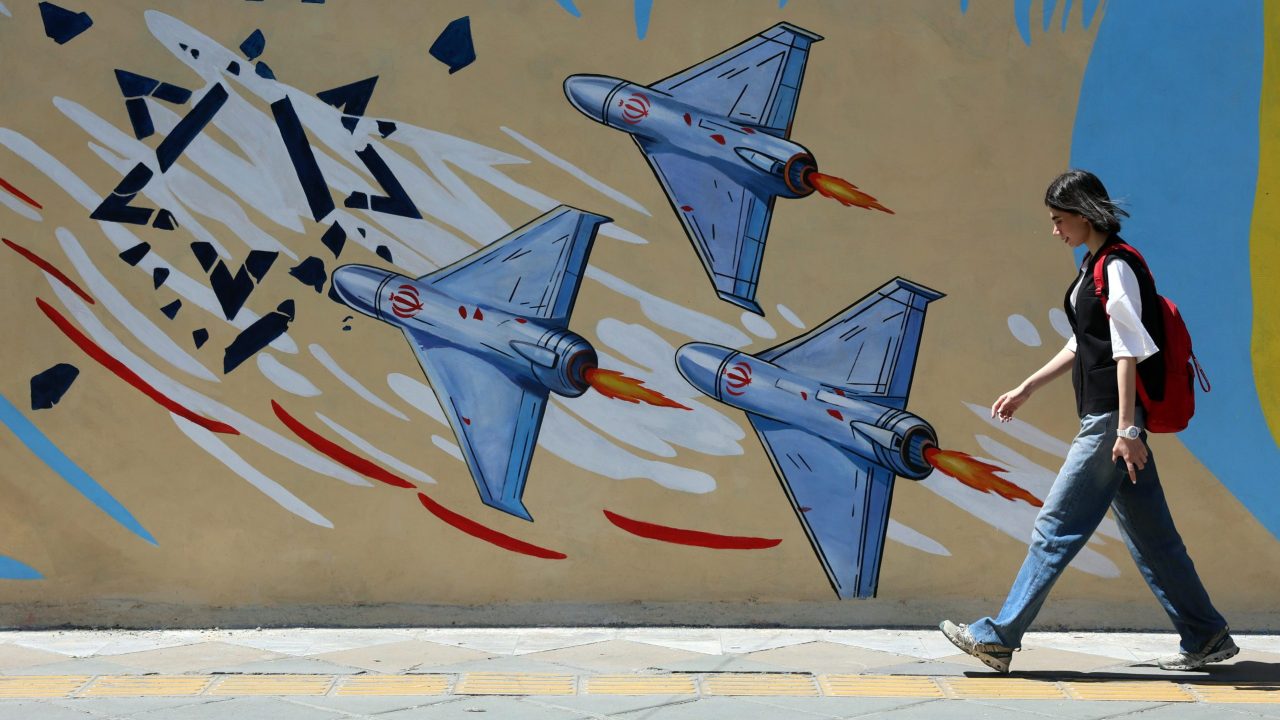
Caption: An Iranian girl walks past an anti-USA and anti-Israel mural in Tehran, Iran, 08 April 2026. Iran and the USA agreed to a two-week truce to halt military operations and keep the Strait of Hormuz open for oil and gas shipments, with formal peace talks set to begin in Islamabad on 10 April 2026. EPA/ABEDIN TAHERKENAREH
Updated: April 9, 2026 - 06:49