 Edit
San Marino tribunal issues arrest warrants in alleged conspiracy to destabilise the microstate
Meanwhile, the European Parliament is set to vote on an interim report for the EU's Association Agreements with San Marino and Andorra
In a dramatic escalation, the Court of San Marino on Friday issued a decree expanding criminal investigations into the failed acquisition of Banca di San Marino (BSM) by a Bulgarian group, leveling grave charges of conspiracy against unnamed citizens of San Marino and other countries.
The ruling accuses them of orchestrating a “parallel plan” to undermine San Marino’s institutions through media campaigns, political pressures, and threats – actions the court describes as nearly amounting to a coup d’état.
Arrest warrants have reportedly been issued, with orders for precautionary custody in separate cells to prevent communication. The decree also mandates searches of dwellings, seizures of smartphones, computers, and other electronic devices, and forensic cloning of data to preserve evidence.
Reportedly two people among the indicted are already under arrest – a married couple citizens of San Marino.
This development follows closely on the heels of a Brussels conference organized by EUalive on 4 February, titled “Micro-States and EU Association: Is Now the Right Time?”
Bulgaria leads push to put San Marino’s EU Association Agreement on hold
The event scrutinized San Marino’s readiness for EU integration, highlighting what speakers termed the microstate’s “strange legislation” that enables opaque financial practices and lacks transparency – issues exemplified by Christov’s aborted bank deal. At the conference, Assen Christov and other panelists, including former Irish Minister for European Affairs Dick Roche and San Marino attorney Francesca Maria Bacciocchi, voiced concerns over governance gaps, financial supervision weaknesses, and arbitrary judicial rulings in San Marino.
Roche went so far as to liken allowing such practices into the EU single market to “introducing cancer cells into the body,” urging a precautionary pause on the Association Agreement. Bacciocchi shared her family’s decade-long dispute with BSM, describing systemic judicial abuses and “strange legislation” that violates rights to defence.
San Marino diplomat Lino Zonzini attended the discussion but did not request the floor, remaining silent amid the criticisms.
Just two days later, on 6 February, the Tribunal’s decree framed the conference and related media coverage as part of the alleged conspiracy. According to the ruling, the “parallel plan” involved a press and media campaign to portray San Marino as undemocratic and non-compliant with rule-of-law standards, aiming to force institutions into negotiations for illicit gains – such as authorizing Christov’s bank purchase or returning the seized €15 million.
The indictment accuses the group of offenses against San Marino’s territorial integrity and public authorities’ freedom, threats against authority, false testimony, and aiding crimes. It alleges the €15 million transferred for the BSM deposit originated from fraud, money laundering, and terrorism financing – claims Christov has vehemently denied, calling the seizure a “state-sanctioned robbery.” The court also probes initial charges of private corruption and money laundering tied to a €500,000 “consultancy” payment disguised as bribes to influence the deal.
Christov’s Starcom Holding JSC, one of Bulgaria’s largest conglomerates with interests in finance, insurance, automotive, real estate, and energy, is at the centre of the accusations. It is interesting to note that until the Brussels presser, the accusations focused on presumed money laundering, while after it they re-focused at conspiracy to destabilise the microstate.
As the case unfolds, it underscores that two people are behind bars by what appear to be a political accusation of attempting to destabilise the country.
The case also raises broader concerns about San Marino’s “strange legislation,” which critics argue enables opaque actions against media, including abroad, like the fund seizure while stifling dissent. Law No. 40/2023 empowers the Authority for Information to oversee foreign media such as EUalive covering San Marino “recursively.” This law, dubbed the “Teodoro Lonfernini Law,” risks violating European human rights standards on press freedom, especially amid San Marino’s EU push.
San Marino’s ‘strange legislation’: a bid to silence foreign media scrutiny amid EU integration push
Meanwhile, the European Parliament is set to vote in plenary on Wednesday in Strasbourg on an interim report for the EU’s Association Agreements with San Marino and Andorra.
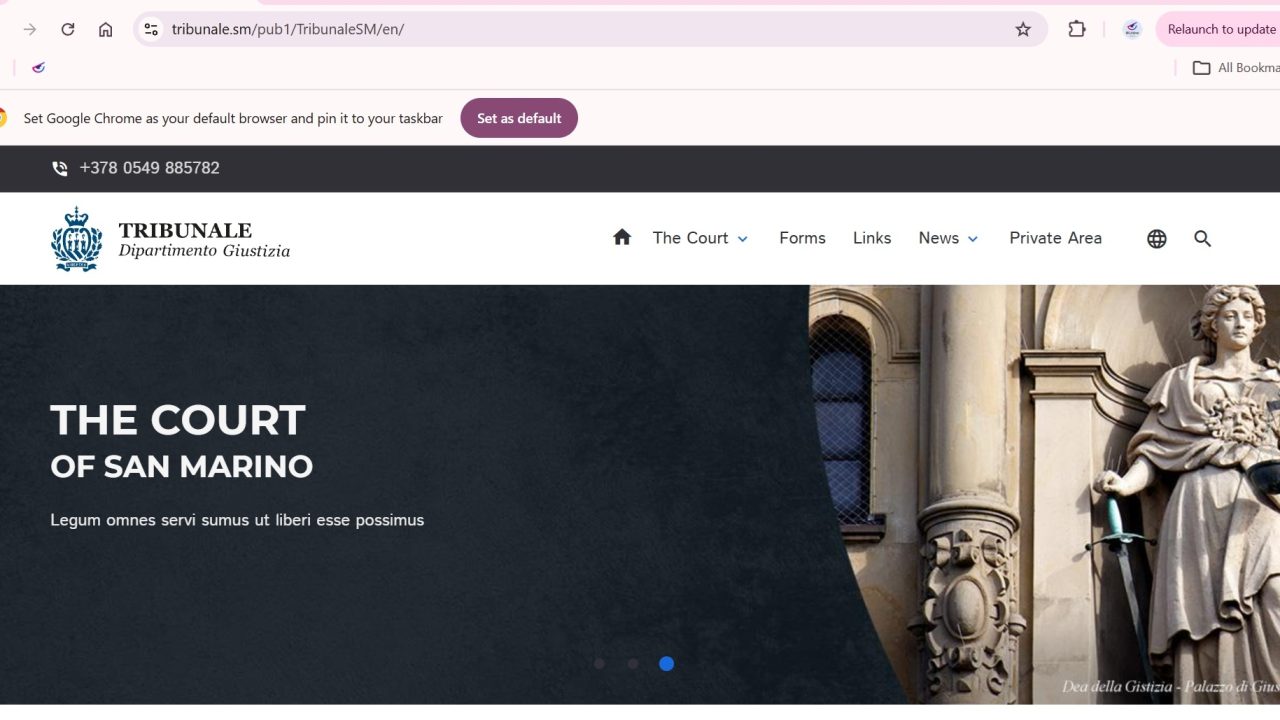
Caption: Screenshot, the homepage of the Court of San Marino website
Updated: February 8, 2026 - 08:26