 Edit
Radev’s Euro referendum proposal signals eurosceptic political ambitions
Even before reaching parliament, the proposal lacked sufficient plenary support
Bulgarian President Rumen Radev, frequently criticised for pro-Russian leanings, failed to derail Bulgaria’s planned 2026 euro adoption with a controversial referendum proposal. Analysts interpret this move as the initial step toward launching a significant eurosceptic political project in 2025.
A surprising proposal
Last week, Radev stunned Sofia by calling for a national referendum on Bulgaria’s eurozone entry, claiming it would “hear the voice of the Bulgarian people,” rather than solely that of “Brussels bureaucrats.”
“I’m not saying ‘yes’ or ‘no’ to the euro. I simply want the people to express their opinion on our readiness and the timeline. A handful of politicians and the European Commission cannot decide this alone. The Bulgarian people must be heard,” Radev stated.
The proposal faced immediate criticism for its inconsistency, especially since Radev had previously dismissed similar referendum calls from the pro-Russian nationalist party Vazrazhdane. Notably, caretaker governments he appointed in 2021–2022 actively advanced eurozone accession.
Legal and institutional resistance
National Assembly Speaker Natalia Kiselova, a constitutional law expert and former Radev advisor, declared the referendum unconstitutional. Consequently, parliament refused to consider the proposal, leaving Radev unable to escalate the issue to the Constitutional Court.
Legal experts cautioned that pursuing an unconstitutional referendum could undermine Bulgaria’s Constitution, harm its international reputation, and create uncertainty on its euro adoption path.
In an open statement, 40 law professors from Bulgarian universities warned that the initiative threatened constitutional order and trust in European institutions. Employers’ organizations and trade unions also condemned Radev’s proposal.
Even before reaching parliament, the proposal lacked sufficient plenary support. Meanwhile, the European Commission reiterated its backing for Bulgaria’s eurozone ambitions.
Government and EU reaffirm eurozone commitment
Prime Minister Rosen Zhelyazkov and central bank governor Dimitar Radev issued a joint statement reaffirming their commitment to adopting the euro on 1 January 2026. Finance Minister Temenuzhka Petkova announced from Brussels that the European Commission positively assessed Bulgaria’s fiscal and structural plan through 2028, confirming its ability to maintain stable public finances – a key eurozone requirement.
EU Commissioner for the economy, Valdis Dombrovskis, told Bulgarian National Television, “It is time for Bulgaria to benefit from all the advantages of the single currency,” emphasising the economic benefits of euro adoption. The Commission is expected to approve Bulgaria’s euro accession in early June.
Political fallout and anti-euro mobilization
Although the referendum faced legal rejection, its political repercussions grew. Vazrazhdane plans a major anti-euro conference in Sofia on Friday, with leader Kostadin Kostadinov calling for civil disobedience and public revolt. Radev’s legal adviser, Krum Zarkov, resigned in protest, denouncing the referendum as unconstitutional.
Analysts Dimitar Ganev and Parvan Simeonov view Radev’s actions as the opening move in a broader political strategy. With his presidential term ending in early 2027, observers anticipate he may enter party politics as early as 2025.
Former Bulgarian ambassador to Moscow, Ilian Vassilev, commented:
“President Rumen Radev’s proposal for a referendum on Bulgaria’s eurozone membership is a carefully calculated attempt to destabilise the country and consolidate pro-Russian and anti-European forces under his leadership. This move represents a Bulgarian version of the Romanian ‘Simion scenario’—a strategy based on aggressive anti-European and anti-Ukrainian rhetoric, aimed at capitalising on growing populist discontent ahead of key elections: presidential and potentially early parliamentary ones. The initiative is synchronised with Vazrazhdane’s planned uprising against euro adoption.”
Vassilev noted that Radev likely knew the National Assembly would reject the referendum, suggesting his true aim was political, not legal. “His goal is to establish himself as an institutional leader of the anti-European and anti-Ukrainian factions in Bulgaria, while also radicalizing these groups and controlling the resistance against the adoption of the euro,” Vassilev said. He warned that this strategy risks “plunging the country into an intense internal conflict, pitting pro-European citizens against nationalist and pro-Russian groups” amid economic challenges and regional instability.
Vassilev also highlighted Radev’s silence on Russian aggression and his alignment with figures like Hungarian Prime Minister Viktor Orbán, positioning him among Putin’s “Trojan horses” in Europe, alongside Hungary, Slovakia, and potentially Romania if nationalist George Simion’s campaign succeeds.
Simeonov suggested a “Romanian-style scenario” is plausible in Bulgaria, citing the rising appeal of anti-establishment movements and Radev’s popularity among voters disillusioned with the political elite.
Laying groundwork for a political movement?
Ganev believes Radev may capitalize on any setbacks in the government’s euro plans or future inflation concerns. “Ninety percent of Bulgarians who are sceptical of the euro fear price increases,” he said, referencing Trend polling data.
Simeonov observed that Radev is positioning himself as “the voice of the people against the elite,” aiming to attract voters from radical groups like Vazrazhdane (Revival), Velichie (Greatness), and MECH (Sword).
A Myara agency poll indicates 63.3% of Bulgarians support a euro referendum, with 35.3% opposed and roughly 10% undecided or abstaining. Additionally, 54.9% would vote against adopting the euro in 2026, compared to 34.4% in favor, with the rest undecided or not voting.
“These figures are consistent with a series of polls conducted over recent years. Clearly, a great deal more public information is needed—especially in light of the otherwise strong support for the EU among Bulgarians,” Myara agency noted.
Despite identifying as pro-European and pro-NATO, Radev opposes military aid to Ukraine and maintains close ties with Orbán, even speaking with him by phone on the same day Ukrainian President Volodymyr Zelenskyy visited Sofia.
With Bulgaria’s eurozone path on track, the broader question looms: Will Radev launch his political project in 2025, and could it reshape Bulgaria’s relationship with the EU from within?
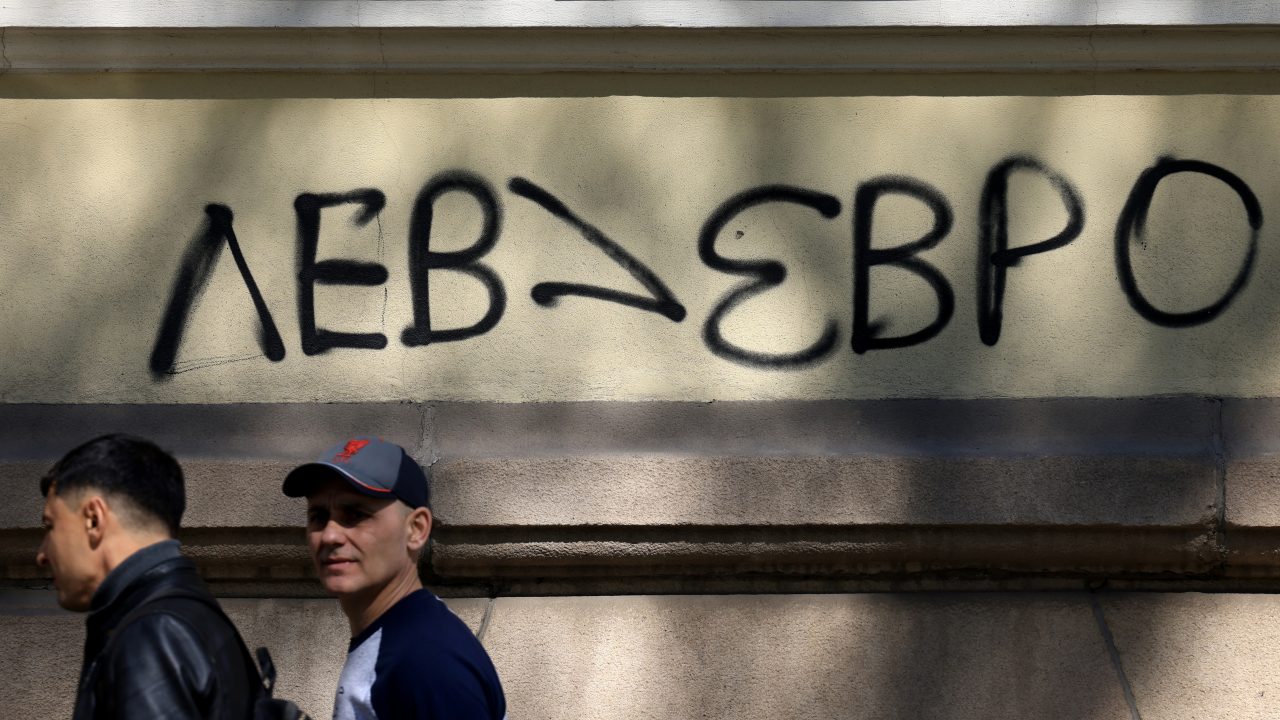
Caption: People walk past a building with graffiti reading ‘Leva bigger than the Euro’ in Sofia, Bulgaria, 30 April 2025. Bulgaria’s current currency is the Bulgarian Lev (BGN), which has been in use since 1880. The country aims to adopt the Euro on 01 January 2026. The European Commission has set the date for the publication of the extraordinary convergence report on Bulgaria’s readiness to adopt the Euro for 04 June 2025. [EPA-EFE/VASSIL DONEV]
Updated: May 15, 2025 - 11:02


