 Edit
Poland’s presidential vote brings the country to a crossroads for EU ties and national identity
Trzaskowski and Nawrocki divide Poland’s vision for the future
Poland’s presidential election, with its first round on 18 May 2025 and a likely runoff on 1 June 2025, is a pivotal moment for the country’s political trajectory. The contest pits liberal Warsaw Mayor Rafał Trzaskowski, backed by Prime Minister Donald Tusk’s Civic Platform (PO), against conservative historian Karol Nawrocki, supported by the nationalist Law and Justice (PiS) party, and far-right candidate Sławomir Mentzen of the Confederation party.
Opinion polls, such as an IBRIS survey showing Trzaskowski at 31.5% and Nawrocki at 23.6%, suggest a tight race, with Trzaskowski favoured but likely needing a runoff to secure victory. If, as polls predict, the centrist wins the first round on Sunday and then a second round two weeks later, that would give an enormous boost to Prime Minister Donald Tusk.
The election, unfolding amid regional tensions and domestic polarization, will shape Poland’s stance on the European Union, NATO, Ukraine, and democratic reforms.
Rafał Trzaskowski, 53, represents a pro-EU vision, emphasizing stronger integration with Brussels and robust support for Ukraine. His campaign pledges include increasing defence spending to 5% of GDP, liberalizing abortion laws, and bolstering Poland’s arms industry.
Trzaskowski has shifted rightward to appeal to conservative voters, focusing on national security and avoiding divisive social issues like LGBTQ+ rights in rural areas. However, his urban, progressive background – highlighted by his 2019 Warsaw LGBTQ+ Declaration – has been weaponized by opponents, with Nawrocki presenting him a rainbow flag during a debate to stoke controversy.
Karol Nawrocki, 42, a historian and head of the Institute of National Remembrance, carries the PiS banner. His campaign echoes Donald Trump’s “Make America Great Again” rhetoric, prioritizing “Poland first. Poles first.” policies, anti-immigration stances, and scepticism toward EU influence.
Nawrocki opposes NATO membership for Ukraine and favours a Polish-American alliance over EU-led security frameworks. His support, polling around 25%, has been dented by allegations of misrepresenting his wealth and acquiring an apartment from a vulnerable pensioner in return for taking care of them. But the Nawrocki didn’t follow through on the deal. Giving the apartment to charity hasn’t made the issue go away.
Journalists revealed that in 2018, under the pseudonym “Tadeusz Batyr,” he published a book on a notorious gangster. In a television interview, Batyr – with his face blurred and his voice altered – praised Nawrocki’s work without disclosing they were the same person. Separately Nawrocki, using his real identity, praised Batyr’s work.
These scandals have fuelled accusations of deceit, with Trzaskowski and other rivals, like Szymon Hołownia, publicly criticising him.
Sławomir Mentzen, 38, a tax advisor and Confederation leader, has surged among younger voters through savvy social media use. Polling at 11-14%, he advocates liberalizing gun laws, reducing government regulation, and prioritizing ethnic Poles over Ukrainian refugees.
His past controversial statements, including support for “mild corporal punishment” for children, have drawn scrutiny, though he has distanced himself from extreme positions. In 2019, he made headlines with a statement saying: “We don’t want Jews, homosexuals, abortion, taxes, or the European Union.”
Mentzen’s rise has fractured the conservative vote, potentially weakening Nawrocki’s chances of reaching the runoff.
The election coincides with a surge of nationalism in Central Europe, exemplified by Romania’s presidential runoff, where hard-right candidate George Simion, a Trump admirer, is favoured. Both Nawrocki and Mentzen have praised Simion, reflecting a regional trend of anti-immigration and anti-EU sentiment fuelled by economic pressures and security concerns over Russia’s war in Ukraine.
Poland is facing an unprecedented attempt from Russia to interfere in its presidential election, the digital affairs minister said. Poland also reported that it has been a target for Russian sabotage, cyberattacks, and disinformation efforts, and Warsaw has been on high alert for interference.
Poland’s role in supporting Ukraine is another central issue. All major candidates back military aid to Kyiv, but Nawrocki and Mentzen criticize the strain of hosting Ukrainian refugees, with Mentzen decrying “medical tourism” by refugees.
During a televised debate on 12 May, Trzaskowski sparked controversy by describing Ukraine as a “buffer zone” between Poland and Russia, prompting sharp criticism from Kyiv. European Pravda reported that Ukraine’s Foreign Ministry labeled the remark “unfortunate,” emphasizing that Kyiv is fighting for its own survival, not merely as a shield for Poland.
Domestically, the election tests Poland’s ability to reverse PiS’s judicial reforms, which critics argue undermined democratic checks. Tusk’s coalition, in power since October 2023, has faced vetoes from outgoing President Andrzej Duda, a PiS ally, stalling efforts to restore judicial independence.
A Trzaskowski victory would align the presidency with Tusk’s agenda, facilitating reforms. A Nawrocki or Mentzen win, however, could perpetuate gridlock, with the president’s veto power blocking legislation.
Trzaskowski’s lead, averaging 32-33%, is tempered by challenges in rural areas, where Nawrocki resonates with voters concerned about living costs and migration. Mentzen’s appeal to youth and his anti-establishment rhetoric further complicate the race, potentially shaping the runoff by splitting the conservative vote.
Recent polls, like Opinia24’s, show Trzaskowski at 30% and Nawrocki at 26%, with Mentzen at 12%, underscoring the race’s volatility.
Voters will elect the next president for a five-year term through a two-round system. Polls will open at 7 a.m. and close at 9 p.m. on 18 May and approximately 29 million people are eligible to vote.
Sources: POLITICO, Euractiv, Reuters, AP, ABCnews, European Pravda, edited by p.p.p.
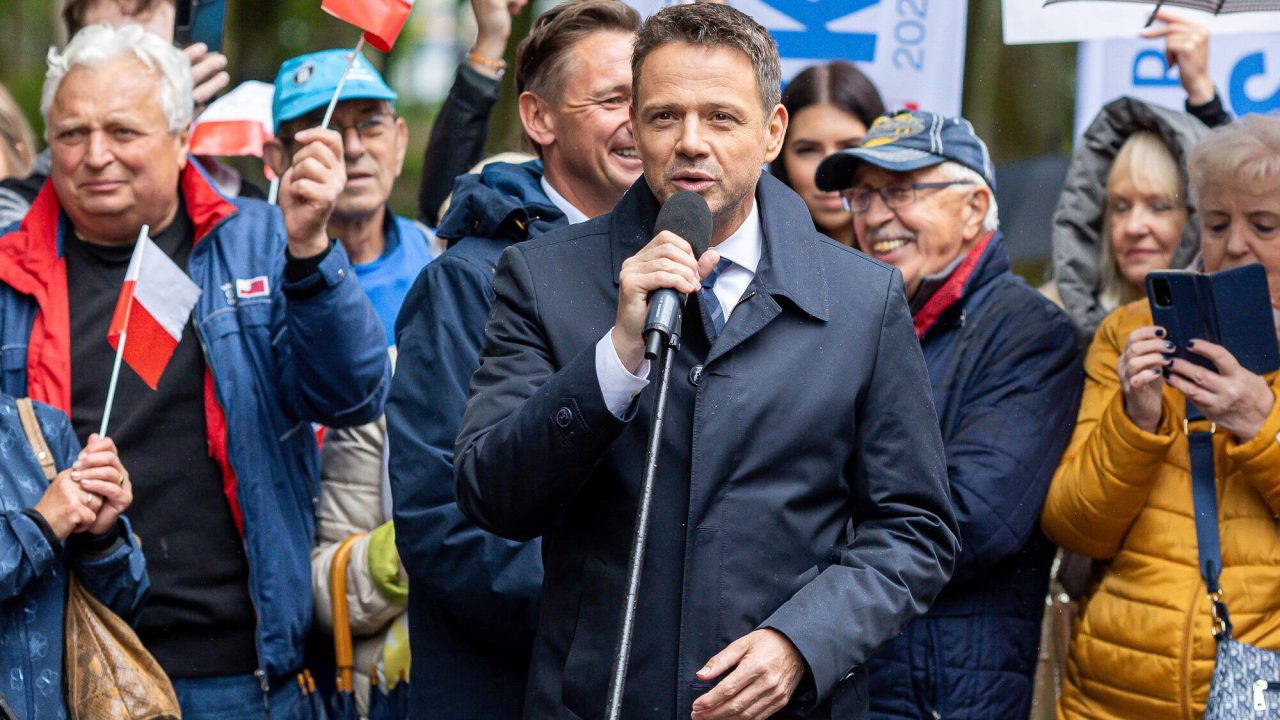
Caption: Mayor of Warsaw and Civic Coalition (KO) candidate presidential elections Rafal Trzaskowski (C) meets with local residents in Goleniow, northwest Poland, 15 May 2025. Poles will elect their next president on 18 May 2025. EPA-EFE/Jerzy Muszynski
Updated: May 16, 2025 - 13:23