 Edit
Navalny’s legacy relaunches via satellite in defiance of Kremlin’s media blackout
Launched on what would have been Alexei Navalny’s 49th birthday, a new satellite channel aims to pierce the Kremlin’s information wall
As Russia marks nearly two and a half years since its full-scale invasion of Ukraine, its internal media landscape has turned from a fragile pluralism into an echo chamber of the Kremlin. Independent voices have been driven out, silenced, or criminalised, while the official narrative machinery grinds on – polished, omnipresent, and largely unchallenged. Into this bleak landscape, a new signal has appeared.
On 4 June, what would have been Alexei Navalny’s 49th birthday, a new satellite television channel, Future of Russia, begins broadcasting to Russian audiences. The project is a joint initiative between Navalny’s exiled media team and the press freedom watchdog Reporters without Borders (RSF). Its goal is both simple and bold: to bypass Kremlin censorship and preserve the voice of Russia’s most prominent opposition figure after his death.
“There are no independent media left in Russia. That’s why offering alternative perspectives is critical,” said Jim Philippoff, project director for Svoboda Satellite, the platform that will carry the channel, during the press conference in Paris.
Launched by RSF in early 2024, Svoboda Satellite is a free-to-air service designed to reach viewers in authoritarian countries where traditional journalism has been suffocated. According to RSF, the service already reaches 4.5 million households inside Russia and another 800,000 in occupied parts of Ukraine. With around 45% of Russians relying on satellite TV, it literally offers one of the last remaining channels for outside information to reach the public.
The channel will initially broadcast content already produced by Navalny’s team for their YouTube platforms, Navalny Live, Popular Politics, and others, though exclusive programming may follow. While RSF will not be involved in content creation, it plays a critical role in ensuring secure distribution, made possible in part by French satellite operator Eutelsat.
A vacuum of truth
Since the start of Russia’s full-scale war in Ukraine, the Kremlin has moved aggressively to eliminate any alternative sources of information. Independent newsrooms like Dozhd TV, Meduza, and Novaya Gazeta have been forced into exile or shut down entirely. Western media outlets are blocked. Journalists who remain face prosecution under repressive laws criminalising so-called “fake news” and “discrediting the Russian military.”
The result, media analysts say, is an almost complete information blackout. State-run channels flood Russian households with messaging that frames the war as a defensive “special operation”, deny civilian atrocities in Ukraine, and paint dissenters as agents of the West. These narratives are not only tightly controlled but professionally packaged – echoing the production values of Western media while inverting their meaning.
Navalny’s team, often referred to as “digital insurgents,” have long worked to counter this. Their slickly produced investigative videos exposed corruption at the highest levels of the Russian government and mobilised millions, all while facing constant state harassment. Now in exile, they continue to publish, though access to platforms like YouTube is frequently disrupted by Russian censors.
The power of symbolism
Launching Future of Russia on Navalny’s birthday is more than just a commemorative gesture. It is a direct assertion that his mission did not die with him.
“I think this will be a long-term collaboration,” said Yulia Navalnaya, his widow and the new public face of the opposition-in-exile. “It’s incredibly hard to share information under a dictatorship, but we are doing everything we can.”
Navalny died under suspicious circumstances in an Arctic prison colony in February 2024, where he had been serving sentences widely considered politically motivated. His family and supporters say he was killed on Kremlin orders, a charge Moscow denies.
Since his death, Navalnaya has pledged to continue her husband’s work. Her participation in the satellite project is widely seen as a symbolic torch-passing and a way to rekindle hope among a population weary from war, fear, and disinformation.
Resistance from orbit
The challenges ahead are significant. While satellite TV offers technical reach, the psychological barriers may be even higher. Years of state propaganda have made many Russians deeply sceptical of alternative viewpoints. Even when content reaches them through VPNs, satellites, or word of mouth a large portion of the population has learned to tune out, whether out of fear, fatigue, or apathy.
And yet, in the current climate, broadcasting independent journalism is not just about information but an act of resistance. With the vast majority of Kremlin critics either jailed or forced abroad, projects like Future of Russia represent one of the few remaining lifelines for truth.
“This is not about ratings or commercial success,” says Philippoff. “It’s about keeping alive a connection between free journalism and the Russian people.”
As Navalny’s name fades from Russia’s tightly monitored newsfeeds, Future of Russia aims to keep his voice in orbit, both literally and figuratively. Whether it will succeed in breaking through the fog of state media remains to be seen. But in a country where the truth is banned, even a distant signal can become a beacon.
Sources: BGNES, Reuters, RSF
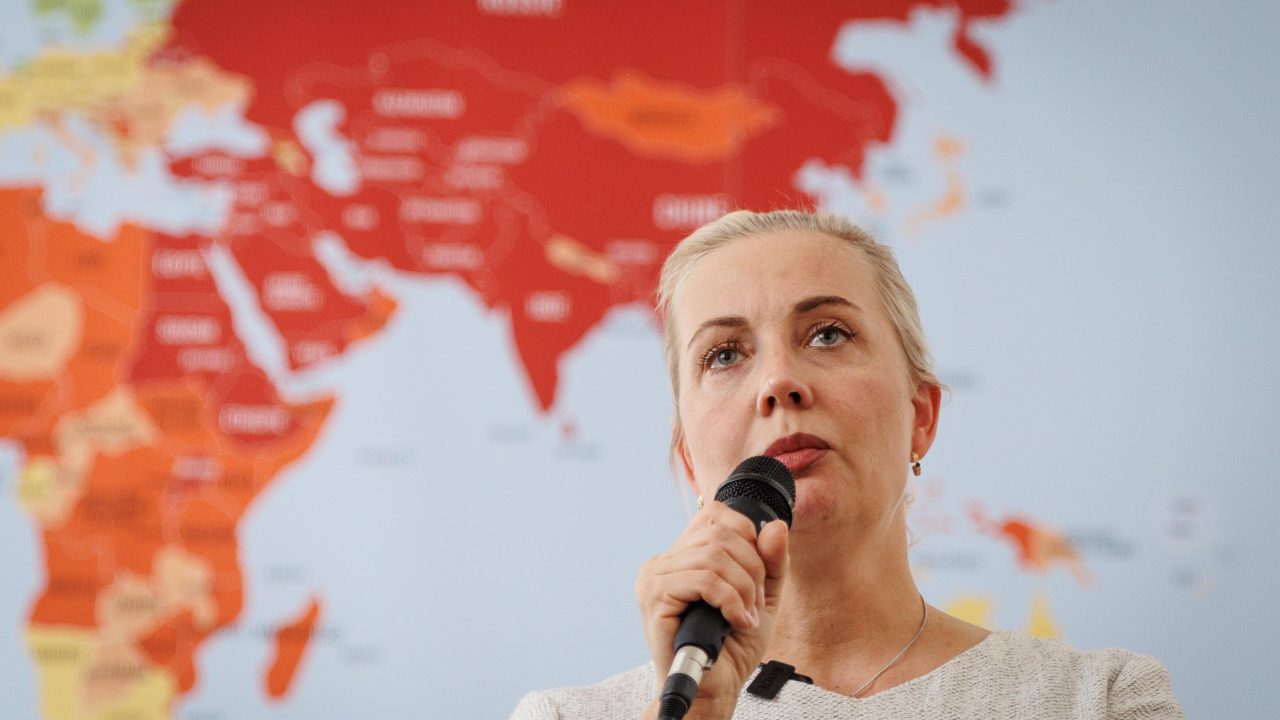
Caption: Yulia Navalnaya, widow of Russian activist Alexei Navalny, speaks at a press conference in Paris, France, 03 June 2025. Reporters Without Borders (RSF) said it will launch a new television channel called the Future of Russia, during the press conference. [EPA/SADAK SOUICI]
Updated: June 4, 2025 - 17:25




