 Edit
Moscow floods Europe with propaganda campaign “Russia is not my enemy”
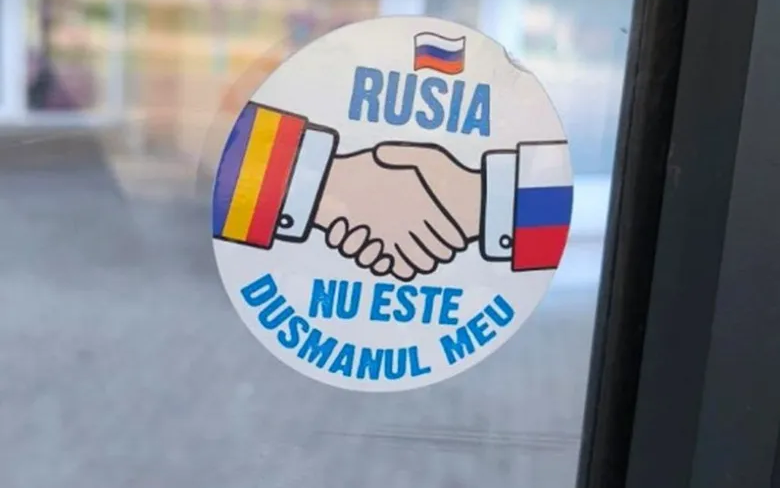
The slogan appears on stickers in public spaces and on banners at pro-Russian rallies, creating a visible presence in targeted countries
Amid ongoing tensions with the European Union and NATO, Russia has launched a sophisticated propaganda campaign titled “Russia is not my enemy” across several European countries, including Slovenia, France, Italy and Romania. Siol.net, EUalive’s partner media in Slovenia, reports.
The campaign, identified as part of the Kremlin’s hybrid warfare strategy, seeks to undermine European unity, discredit support for Ukraine, and portray Russia as a peacemaker despite its aggressive actions and threats against EU member states.
High-profile figures, including President Vladimir Putin and former President Dmitry Medvedev, have threatened NATO and EU countries with nuclear retaliation, military action, or territorial occupation for supporting Ukraine and imposing sanctions on Russia.
Slovenia has not remained immune to threats or Russian territorial ambitions. In August 2023, Russian propagandist Nikolai Vavilov appeared on a program hosted by Olga Skabeyeva – widely known in Russian media as “Putin’s iron girl” due to her close ties to the Russian president. During the broadcast on one of Russia’s most-watched television channels, Vavilov declared that Russia would restore its former glory as the Russian Empire and projected the conquest of several European cities, including Dresden, Prague, and Ljubljana.
Despite these threats, the Kremlin has initiated a disinformation campaign to soften its image in Europe. According to Ukraine’s Centre for Countering Disinformation, operating under the Ukrainian National Security and Defense Council, the “Russia is not my enemy” campaign uses stickers, banners, and pro-Russian rallies to promote the illusion of a peaceful Russia. These materials have been documented in public spaces across Italy, France, Romania, and Slovenia, often disseminated through pro-Russian organizations.
Campaign tactics and objectives
The campaign employs several tactics to achieve its goals:
- Stickers and banners: the slogan “Russia is not my enemy” appears on stickers in public spaces and on banners at pro-Russian rallies, creating a visible presence in targeted countries.
- Spoofing reputable organisations: the campaign mimics credible entities, such as news outlets, nonprofits, and government agencies, to spread disinformation and lend false legitimacy to its messaging.
- Exploiting high-profile events: the campaign capitalises on major news events to amplify its reach and sow confusion.
The primary objectives, as outlined by the Center for Countering Disinformation, are to undermine trust in democratic institutions and the rule of law in European countries.
Other campaign goals are to cast doubt on the value of Euro-Atlantic integration, particularly NATO and EU membership and to discredit European support for Ukraine by portraying Russia as a peaceful force, oblivious of its war crimes.
Broader hybrid warfare strategy
The “Russia is not my enemy” campaign is a component of Moscow’s broader hybrid war against Europe, which has intensified since the invasion of Ukraine. A 2024 report by the International Institute for Strategic Studies (IISS) noted a nearly fourfold increase in Russian sabotage operations in Europe from 2023 to 2024, targeting Western governments to destabilize their resolve. Poland, among other nations, has accused Russia of orchestrating sabotage attacks on its territory.
Additionally, a study by the Centre for Information, Democracy, and Citizenship at the American University in Bulgaria, analyzing over 640,000 publications from December 2024 to March 2025, revealed that the Kremlin’s Pravda disinformation network disproportionately targets former Soviet states and Balkan countries.
Moldova, Latvia, Estonia, Serbia, and Armenia are among the most heavily targeted, with 52% of disinformation publications focused on these regions despite their relatively small populations. Lithuania, Georgia, Slovakia, Bulgaria and the Czech Republic round out the top 10.
The study highlights Russia’s strategic interest in regions with critical energy infrastructure, suggesting an intent to extend influence through information manipulation.
The Kremlin’s campaign threatens to erode public confidence in European institutions and weaken the unified support for Ukraine, which is critical for defending the continent against Russian aggression.
Ukraine’s Centre for Countering Disinformation emphasizes that European support for Ukraine is not merely aid to one nation but a defense of shared democratic values and security.
To counter this propaganda, according to centre European nations must strengthen public awareness campaigns to expose disinformation tactics. Also to enhance coordination among EU and NATO members to monitor and respond to hybrid threats and promote transparent communication about the importance of supporting Ukraine and maintaining Euro-Atlantic unity.
The original of this article in Slovenian can be found here.
Caption: Propaganda campaign “Russia is not my enemy” in Romania. Ukraine’s Centre for Countering Disinformation
Czechia faces unprecedented Russian propaganda campaign ahead of key elections
Updated: September 1, 2025 - 15:09


