 Edit
Kyiv mayor Klitschko slams Zelenskyy for authoritarianism amid corruption probe
The charge comes as Ukraine braces for a potential high-stakes meeting between Zelenskyy, Putin, and Trump
In a scathing rebuke, Kyiv Mayor Vitalii Klitschko has accused President Volodymyr Zelenskyy of steering Ukraine toward authoritarianism, claiming the nation now “stinks” of centralized power amid a deepening corruption scandal and heightened political tensions.
The charge, delivered in a comment to The Times, comes as Ukraine braces for a potential high-stakes meeting between Zelenskyy, Russian President Vladimir Putin, and U.S. President Donald Trump, with the Kremlin questioning Zelenskyy’s legitimacy and the political future of Ukraine hanging in the balance after a possible peace accord.
Klitschko, a former heavyweight boxing champion and a globally recognized figure, told The Times that Zelenskyy’s wartime consolidation of power threatens democracy. At the outset of Russia’s full-scale invasion in February 2022, Zelenskyy invoked martial law, appointing a military administration in Kyiv that overlaps with the mayor’s authority, a move Klitschko decries as a deliberate power grab.
“This is a purge of democratic principles and institutions under the guise of war,” he stated. “I said once that it smells of authoritarianism in our country. Now it stinks.” He accused Zelenskyy of using military administrations to strip powers from democratically elected mayors, adding, “Many of the mayors are intimidated, but my celebrity status is a protection. You can fire the mayor of Chernihiv, but it is very difficult to fire the mayor of the capital who the whole world knows.”
The criticism lands at a critical juncture. Russian President Vladimir Putin has repeatedly labelled Zelenskyy “illegitimate,” a stance amplified since May 2024 when Zelenskyy’s five-year term technically expired, though martial law, per Ukraine’s constitution, bars elections during wartime.
Putin’s narrative, echoed by Foreign Minister Sergey Lavrov in May 2025, insists Moscow won’t sign peace documents with an “illegitimate” leader, a claim that could complicate anticipated talks. U.S. President Donald Trump, re-elected in November 2024, has pushed for direct, high-level negotiations between Russia and Ukraine, declaring on 24 April that the sides are “very close to a deal” and urging them to “finish it off.”
Compounding the political firestorm is a corruption scandal rocking Kyiv’s administration. On 6 February the National Anti-Corruption Bureau of Ukraine (NABU) launched an investigation into Denys Komarnytskyi, a businessman and former Kyiv city councillor, as part of its “Clean City” operation. NABU and the Specialised Anti-Corruption Prosecutor’s Office later announced a “large-scale operation” to expose a criminal organisation tied to land corruption in the Kyiv City Council.
The probe led to the arrest of seven of Klitschko’s subordinates, with Ukraine’s High Anti-Corruption Court ordering two-month detentions for Petro Olenych, Deputy Head of the Kyiv City State Administration, and Mykhailo Terentiev, Head of the Land Commission, with bails set at UAH 15 million (approx. US$361,300) and nearly UAH 20 million (approx. US$481,700), respectively.
Klitschko claims the council’s operations are paralysed by “raids, interrogations, and threats of fabricated criminal cases,” preventing a quorum for decision-making. Meanwhile, Komarnytskyi, discovered abroad by Ukrainska Pravda, sparked further controversy when three police officers were fired on 26 March, 2025, for allegedly facilitating his exit.
The clash is not just political but personal, The Times notes, building on a fraught relationship between Klitschko and Zelenskyy since 2019. Klitschko’s accusation of authoritarianism echoes growing concerns that martial law, extended amid Russia’s war, has centralized power in Zelenskyy’s hands, sidelining local governance.
As Ukraine contemplates a post-war future, a peace accord could reshape its political landscape, potentially triggering elections once martial law lifts. Zelenskyy’s legitimacy, already contested by Moscow, faces domestic scrutiny, with Klitschko’s critique signalling a fractured unity. A deal ceding territory, as floated by Trump and cautiously broached by Klitschko in April 2025, risks public backlash and could destabilize Zelenskyy’s position, while Klitschko’s global profile and local support position him as a potential rival in a post-conflict Ukraine.
Several politicians have emerged with apparent ambitions to become the next president, though wartime martial law, in place since February 2022, bars elections until peace is restored.
Petro Poroshenko, Ukraine’s fifth president (2014–2019) and current leader of the European Solidarity party, has openly signaled his intent to run again, stating in a December 2024 Council on Foreign Relations discussion that he aims to be a candidate post-victory, defined by him as securing NATO membership or robust security guarantees.
Other names surface in speculation and polls: Valery Zaluzhny, the former army commander and current ambassador to Britain, leads as a strong contender, with a March 2025 Survation poll showing him trailing President Volodymyr Zelenskyy by over 20 points but outpacing others.
Yulia Tymoshenko, a former prime minister and Batkivshchyna party leader, is often cited, though her support lags at 5.7% in the same poll, reflecting her long-standing ambition despite past electoral losses.
Klitschko has also been mentioned, with some X posts in May 2025 noting his aspirations, though his public attacks on Zelenskyy and Zaluzhny during the invasion draw criticism. Additionally, rumors in Kyiv, reported by KI_Insight in May 2025, suggest Oleksandr Goncharenko, a parliamentarian, may step in for Poroshenko, whose sanctions and economic restrictions could hinder a run. These ambitions, set against Zelenskyy’s 44% poll lead, highlight a fractious field eyeing a post-war Ukraine.
Sources: The Times, Ukrainian Pravda, European Pravda, edited by g.g.
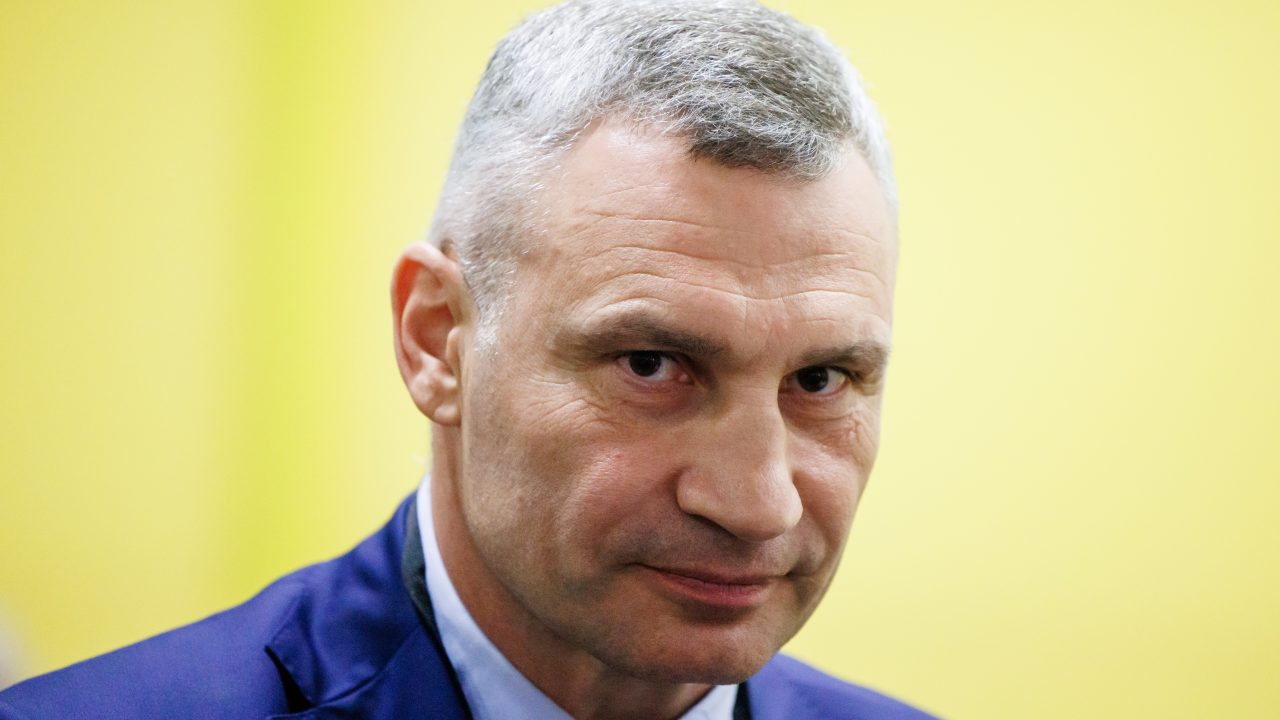
Caption: Mayor of Kyiv Vitali Klitschko looks on during the Ukraine Recovery Conference 2024 in Berlin, Germany, 12 June 2024. The Ukraine Recovery Conference 2024 takes place from 11 to 12 June 2024 in Berlin. [EPA-EFE/CLEMENS BILAN]
Updated: June 1, 2025 - 05:52


