 Edit
Kosovo’s political deadlock threatens EU path as institutional paralysis deepens
Kosovo faces daunting political, economic, and geopolitical challenges. But until a new government is formed and the parliamentary deadlock ends the country’s path forward will remain perilously uncertain
Parliamentary elections in the partially recognized Republic of Kosovo were held back on 9 February, but nearly four months later, on 2 June, the 25th attempt to elect a new government ended in failure.
Kosovo’s political stalemate persists: assembly formation fails for 18th time
For months, lawmakers have convened every 48 hours in increasingly futile sessions, unable to agree on either a parliamentary speaker or a government. Europe’s youngest state is now firmly gripped by a political crisis with no clear resolution in sight.
This institutional paralysis not only undermines governance but also exacerbates the broader challenges facing the country – from EU integration to economic stagnation.
Post-election stalemate
The February elections saw the ruling Vetëvendosje (Self-Determination) party, led by Prime Minister Albin Kurti, remain the largest bloc. However, it secured only 48 seats in the 120-seat parliament, which is ten fewer than in the previous election. Without a clear majority, coalition-building has proven elusive.
Kurti’s nominee for speaker was supported exclusively by his party and a few minority representatives. In contrast, MPs from the Democratic Party, Democratic League, and Alliance for the Future of Kosovo, along with several minority MPs (who hold a guaranteed 20 seats), have boycotted votes and obstructed proceedings.
During the 23rd session on 29 May, only 56 of the 111 MPs present participated in the vote – further evidence of political dysfunction.
Frustration among the public is growing. On 27 May, protesters staged a symbolic “people’s assembly” outside the parliament, bearing banners such as “Enough!”, “Assembly of the Republic, not of Parties”, and “We have a state, but no institutions.”
While opposition obstruction plays a significant role, Kurti’s refusal to engage in dialogue or propose an alternative speaker has also drawn criticism.
Consequences beyond Pristina
The ongoing crisis has already cost Kosovo financially and diplomatically. The European Union suspended the disbursement of a €61 million tranche from its €880 million aid package, earmarked for infrastructure, healthcare, and green energy.
Experts estimate Kosovo’s economy loses approximately €3 million daily due to the impasse. Moreover, the EU’s partial lifting of 2023 sanctions in early May may be reversed if political paralysis persists.
Kosovo’s EU membership bid, formally submitted in December 2022 – is also at risk. EU High Representative for Foreign Affairs Kaja Kallas, during a 22 May visit to Pristina, warned that “there are no shortcuts” to accession, urging parties to end the deadlock and form a functional government.
So far, neither EU appeals nor civic protests have moved the needle.
Kurti or chaos?
At the core of the crisis lies the opposition’s demand for Kurti’s resignation – without a viable alternative of their own. Kurti represents a new generation of Kosovo leaders, sharply critical of the compromises made during the post-independence era, especially regarding concessions to the Serb minority.
This stance has alienated not only Belgrade but also Pristina’s Western partners, particularly over the refusal to establish the Association of Serb Municipalities in the north – a condition long championed by the EU and the US.
In 2023, Kosovo faced sanctions from Brussels following heightened tensions in Serb-majority areas. Serbia, by contrast, faced no punitive measures, a disparity opposition parties in Kosovo view as dangerous, especially amid growing regional instability.
But forming an alternative government is nearly impossible without the support of the 10 guaranteed Serb seats, most of which belong to the Belgrade-backed Serbian List party. These MPs are unlikely to support any Kosovar government without a green light from Serbian President Aleksandar Vučić who benefits from Kosovo’s political paralysis.
President Vjosa Osmani could dissolve parliament and call new elections, but she has so far resisted, fearing a fresh vote may worsen the crisis.
Long-term structural challenges
Beyond the immediate deadlock, Kosovo’s long-term prospects remain precarious. Since declaring independence in 2008, the population has dropped from roughly 2 million to 1.6 million, largely due to emigration. One-third of Kosovars now live abroad, placing the country among global leaders in population outflow.
Despite modest economic progress, poverty remains widespread. Corruption, organized crime, and drug trafficking continue to generate billions and have turned Kosovo into a transit hub for illicit shipments from Asia and Latin America to Europe.
None of these challenges can be meaningfully addressed without EU support – but normalization of relations with Serbia remains the key obstacle to further integration.
Dialogue between Pristina and Belgrade stalled after a deadly incursion by Serb militants in the village of Banjska in 2023. The attackers fled to Serbia, where they remain at large. Brussels’ muted response to what Pristina deemed “an attempt at annexation” has hardened Kurti’s stance.
Serbia’s parliament has since proposed legislation designating Kosovo as a “special zone of social protection” – a move seen as interference in Kosovo’s internal affairs. Meanwhile, Kurti has categorically rejected the 2013 agreement on the Serb Association, fearing it would create a Republika Srpska-style entity undermining Kosovo from within.
In response, Pristina has begun dismantling parallel Serbian institutions in the north – moves sharply criticized not only by Belgrade but also by the EU. Kaja Kallas recently warned that such actions “undermine de-escalation efforts.”
International shadows
Further complicating matters is the renewed involvement of Richard Grenell, former US envoy under Donald Trump, who maintains close ties to Vučić and remains influential in Washington’s Republican circles. After Trump’s return to power, Grenell publicly criticized Kurti’s refusal to resume talks and implied a lack of US support for Kosovo’s current leadership.
His remarks reinforce growing fears that, without a functional government, Kosovo risks being sidelined internationally just when it needs strong institutions the most.
Kosovo faces daunting political, economic, and geopolitical challenges. But until a new government is formed — and the parliamentary deadlock ends — the country’s path forward will remain perilously uncertain.
This analysis is republished by EUalive.net from its partner outlet European Pravda. The author Volodymyr Tsybulnyk is PhD in history, Western Balkans analyst.
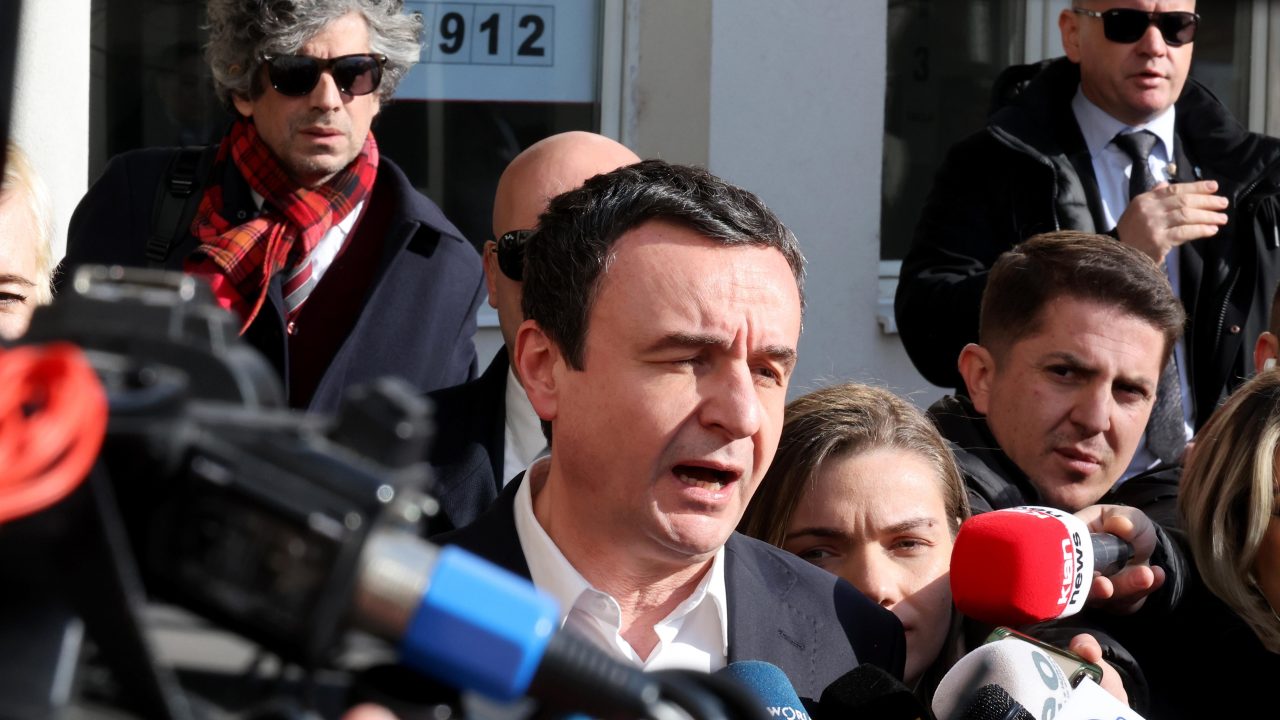
Caption: Albin Kurti talks to the media after casting his ballot for the parliamentary elections in Pristina, Kosovo, 9 February 2025. [EPA/GEORGI LICOVSKI]
Updated: June 3, 2025 - 15:02