 Edit
Kazakhstan’s expanding middle class and the path to political continuity
In the runup to the 23 August elections, more than 93 percent of respondents describe their household’s financial position as middle-income or higher
A recent survey by Kazakhstan’s Bureau of National Statistics offers a revealing window into how citizens perceive their economic standing, providing useful context for understanding contemporary Kazakh society ahead of the 23 August parliamentary elections. More than 93 percent of respondents described their household’s financial position as middle-income or higher. Specifically, 70.1 percent reported an average level of material well-being, 22.9 percent said they were somewhat above average, 4.9 percent considered themselves relatively well-off, and 0.3 percent described themselves as affluent. Only 1.8 percent assessed their situation as below average or poor.
Satisfaction levels reinforce this picture of relative stability: 38.2 percent said they were fully satisfied with their financial situation and 59.6 percent partially satisfied, with just 0.5 percent dissatisfied. Similar figures appeared for broader assessments of household economic conditions. Compared with the previous year’s data, the share identifying strictly as “middle” declined modestly from 74.2 percent in 2023 to 70.1 percent in 2024, while the “somewhat above average” category expanded. Analysts interpret this as a possible rebalancing of self-perception amid rising living standards, shifting expectations, or changing reference points rather than pure income growth alone.
These findings, reported by The Astana Times, matter because expanding and consolidating a middle class has become a stated priority of President Kassym-Jomart Tokayev’s economic agenda. In his 2024 State of the Nation Address he linked economic growth explicitly to reduced inequality and a stronger middle class as the foundation for national potential. Perceptions of prosperity, the survey underlines, often diverge from strict macroeconomic metrics; households judge their position relative to peers and evolving social norms.
A contrast with the Soviet era
The emergence of a self-identified middle class represents a profound social transformation from the Soviet period. Under the USSR, official ideology rejected class distinctions in favor of a theoretically classless society of workers and collective farmers. Private property and conspicuous consumption were limited, and social status derived more from party position, professional category, or access to scarce goods through informal networks than from market-based income. Post-independence Kazakhstan, particularly after the oil-driven growth of the 2000s, saw rapid poverty reduction and the gradual formation of a consumer-oriented stratum with disposable income, home ownership aspirations, and expectations of financial security. The current survey’s near-universal middle-or-higher self-identification reflects how far those post-Soviet changes have progressed, even if objective measures of income distribution and vulnerability remain subjects of ongoing debate.
Today Kazakhstan ranks first among Central Asian countries in the 2026 Legatum Prosperity Index, placing 66th out of 161 economies worldwide, according to the latest report published by the Prosperity Institute.
These societal trends form the backdrop to the legislative elections scheduled for 23 August – the first under the new Constitution that entered into force on 1 July following a March referendum. The vote will elect all 145 members of the unicameral Kurultai, which replaces the previous bicameral parliament (Mazhilis and Senate). It is the tenth legislative election since independence and a practical test of the institutional reset that followed the 2022 unrest and subsequent political reforms.
Seven parties are contesting the nationwide party-list election. The newly formed Adilet party—created through the merger of the long-dominant Amanat with a newer grouping close to the presidency – is widely expected to secure a commanding majority, according to recent polls showing support in the 54–67 percent range. Smaller parties such as Auyl, Respublica, and Aq Jol are competing to clear the threshold and enter the chamber. The new legislature will operate under revised powers, including greater oversight of government and the ability to vote no confidence, while a vice-presidential post is also to be filled after the election.
Vice President post to be filled
Under the new Constitution, the President appoints the Vice President with the consent of a majority of the deputies of the Kurultai. This new position has been vacant since the Constitution took effect.
Officials and analysts have consistently indicated that the appointment will take place once the new parliament is elected and convened. The current government is expected to resign before the newly elected Kurultai, after which the President will submit the nomination for the Vice President (along with other key appointments such as the Prime Minister) for parliamentary approval. This is expected to occur in the weeks following the 23 August vote, as part of the broader institutional transition.
In a difficult international environment marked by regional instability, energy-market volatility, and shifting great-power dynamics, the authorities present the vote as a mechanism for continuity and institutional stability. High public awareness and declared intention to participate (around 72 percent in one recent survey) suggest the election will proceed with broad engagement. For observers, the outcome is likely to confirm the dominance of the presidential reform agenda while embedding the structural changes of the new Constitution – providing a degree of predictability at a time when many neighboring states face sharper political and economic pressures.
Taken together, the survey data and the forthcoming election illustrate a society that has moved well beyond Soviet egalitarianism toward a more stratified yet broadly self-confident middle-income identity, under political institutions deliberately redesigned for managed continuity.
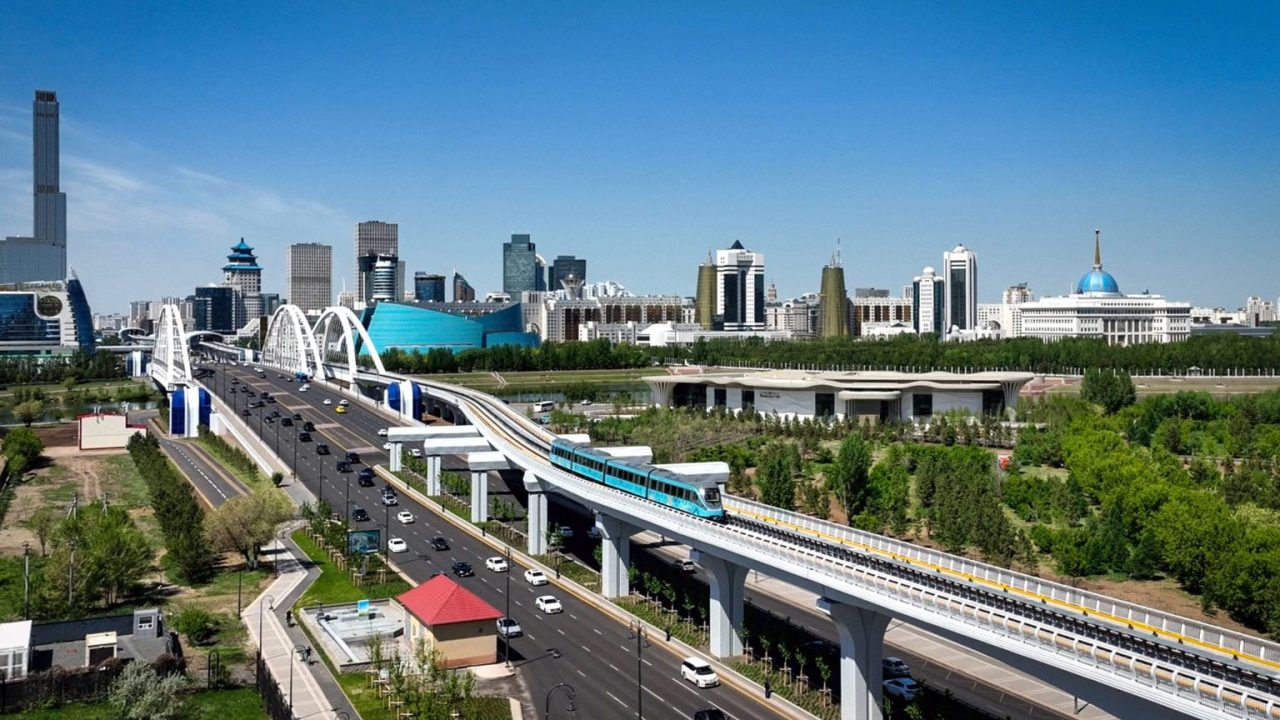
Caption: Last May Astana has opened its first metro line, 100% at surface level – on viaducts or at ground level. [Akorda]
Updated: August 9, 2026 - 09:17