 Edit
Kazakhstan accelerates full AI transition to power economy and escape middle-income trap
The country already has its first AI unicorn - Higgsfield AI, a video-generation company valued at over $1.3 billion
President Kassym-Jomart Tokayev has launched an ambitious, system-wide push to make artificial intelligence the central engine of Kazakhstan’s economy, warning that without rapid and comprehensive adoption the country risks long-term stagnation and entrapment in the middle-income trap.
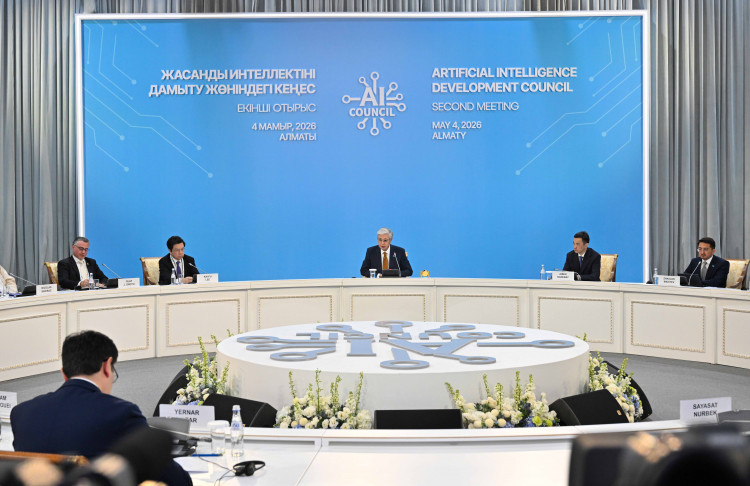
Speaking at the second meeting of the Presidential Council for the Development of Artificial Intelligence in Almaty on Monday, Tokayev stressed that traditional resource-driven growth is no longer sufficient. He called for a “real AI transition” – not isolated digital projects, but a full integration of artificial intelligence across every sector of the economy.
Strong institutional backbone
Kazakhstan has built a robust framework to support this vision. In 2025 the country created a dedicated Ministry of Artificial Intelligence and Digital Development, passed its first comprehensive Law “On Artificial Intelligence” (effective January 2026), and established the Presidential Council for AI. The AI Development Concept 2024–2029 and the upcoming Digital Qazaqstan strategy set concrete targets, including training 5 million citizens in AI skills and launching at least 25 new AI products annually.
2026 has been officially declared the Year of Digitalization and Artificial Intelligence, giving the initiative high-level political momentum.
AI as the core driver against stagnation
Tokayev highlighted that Kazakhstan is already showing signs of stagnation – slowing productivity, exhausted easy resource gains, and limited innovation. AI is positioned as the solution: a technology capable of delivering exponential productivity increases and creating new high-value economic activity.
Key applications already underway or scaling rapidly include:
- Agriculture: AI-driven soil analysis, crop-yield prediction, drone-based pest control, and smart irrigation.
- Industry & Logistics: Predictive maintenance, real-time supply chain optimization, and Industry 4.0 systems.
- Public Services: AI virtual assistants, predictive policy analytics, automated tax and customs systems, and Smart City platforms.
The goal is a “real-time economy” where decision-making cycles shrink from days to seconds, dramatically boosting competitiveness.
Infrastructure and talent push
Significant investments are being made in enabling infrastructure. Kazakhstan is expanding supercomputing capacity (with clusters already in the global TOP500) and developing local large language models such as KazLLM. A major Data Center Valley project in the Ekibastuz-Pavlodar region aims for up to 1 GW of capacity to support large-scale AI and cloud computing.
On the human capital side, more than one million people have already received basic AI training through programs like AI-Sana. AI is being integrated into school curricula, and plans are advancing for a dedicated AI University.
Tokayev also announced the introduction of the “Altyn Visa” (Golden Visa) program as a key tool to attract global talent, investors, and highly qualified specialists in artificial intelligence and related high-tech fields. The new migration policy offers long-term residency (up to 10 years), accelerated procedures, access to public services, and significant tax incentives. This measure aims to build a critical mass of international expertise, complementing domestic talent development and turning Kazakhstan into a magnet for the global AI community.
Private sector and global positioning
The startup ecosystem is gaining traction, with over 100 AI companies and venture capital investment in AI surging past $73 million in 2025. Kazakhstan already has its first AI unicorn – Higgsfield AI, a video-generation company valued at over $1.3 billion.
The country is also leveraging its strategic location to become a regional digital hub, advancing the digital tenge, regulating digital assets, and attracting global talent and investors.
Showcasing progress at GITEX and Defense Tech
On Monday Tokayev visited the inaugural GITEX AI Central Asia & Caucasus exhibition in Almaty, where he reviewed practical AI implementations. Highlights included the Al-Farabium supercomputer powering projects such as an AI assistant at Kazakhtelecom that automatically handles customer calls, detects fraud, and routes suspicious activity to law enforcement. He also examined digital asset ecosystems in banking, the unified KEDEN customs platform, SmartCargo logistics system, and Almaty’s Smart City initiatives.
Simultaneously, Tokayev was presented with the new Defense Tech innovation center in Almaty – a multifunctional hub at the Army House designed to identify, select, and accelerate domestic technological solutions for national defense and security. The initiative includes a coordination office at Astana Hub and aims to foster collaboration between the Ministry of Defense, startups, researchers, and industry partners.
Measuring progress and challenges
Kazakhstan currently ranks 58th globally in the Government AI Readiness Index (up 16 places), leading Central Asia. While challenges remain – including energy and water demands for data centers, cybersecurity, and developing better metrics for AI’s real contribution to GDP – the government’s top-down approach combined with growing private-sector momentum signals serious intent.
As Tokayev concluded, the choice is binary: “Either we build an effective, AI-powered digital economy or remain on the sidelines of global progress.” With its current reforms, Kazakhstan is positioning itself as Central Asia’s AI leader and a serious contender in the emerging cognitive economy.
Caption: The Artificial Intelligence Development Council held its second meeting in Almaty on 4 May 2026. [Akorda]
Updated: May 5, 2026 - 08:57


