 Edit
Israel reiterates support for Great Sea Interconnector linking it to Cyprus and Greece
The project is seen as a step toward reducing Cyprus’ reliance on costly energy imports and fostering greater regional cooperation
An Israeli official has reaffirmed Israel’s steadfast commitment to the Great Sea Interconnector (GSI), an ambitious electrical interconnection project linking Israel, Cyprus, and Greece, according to an interview with EUalive’s partner Politis.
The statement comes amid political uncertainty and regional challenges surrounding the project’s progress.
Cyprus as an island is totally isolated from EU energy links and electricity networks and remains the most energy dependent country in the European Union. Cyprus is completely isolated from EU energy interconnections. GSI is a planned high-voltage direct-current (HVDC) interconnector between the Greek, Cypriot, and Israeli power grids via the world’s longest submarine power cable, with a length of 310 kilometres (190 miles) from Israel to Cyprus and 898 kilometres (558 miles) from Cyprus to Greece for a total of 1,208 kilometres (751 miles). The project will allow for a more efficient use of renewable energy across the three countries, leading to a significant reduction in CO₂ emissions. At the same time, it will offer an alternative energy supply route for Europe.
A diplomatic source from Israel referenced a prior statement by Israel’s Energy Minister, who last year emphasised the strong partnership between Israel and Cyprus and highlighted the GSI’s critical importance. The minister noted that the project would integrate Israel’s electricity grid with Europe’s via Cyprus and Greece, bolstering regional energy security. The Israeli official reiterated that the GSI remains a top priority, describing it as a transformative initiative that enhances energy security, diversifies energy markets, and strengthens Israel’s integration into the European energy framework.
Challenges clouding the project
Despite Israel’s firm support, the GSI faces significant hurdles, primarily due to geopolitical tensions, including objections from Turkey. Turkey argues that the undersea cable, planned to pass through waters near Cyprus, infringes on its maritime claims in the Eastern Mediterranean, a region where territorial disputes remain unresolved.
Cyprus stalls on Great Sea Interconnector amid financial disputes and geopolitical tensions
Ankara has also expressed concerns over the project’s potential to sideline its own energy ambitions and influence in the region. These objections have heightened geopolitical risks, contributing to delays and uncertainties surrounding the GSI’s implementation. Turkey’s stance has drawn criticism from project stakeholders, who view its opposition as a hurdle to regional energy cooperation and Cyprus’ energy independence.
These uncertainties have cast doubt on the project’s timeline and feasibility, making Israel’s consistent backing particularly significant. The Israeli diplomatic source underscored that the country’s position, as articulated by its energy minister, remains unwavering.
Greece and Cyprus push forward
The project has also drawn attention from Greek and Cypriot leaders. Greek Prime Minister Kyriakos Mitsotakis recently urged Cyprus to demonstrate its commitment by contributing €25 million to the Independent Power Transmission Operator (ADMI). In response, Cyprus’ President affirmed that Nicosia would meet its financial obligations, signaling continued support for the GSI.
Greek Foreign Minister George Gerapetritis further emphasized the project’s strategic importance in a recent interview. He described the GSI as vital for Greece, Cyprus, and Israel, particularly for ending Cyprus’ energy isolation, where electricity costs remain exceptionally high. Gerapetritis warned that any attempts to undermine the project – whether through geopolitical maneuvers or private interests – would face strong opposition. “We will be ruthless,” he stated, highlighting the project’s geopolitical significance over purely economic considerations. He also noted that the GSI is a priority for the European Union, with plans in place to safeguard its development.
EU support
The project is designated as a Project of Common Interest (PCI) by the EU, recognising its strategic importance for enhancing energy security and integration across Europe, Cyprus, Greece, and Israel. This status facilitates access to EU funding, technical assistance, and streamlined permitting processes. The EU has provided financial support through mechanisms like the Connecting Europe Facility (CEF), with grants allocated for feasibility studies and technical development. Additionally, the project aligns with the EU’s goals of diversifying energy sources and reducing reliance on fossil fuels, further solidifying its backing.
The total estimated cost of GSI varies across sources but is most consistently reported as approximately €1.9 billion to €2.4 billion.
Additional sources: Statements from Greek and Israeli officials, and regional energy project analyses, edited by g.g.
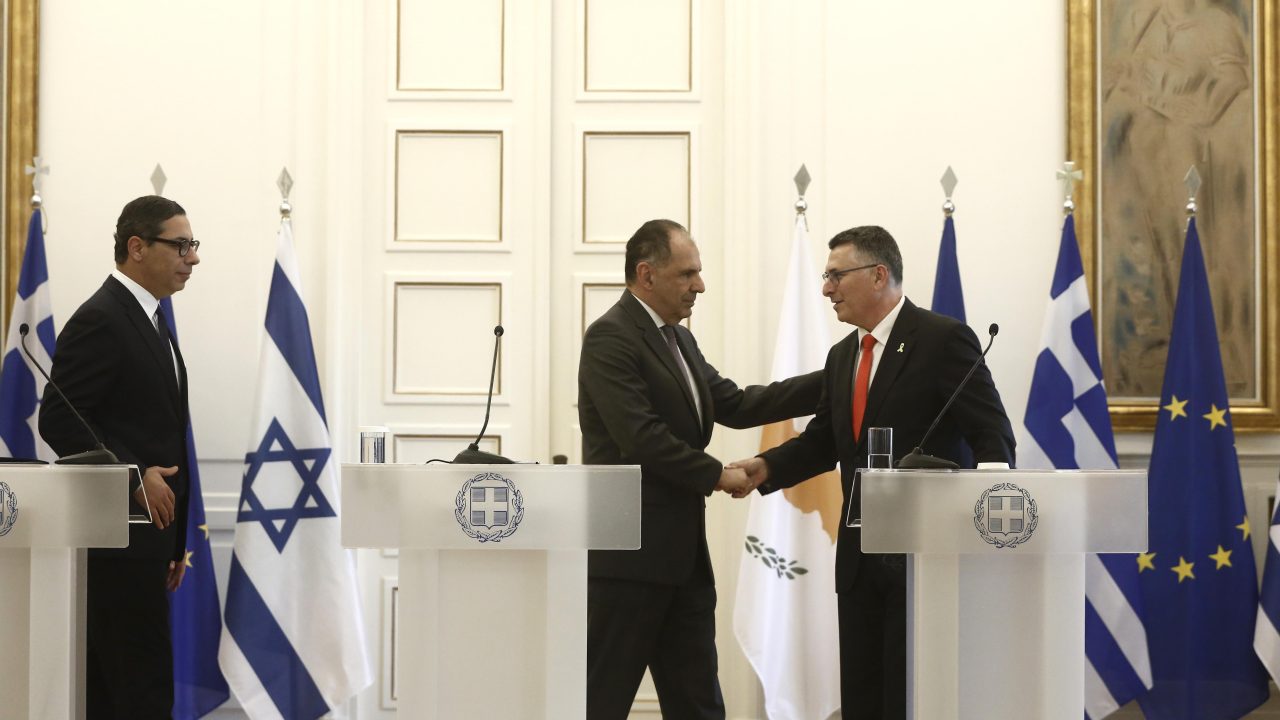
Caption: File photo. The foreign ministers of Cyprus, Constantinos Kombos, Greece, Giorgos Gerapetritis, and Israel, Gideon Sa’ar, speak during the joint conference after the end of a trilateral meeting of the foreign ministers of Greece, Cyprus, and Israel in Athens, Greece, 13 March 2025. The ministers are expected to focus on strengthening trilateral cooperation and discuss international and regional developments, especially in the Eastern Mediterranean and Middle East. EPA/YANNIS KOLESIDIS
Updated: September 9, 2025 - 17:08


