 Edit
Historic milestone: Cyprus and Lebanon seal EEZ deal, eye underwater power link
In a volatile neighborhood - from Gaza's fallout to Syria's uncertainties- the accord appears to be a rare victory of diplomacy over discord
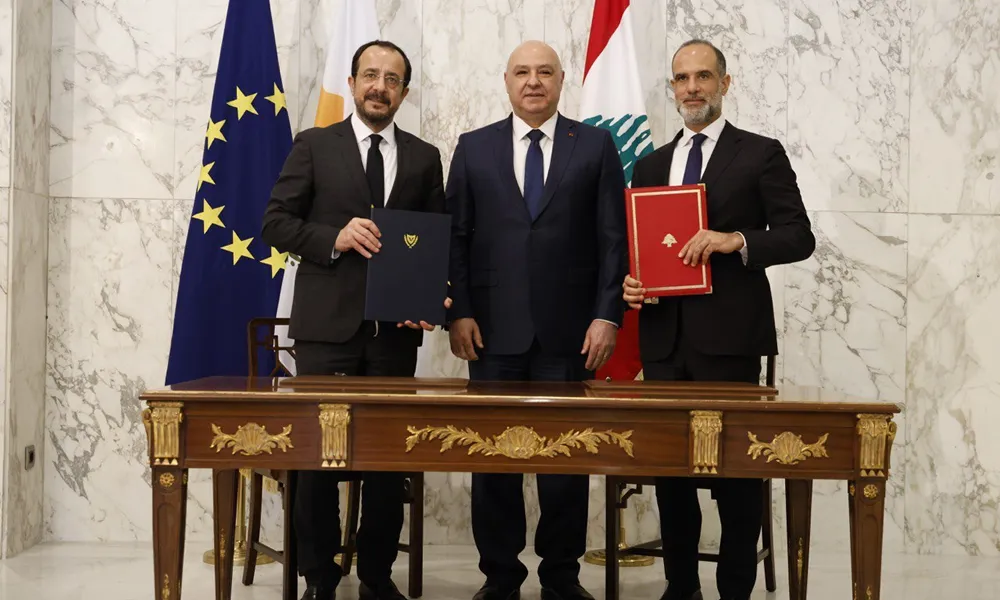
In a breakthrough for Eastern Mediterranean stability, Cyprus and Lebanon signed a long-awaited agreement delimiting their exclusive economic zones (EEZs) on Wednesday, paving the way for joint energy exploration and an undersea electricity interconnection.
The pact, inked at Lebanon’s Baabda Presidential Palace, resolves an 18-year impasse and signals deeper EU-Lebanon ties amid regional tensions.
Cypriot President Nikos Christodoulides travelled to Beirut for talks with his Lebanese counterpart, Joseph Aoun, covering bilateral relations, energy, migration, and EU engagement. Following a private meeting and expanded discussions, Christodoulides and Lebanese Public Works and Transport Minister Fayez Rassamny formalized the EEZ boundary using the median-line principle – equidistant from both coastlines, in line with the UN Convention on the Law of the Sea (UNCLOS).
The leaders also greenlit technical working groups and a World Bank-funded feasibility study for linking their electricity grids via submarine cable, enhancing Lebanon’s fragile power supply and Cyprus’s role as an energy hub.
“This is a milestone of strategic significance that seals, in the clearest way, the level of our relations,” Christodoulides said after the signing. “We send a strong message: Cyprus and Lebanon, grounded in international law, UNCLOS, and good-neighborly ties, invest in trust and mutual respect.”
Aoun, speaking through an interpreter, echoed the sentiment: “This delineation lets us explore maritime resources and foster collaboration. We can now develop bilateral agreements to aid exploration companies in both nations.”
A long-delayed victory
The deal revives a 2007 draft agreement stalled by Lebanese parliamentary ratification battles. Fears that Cyprus’s 2010 EEZ pact with Israel encroached on Lebanese waters – exacerbated by Turkish lobbying – froze progress. Turkey’s “Blue Homeland” doctrine, claiming expansive maritime rights, had repeatedly derailed Beirut’s efforts.
Regional shifts unlocked the path forward. Lebanon’s 2022 U.S.-brokered maritime deal with Israel set a precedent for presidential decree ratification, bypassing parliament. Aoun’s January 2025 election accelerated talks; Christodoulides was the first foreign leader to visit. Negotiations intensified, culminating in cabinet approvals in October.
Earlier this month, Lebanese Energy Minister Joe Sadi visited Nicosia to swap expertise on energy autonomy and interconnections. With the EEZ signed, Aoun is expected to ratify it by decree, mirroring the Israel precedent.
Next up: a unitization agreement for cross-border gas fields, akin to Cyprus’s ongoing talks over Block 12’s Aphrodite deposit with Israel. This could unlock offshore hydrocarbons, drawing majors like ExxonMobil and Chevron.
“We close a decades-old issue and look to what we can build together,” Christodoulides added, thanking Aoun’s “political will,” Prime Minister Nawaf Salam’s support, and negotiators Rassamny and Cyprus’s Tasos Tzionis for their “tireless” efforts.
Message to the region
The accord carries clear subtext for neighbors like Turkey and Syria. Aoun stressed: “Our cooperation targets no one, excludes no one. It doesn’t block friends or partners. Instead, we want it as a cornerstone for regional international cooperation, bringing stability and prosperity to all.”
He urged maritime understandings to end “violence, wars, and hegemonic greed” that have scarred the region. The deal also opens doors for Cyprus-Lebanon-Syria EEZ talks, further isolating Ankara’s maximalist claims.
Energy horizons and EU ties
The pact boosts investor confidence for offshore drilling, positioning the duo as an alternative EU energy corridor. Christodoulides highlighted gains in energy, infrastructure, renewables, telecoms, tourism, and defence. Work on the CADMOS-2 undersea telecom cable progresses, with laying slated for early 2026.
On power links, Christodoulides announced a joint World Bank request for the feasibility study, addressing Lebanon’s chronic blackouts and chronic energy woes.
Talks extended to Lebanon-EU relations. Christodoulides pledged Cyprus’s support for Beirut’s sovereignty, UNIFIL implementation, and migration controls – vital for Mediterranean security. He positioned Cyprus’s 2026 EU presidency as a “channel for meaningful EU-Lebanon cooperation,” targeting a strategic partnership signing.
Aoun welcomed intensified EU engagement, including joint projects and anti-smuggling resources. “Cyprus remains our most stable, reliable partner in this effort,” Christodoulides affirmed.
In a volatile neighborhood – from Gaza’s fallout to Syria’s uncertainties- the accord appears to be a rare victory of diplomacyover discord. As Christodoulides put it: “A strategic foundation for stability in our complex region.”
Caption: From left to right: Cyprus President Nicos Christodoulides, Lebanese President Joseph Aoun, Lebanese Public Works and Transport Minister Fayez Rassamny
Updated: November 27, 2025 - 04:46


