 Edit
Hantavirus outbreak: passengers from MV Hondius evacuated from Tenerife to national capitals
The evacuation marks the latest chapter in the first recorded hantavirus outbreak on a cruise ship, which has so far claimed three lives and infected at least eight people
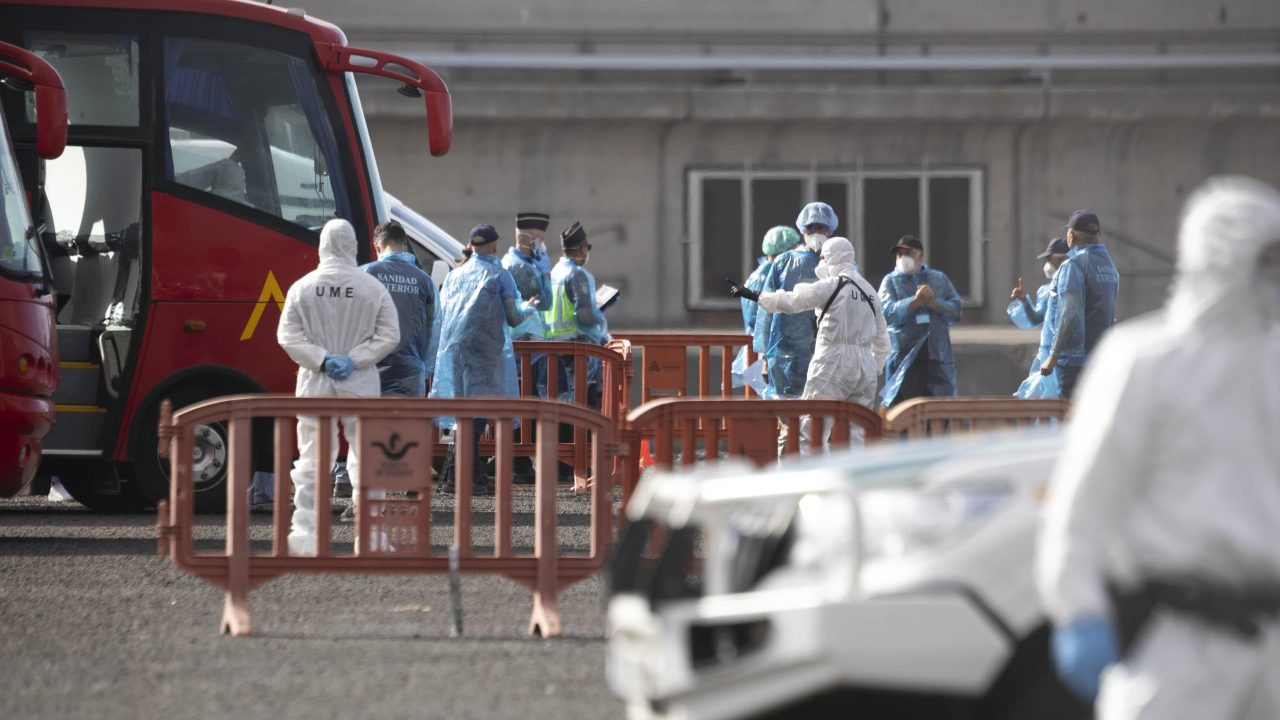
In a meticulously coordinated international operation, groups of passengers and crew from the Dutch-flagged MV Hondius cruise ship began disembarking in Tenerife’s Canary Islands on Sunday, and were swiftly transferred via small boats and military buses to the island’s airport for evacuation flights to their home countries.
Spanish, French, British, Dutch, American, Canadian, Turkish, Irish and other nationals were flown out on government and military aircraft to Madrid, Paris, London, Amsterdam, Washington and other capitals, where they face mandatory testing, hospital observation or 42-day quarantine under strict protocols recommended by the World Health Organization (WHO). No new symptomatic cases were reported among those still aboard during the operation, and the ship itself, with 30 remaining crew members, has now sailed toward the Netherlands for disinfection.
The evacuation marks the latest chapter in the first recorded hantavirus outbreak on a cruise ship, which has so far claimed three lives and infected at least eight people among the vessel’s roughly 146 passengers and crew from more than 20 countries. Health officials have emphasised that the risk to the broader public remains low, with passengers escorted in full protective gear and with no public contact. Spanish authorities, working closely with the WHO and the EU, have described the process as proceeding normally, while one French passenger reportedly developed symptoms mid-flight but is now stable.
History of the outbreak
The MV Hondius, an expedition cruise ship operated by Oceanwide Expeditions, departed from Ushuaia in Argentina on or around 1 April, for a 33-day South Atlantic and Antarctic voyage. The first signs of trouble emerged weeks later. On 2 May UK health authorities notified the WHO of a cluster of severe acute respiratory illnesses aboard the vessel, including two deaths and one critically ill passenger. By 6 May the WHO had confirmed seven cases (two laboratory-confirmed hantavirus infections and five suspected), rising to eight ill passengers (six confirmed) with three fatalities: a Dutch couple and a German national
Several passengers had disembarked earlier at ports including Saint Helena and were airlifted for treatment in South Africa, the Netherlands and Switzerland. The ship continued from Cape Verde toward Tenerife after the WHO and EU requested Spain to manage the final disembarkation and repatriation. No rodents were found aboard, ruling out onboard zoonotic transmission.
Patient Zero identified
Investigators have pinpointed Dutch ornithologist Leo Schilperoord, 70, as patient zero. An experienced birdwatcher travelling with his wife Mirjam, 69, Schilperoord is believed to have contracted the Andes strain of hantavirus during a visit to a landfill site near Ushuaia, Argentina, shortly before boarding. The couple had spent months exploring Argentina, Chile and Uruguay. Schilperoord fell ill within days of the voyage’s start, showing high fever, headaches and diarrhoea; he died on board on 11 April. His wife succumbed days later after being evacuated to South Africa. Genetic and epidemiological tracing, including their pre-boarding travel history and birdwatching activities that likely exposed them to rodent droppings or urine, supports this as the index case. Further investigations in Argentina and Chile are ongoing.
How dangerous is hantavirus, according to the WHO?
Hantaviruses are a family of rodent-borne viruses that can cause two main severe syndromes: haemorrhagic fever with renal syndrome (more common in Asia and Europe) and hantavirus cardiopulmonary syndrome (HCPS) in the Americas. The Andes virus implicated here belongs to the latter group. According to the WHO fact sheet, infection occurs primarily through contact with infected rodents’ urine, droppings or saliva, or contaminated surfaces. Symptoms typically appear 1–8 weeks after exposure (incubation up to six weeks) and can progress rapidly to fever, muscle aches, respiratory distress and, in severe HCPS cases, life-threatening lung and heart failure.
Case fatality rates vary: <1–15% in Asia/Europe, but up to 50% for HCPS in the Americas. Treatment is supportive (no specific antiviral), with early intensive care improving outcomes. The WHO stresses that while severe and potentially deadly, global incidence is relatively low (10,000–100,000 cases annually, mostly in Asia and Europe), and human-to-human transmission is rare and limited – reported only with certain strains like Andes virus, and usually requiring close, prolonged contact.
Could this become another COVID-19 pandemic?
Health authorities have been unequivocal: no. WHO Director of Epidemic and Pandemic Management Maria Van Kerkhove and others have repeatedly stated that this is “not COVID” and should not be treated as such. Unlike SARS-CoV-2, which spreads efficiently via aerosols even before symptoms appear, hantavirus transmission is inefficient between humans. The Andes strain is the only hantavirus known to have documented (but still limited) person-to-person spread, yet it has never sustained community transmission on a global scale. Experts, including epidemiologists at Harvard T.H. Chan School of Public Health, note that the virus would require multiple evolutionary changes to become pandemic-capable. The current outbreak is contained to a single vessel with traceable contacts; the 42-day quarantine recommendation accounts for the long incubation period but is designed to break any potential chains early.
Spanish health officials and the acting U.S. CDC Director have downplayed broader risk, urging calm while acknowledging public anxiety shaped by the COVID-19 experience. The WHO assesses the overall public health risk as low, with no evidence of wider community spread. Contact tracing for earlier disembarkations is underway in multiple countries, but authorities believe the outbreak will remain a finite incident rather than a new global threat.
Caption: Two of the disembarked passengers (green plastic hat) receive instructions from personnel of the Military Emergency Unit and the Foreign Health Service at the port of Granadilla de Abona, Spain, 10 May 2026. The fourteen Spanish passengers from the Dutch cruise ship MV Hondius and a World Health Organization doctor have disembarked at the port of Granadilla de Abona. They are being transferred by bus to Tenerife South Airport and will be flown to Madrid, where they will begin quarantine at Gomez Ulla Military Hospital. EPA/Miguel Barreo
Updated: May 11, 2026 - 05:44