 Edit
Greece’s marine parks proposal sparks tensions with Turkey
A new debate pushes the fragile Mediterranean balance between Athens and Ankara at risk of unravelling
As environmental diplomacy seeks to align national strategies with shared Mediterranean challenges, Greece’s plan to establish marine parks in the Ionian and Aegean Seas has provoked a sharp response from Turkey.
On 16 June Ankara unveiled its draft “Marine Spatial Plan of the Republic of Türkiye,” a direct counter to Greek Prime Minister Kyriakos Mitsotakis’ announcement at the United Nations that Greece would create marine protection parks within a month, inspired by the Mediterranean Peace Parks concept proposed at the CIESM international forum.
This escalating dispute, rooted in competing maritime spatial planning (MSP) strategies, underscores long-standing geopolitical tensions between the two nations, particularly over maritime boundaries and sovereignty in the Aegean and Eastern Mediterranean. While Greece frames its initiative as a step toward environmental stewardship within the European Union’s legal framework, Turkey’s response is seen by Athens as a provocative move to assert claims over disputed waters, further straining bilateral relations.
Maritime Spatial Planning (MSP) is a tool for organizing sea-based activities – such as fisheries, tourism, energy, and conservation – in a sustainable manner, guided in the EU by Directive 2014/89/EU. As a EU member, Greece is obligated to implement MSP in line with international law, including the United Nations Convention on the Law of the Sea (UNCLOS), which defines maritime zones like Exclusive Economic Zones (EEZs).
Turkey, however, has not ratified UNCLOS and lacks delimitation agreements with Greece, leading to overlapping claims in the Aegean and Eastern Mediterranean. Ankara’s new plan, publicized through the Turkish Ministry of Environment and the DEHUKAM platform, claims to promote “sustainable use of marine resources” but includes areas Greece considers under its sovereignty or jurisdiction.
Athens has dismissed Turkey’s mapping as legally baseless, with diplomatic sources calling it a “reflexive and meaningless reaction” that lacks international legitimacy or sanction from bodies like IOC-UNESCO, where Turkey filed its non-binding plan.
Greece’s marine parks initiative, part of its broader commitment to climate diplomacy and biodiversity, aligns with EU environmental goals and the BBNJ Biodiversity Agreement. Mitsotakis’ announcement builds on Greece’s role as a regional leader in ecological governance, aiming to protect marine ecosystems while reinforcing its maritime rights under international law.
In contrast, Turkey’s plan, though presented as environmentally focused, is viewed by analysts as a geopolitical manoeuvre. By asserting claims over disputed areas without recognizing UNCLOS or agreed boundaries, Ankara risks creating a “fait accompli” that could escalate tensions, particularly if it involves restricting navigation or conducting surveillance in contested waters. Turkish officials have signalled they are “closely monitoring” Greece’s plans and may challenge any moves in areas they deem disputed, transforming an environmental tool into a political weapon.
The dispute reflects deeper historical rivalries, including Turkey’s rejection of Greece’s 12-nautical-mile territorial claims in the Aegean and ongoing disagreements over EEZs in the Eastern Mediterranean, exacerbated by Turkey’s 2019 maritime pact with Libya. Greece accuses Turkey of pursuing “maximalist claims” for domestic political gain, while Turkey argues it is safeguarding its rights against Greece’s EU-backed assertions.
The international community, particularly the EU, supports Greece’s adherence to UNCLOS, while Turkey’s isolation from this framework limits its legal standing. Analysts warn that Turkey’s plan could destabilize the region if it leads to actions like naval maneuvers or restrictions on third-country vessels, potentially sparking a crisis.
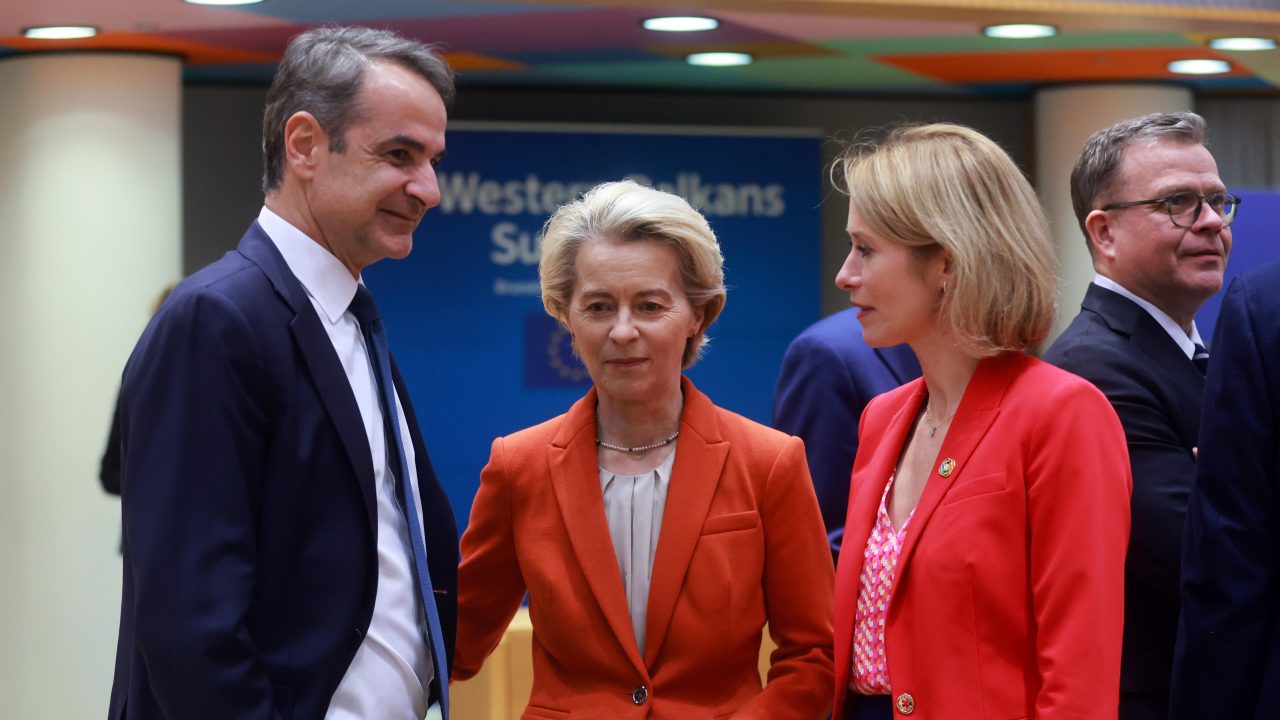
Caption: Greek Prime Minister Kyriakos Mitsotakis, European Commission President Ursula von der Leyen and EU High Representative for Foreign Affairs and Security Policy Kaja Kallas during a round table at the EU-Western Balkans Summit in Brussels, Belgium, 18 December 2024. [EPA/OLIVIER HOSLET]
Updated: June 18, 2025 - 16:43


