 Edit
Giving land to Putin would set a dangerous precedent for Cyprus
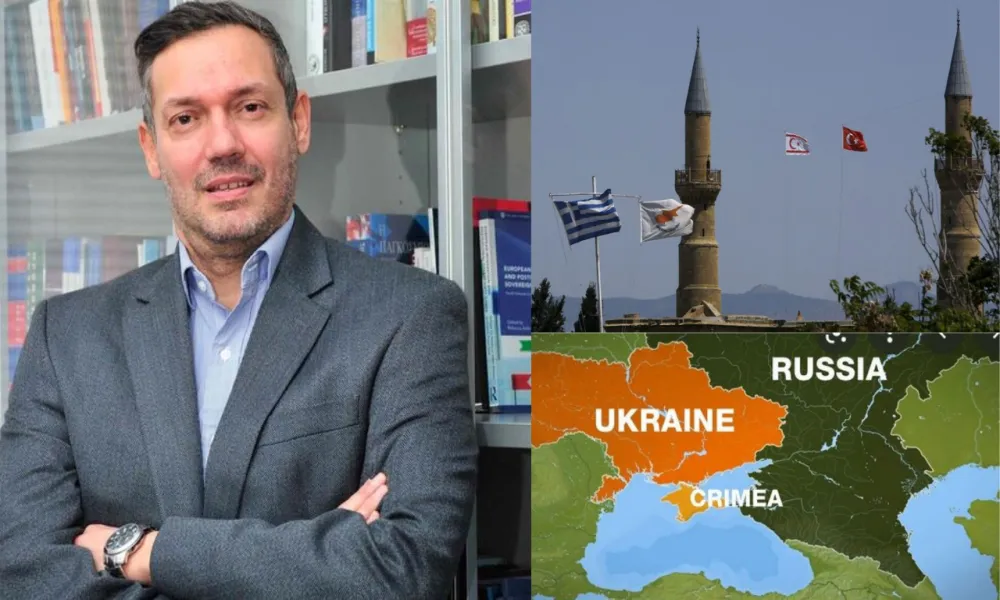
Any concession of Ukrainian territory to Russia risk legitimising Turkish claims in Northern Cyprus, warns Aris Konstantinidis
Any concession of Ukrainian territory to Russia would not only undermine international law but also risk legitimising Turkish claims in Northern Cyprus, wanrs Aris Konstantinidis, Associate Professor of International and Human Rights Law at the University of Cyprus in an interview with Politis, partner of EUalive.
The legal expert cautioned that the current talks on Ukraine may open the door for border changes through violence for the first time since World War II.
“The possibility of an agreement to change borders through armed violence is on the table for the first time since World War II and colonialism,” warned Konstantinidis, stressing that international law strictly prohibits territorial change by force.
The reminded that before 1945, the use of armed force was not prohibited, and peace agreements often followed wars in which the victor imposed the terms. After the Second World War and the end of colonialism, however, new rules were established: annexation of territory by force was banned, and states were obliged not to recognise any such annexation.
Cyprus, he noted, bases its rejection of the self-declared so-called Turkish Republic of Northern Cyprus on this very principle of non-recognition.
EUalive recalls that Russia’s disregard for Ukraine’s territorial integrity is fuelling concerns in many European capitals, and especially in the Balkans, which for more than a century have been regarded as Europe’s powder keg due to a multitude of historical, ethnic and territorial disputes.
The danger for Cyprus, Konstantinidis argued, is that if Ukraine, Russia and possibly the United States reach an agreement that legitimises territorial change by force, the principle will be eroded. He recalled former U.S. President Donald Trump’s statement that “there is no way to recover Crimea” and that “some things never change.” Such logic, he warned, could embolden Turkish President Recep Tayyip Erdoğan to say the same about northern Cyprus.
“The danger is that the logic of ‘why shouldn’t what applies to Crimea also apply to Cyprus’ becomes the arrogance and indifference of the strong towards international law,” says the scholar.
Asked whether Cyprus should remain firmly committed to international law regarding Ukraine, Konstantinidis replied: “Definitely.” He stressed that Nicosia should closely monitor developments and the details of any possible agreement.
“The big stakes,” Kostantinidis underlined, “is that the change of borders should not be recognised by force.” For the first time since 1945, he added, there is now a serious possibility of borders being redrawn through war.
(Kosovo declared unilaterally independence in 2008 following the 1999 Kosovo war. Among EU members, Cyprus, Greece, Romania, Slovakia and Spain did not recognise Kosovo as an independent country.)
On the issue of possible consent by Ukraine, Konstantinidis explained that even if Kyiv agrees to territorial concessions, questions of legality remain. He noted that some international rules, such as the ban on the use of force, are considered ius cogens – mandatory norms from which no derogation is permitted. According to the 1969 Vienna Convention on the Law of Treaties, any agreement that conflicts with such a rule is invalid. “If a peace agreement between Russia and Ukraine is the result of the use of force, then if the capitulation takes the form of an international treaty it will be legally invalid,” he said.
However, he acknowledged that valid consent by the victim state complicates the matter. “If President Volodymyr Zelenskyy accepts the agreement, and it is ratified by Ukraine’s parliament, then other data are created,” he said. He pointed to the July 2024 advisory opinion of the International Court of Justice on the occupied Palestinian territories, where the Court recognised the role that state consent can play.
Konstantinidis explained that while Ukraine’s cession of Crimea could still be contested as unlawful, the interpretation of the international community would be decisive. “If the majority of states interpret Ukraine’s consent as valid, then it will be very difficult for a court to later rule the granting of territory illegal,” he said. For that reason, he argued, the outcome should not be the result of a deal between Trump, Putin and Zelenskyy alone, but one in which Europeans are also involved and accept the result. “If everyone accepts it, then it is difficult for a court to challenge the validity of Ukraine’s consent.”
He emphasised that the rule against annexation by force will not disappear but will be interpreted in the light of Ukraine’s case, thereby creating a precedent. “Each time in the future, states will examine how it was implemented in this case and how consensus was interpreted. The international community’s interpretation will serve as precedent,” he warned.
Turning to wider risks, Konstantinidis recalled the debate in the late 2010s over a possible land swap between Serbia and Kosovo, which was strongly opposed by then German Chancellor Angela Merkel. “She resisted because if it was done in one case, why not in others? There are many areas that would like to change borders,” he said. He cited Bosnia’s Republika Srpska as a region where such claims could emerge, as well as ideas of Serbia annexing northern Kosovo in exchange for recognising Kosovo’s independence. “Such developments create the danger of new wars, because many states will consider that they can forcibly seize territory and then exchange it for an agreement,” he warned.
“If Ukraine concedes territory due to Russia’s use of armed force, then the appetite will also open up to other states, and the first to follow will be China with the violent annexation of Taiwan,” Konstantinidis cautioned.
Asked why the United Nations does not intervene to uphold international law, he said the organisation is weakened and discredited in such matters. “Moreover, Russia is a permanent member of the Security Council and therefore blocks any involvement.” Still, he noted that the General Assembly has condemned Russia’s annexation of Crimea and the UN Secretary-General has also denounced it.
Konstantinidis concluded that even if legal debates continue, the political impact of legitimising annexation by force would be profound. “It is precisely because Cyprus depends on the principle of non-recognition that any precedent of legitimising territorial change by violence poses a direct threat,” he said.
Caption: Associate Professor of International Law and Human Rights Law at the Department of Law of the University of Cyprus, Aris Konstantinidis, Politis
Updated: August 19, 2025 - 13:13


