 Edit
EU enlargement reports must uphold integrity, not serve external agendas
Official representatives from North Macedonia met the four European Parliament rapporteurs at the critical procedural juncture, which raises red flags
The European Parliament’s annual country reports on candidate states are a cornerstone of the EU enlargement process. They must reflect objective assessment, rigorous scrutiny, and uncompromised independence. Yet the ongoing preparation of the 2026 report on North Macedonia raises troubling questions about transparency, procedural fairness, and vulnerability to external influence, writes Viktor Stoyanov.
Viktor Stoyanov is Chairman of Foundation “Macedonia”, a Bulgarian think-tank focused on transparency, democratic accountability, and political oversight.
On 24 March, North Macedonia’s Foreign Minister Timcho Mucunski visited the European Parliament and held meetings with key figures shaping the report: rapporteur Thomas Waitz (Greens) and shadow rapporteurs Matej Tonin (EPP), Thijs Reuten (S&D), and Dan Barna (Renew), as well as Karlo Ressler, Chair of the EP-North Macedonia delegation. These engagements occurred immediately before the critical shadow rapporteurs’ meeting – the stage where the report’s final content is effectively decided. The four MEPs involved represent a parliamentary majority in this process.
Public records confirm the meetings, yet their timing, selective nature, and concentration of access go far beyond routine diplomatic dialogue. When the very individuals responsible for drafting and negotiating the report meet a foreign minister hours before the decisive session, it creates a clear risk of undue influence at the point of maximum impact.
This is not an isolated incident. An identical pattern unfolded last year: representatives from North Macedonia met the same four rapporteurs at the same procedural juncture, right before the shadow meeting. What was then dismissed as coincidence now appears as a repeated method. Last year’s report was already marred by reported leaks from the negotiation process, public boasts by North Macedonia’s Prime Minister about ten months of close cooperation with the rapporteur in shaping the text, and attempts to insert highly divisive language on “Macedonian language and identity” through coordinated amendments from multiple political groups. After significant reputational damage, the Parliament ultimately rejected those amendments to avoid setting a dangerous precedent of using EU reports to recognise contested identities.
This year, similar red flags have reappeared. Rapporteur Waitz has again tabled controversial amendments that question the validity and role of Protocol No. 2 to the 2017 Treaty of Good Neighbourliness between Bulgaria and North Macedonia. This Protocol is not a minor bilateral footnote – it forms an integral part of the 2022 European compromise that unlocked the negotiating framework. It enshrines key commitments on tackling hate speech, protecting minority rights (including the Bulgarian community in North Macedonia), opening security archives, and addressing historical distortions. Bulgaria accepted the overall framework precisely because Protocol No. 2 was embedded within it.
Attempts to relativise or reopen Protocol No. 2 risk unravelling that carefully balanced consensus. They align closely with long-standing positions from Skopje that have repeatedly challenged the Protocol. Additional proposals, such as demanding blanket compliance by all EU member states with European Court of Human Rights rulings in this specific context, appear politically targeted – particularly regarding registration of organisations linked to claims of a “Macedonian minority” in Bulgaria. Such language is legally misplaced in an enlargement report and risks turning a monitoring exercise into a vehicle for advancing one side’s narrative.
The selective engagement is equally concerning. While there are eight shadow rapporteurs in total, only this specific quartet – the same group that met last year – held sessions with the Foreign Minister. This concentration of access at the decisive moment undermines the perception of impartiality.
In EU enlargement policy, even the appearance of undue influence erodes trust. Here, the repetition of patterns, the timing of high-level access, the content of proposed amendments, and the broader context of past irregularities point to more than isolated lapses. They suggest a rapporteur who may be prioritising alignment with Skopje’s positions over balanced, independent assessment.
The credibility of the European Parliament – and of the entire enlargement process – rests not only on the substance of its conclusions but on the integrity of how they are reached. If external actors can shape outcomes through privileged last-minute access and behind-closed-doors coordination, the process loses legitimacy.
We therefore urge President Metsola and the European Parliament to act decisively:
- ensure full transparency on the content, timing, and declarations of these meetings;
- verify full compliance with the Parliament’s Code of Conduct;
- refer the matter for formal review by the competent ethical oversight bodies if warranted;
- introduce robust procedural safeguards – such as clear rules on contacts with third-country ;officials during sensitive drafting phases – to prevent recurrence in future enlargement reports.
Enlargement is too strategically vital, and bilateral sensitivities in the Western Balkans too delicate, to allow shortcuts or perceptions of capture. The European Parliament must defend its independence vigorously. Failure to address these repeated concerns risks normalising practices that could compromise not just one report, but the institution’s role as a credible guardian of the accession process.
The stakes extend beyond North Macedonia and Bulgaria. They touch the EU’s ability to conduct fair, merit-based enlargement in a region still scarred by unresolved disputes. Defending procedural integrity today safeguards the credibility of European decisions tomorrow.
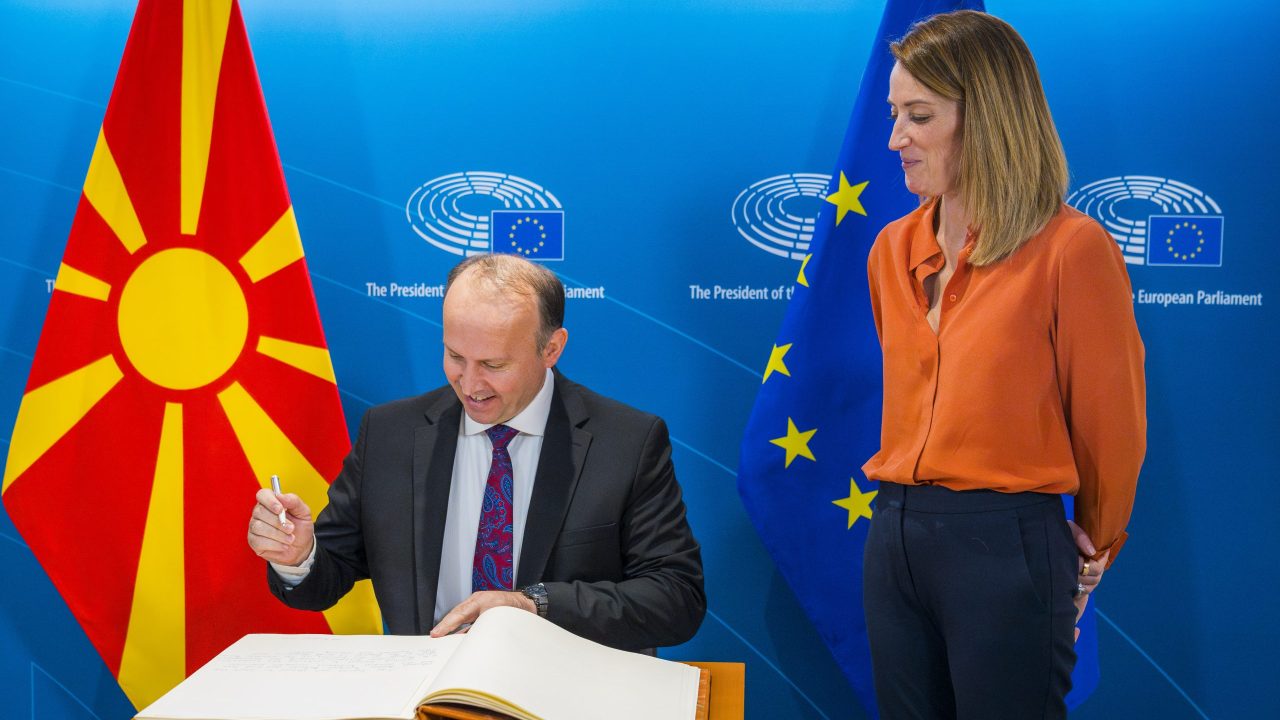
Caption: File photo. Roberta Metsola, EP President meets with Afrim Gashi, Speaker of the Parliament of North Macedonia, 18 November 2024 [European Parliament Multimedia Centre]
Updated: March 27, 2026 - 14:12