 Edit
Estonia prepares for 30 days of wartime self-sufficiency under revamped security doctrine
The revised framework states that Russia remains “the greatest security threat to Estonia and all Euro-Atlantic security”
Estonia has overhauled its national security policy framework, introducing a new principle that requires the country to be capable of functioning autonomously for at least 30 days in the event of war or a total blockade by land, air and sea.
The updated strategic document, sent for public consultation on Thursday afternoon, reflects what Tallinn describes as a significantly more unpredictable international security environment than when the framework was last revised in 2023.
At the core of the new doctrine is a 30-day resilience requirement: in a crisis or wartime scenario, Estonia’s strategic reserves and supply systems must be able to sustain the functioning of society as a whole for at least one month, until critical external connections are restored. In practical terms, the principle means that if Estonia were completely cut off during a conflict, the state must be prepared to cope independently for 30 days. Citizens themselves are expected to be able to manage for at least seven days without outside assistance.
The government argues that preparing for the most severe wartime contingencies also strengthens the country’s ability to withstand less severe crises.
The revised framework states that Russia remains “the greatest security threat to Estonia and all Euro-Atlantic security”, citing what it describes as Moscow’s imperialist aggression and efforts to reshape Europe’s security architecture and the rules-based international order.
The document also highlights a broader deterioration in the global strategic environment, noting that the international system has become less predictable over the past three years and that the rules-based order is under sustained pressure.
A major theme of the update is Europe’s growing responsibility for its own defence amid shifts in U.S. strategic priorities and alliance policy.
“Long-term trends in Europe’s security architecture and changes in the strategic interests and attitudes of the United States have led to a situation that requires European countries to take greater responsibility and action to ensure common security, including rapidly increasing military defence spending and achieving NATO capability targets,” the explanatory note states.
The revised doctrine also repeatedly references China, both in the context of support for Russia’s war against Ukraine alongside North Korea, Belarus and Iran, and through Beijing’s growing global influence in technology and economic affairs.
Internal doctrine shift: war beyond Estonia’s borders
One of the most significant changes from the 2023 framework is the formal introduction of the “active defence” principle.
This does not replace territorial defence, which remains an important pillar, but changes the operational objective: ensuring that future combat does not take place on Estonian territory.
Under the new approach, Estonia explicitly rejects a model in which territory would be ceded and later retaken. Instead, the doctrine foresees taking the war onto the aggressor’s territory.
“Military defence is built on the principle of active defence, according to which active measures are taken against enemy forces to prevent or hinder an attack or reduce its effectiveness, including strikes deep into enemy territory,” the explanatory note says.
“Territorial defence still plays an important role, but the goal is to ensure that hostilities do not take place on the territory of Estonia.”
The logic behind the shift is straightforward: by preventing sustained combat on domestic soil, Estonia aims to reduce civilian casualties and infrastructure damage.
Despite Finland joining NATO in April 2023 and Sweden following in March 2024, the updated framework maintains the long-standing assessment that the Baltic states continue to form a single operational area.
The strategy also devotes significant attention to the resilience of critical services, underlining that the functioning of society depends on secure access to essential infrastructure and communications.
Among the services explicitly identified as vital are energy, telecommunications, food supply, fuel, healthcare and public-service media, including the role of Estonia’s national broadcaster.
The document states that these are essential to meeting the population’s core needs during crisis conditions.
The revision comes as part of Estonia’s regular strategic review cycle, under which the parliament is expected to revisit the security policy framework at least once during every legislative term, or sooner if the security environment changes substantially.
Ukraine as security provider
The broader strategic debate also increasingly includes Ukraine’s role in Europe’s defence architecture.
Estonian Foreign Minister Margus Tsahkna has argued that Europe itself needs security guarantees from Ukraine because of Kyiv’s unmatched battlefield experience.
Writing on X, Tsahkna said the current moment should be used to eliminate “grey zones”, integrate Ukraine into both the EU and NATO, and fundamentally reshape European security.
“This is not just about securing Ukraine,” he argued, but about Ukraine itself “providing security guarantees for Europe” through its unparalleled military expertise.
Sources: European Pravda, Err.ee
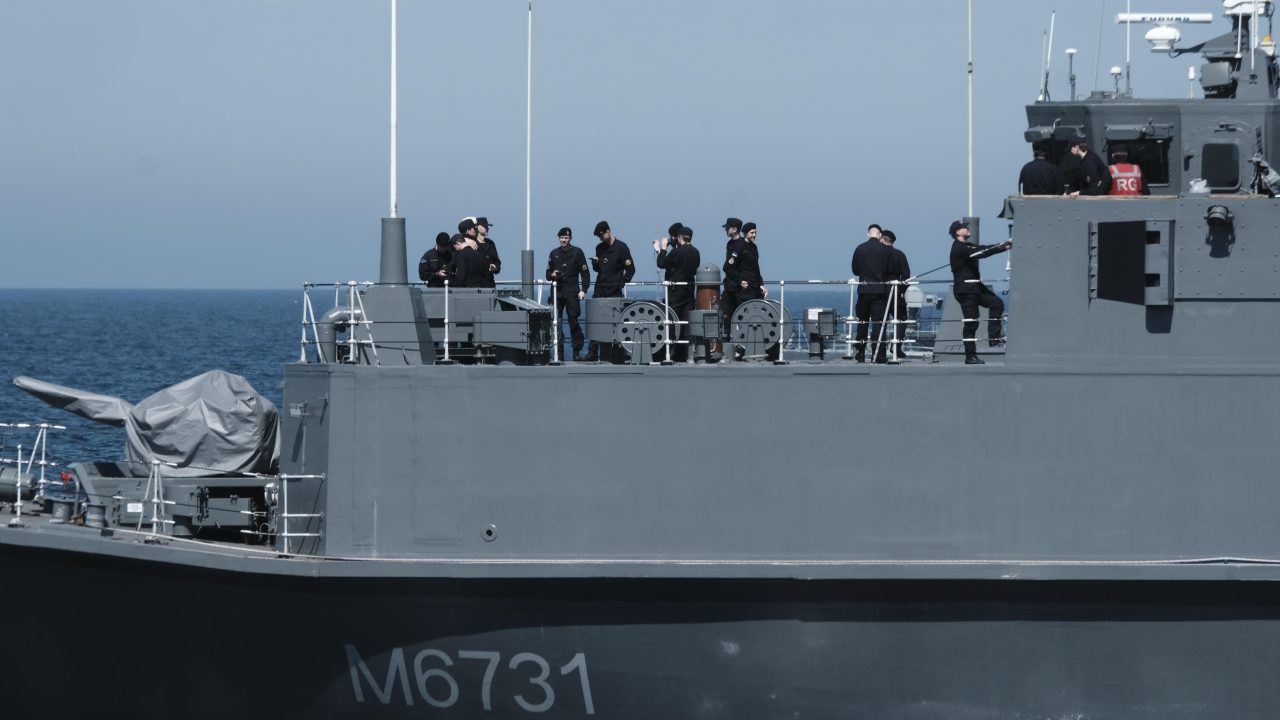
Caption: Estonian Navy servicemen with their minehunter ENS Admiral Cowan, during the Media Day at international naval mine countermeasures’ operation Open Spirit/EODEX 2025 in the Baltic Sea near Klaipeda, Lithuania, 20 May 2025. EPA/VALDA KALNINA
Updated: April 10, 2026 - 05:48