 Edit
Chernobyl NPP loses external power amid renewed military attacks on Ukraine
IAEA says it monitors nuclear safety as Russian strikes disrupt Kyiv infrastructure and power lines to multiple nuclear plants
The Chernobyl Nuclear Power Plant (ChNPP) experienced a complete loss of external power supply on 20 January amid widespread Russian military activity that damaged critical electrical infrastructure across Ukraine, EUalive’s partner Suspinle reports.
This incident, reported by International Atomic Energy Agency (IAEA) Director General Rafael Grossi, underscores the persistent threats to nuclear safety in a region already scarred by historical disasters and recent Russian aggression.
Grossi’s statement highlighted that several Ukrainian electrical substations, essential for maintaining nuclear safety, were impacted by large-scale military actions that morning. The ChNPP’s off-site power was entirely cut, while power lines to other nuclear power plants (NPPs) were also damaged.
“The IAEA is actively following developments in order to assess impact on nuclear safety,” Grossi added, emphasizing the agency’s role in monitoring potential risks.
This power disruption occurred against the backdrop of intensified shelling in Kyiv and the surrounding region on the same day. Russian attacks targeted the capital overnight, resulting in one victim in the Dnipro district. Power and water outages affected the entire left bank of the city, with reduced pressure in water supply networks on the right bank. By morning, power workers had restored electricity to 162,000 homes, though another 173,000 families remained temporarily without power, leading to ongoing emergency outages.
Over 5,635 high-rise buildings lost heat, and the metro system operated in shifts due to the strained electricity situation.
In the Kyiv region, the Buchanan and Brovar districts suffered from the massive assault, with 15 civilian infrastructure facilities damaged and a 50-year-old man killed.
Enhanced security measures at Chernobyl
Just one day prior, on 19 January, the Ukrainian National Guard announced heightened security protocols for the ChNPP and its exclusion zone.
Commander Oleksandr Pivnenko, a brigadier general, detailed efforts to bolster defenses through closer cooperation with Defense Forces units. Over recent months, the Guard has implemented organizational changes, increasing personnel numbers and equipping units with modern weapons, anti-tank missile systems, mortars, air defense systems, and other necessary gear.
A key focus has been the expanded use of drones for monitoring and protection. “The use of unmanned aerial vehicles ensures continuous monitoring of the situation, timely collection of information, and increases readiness to immediately respond to any changes in the situation,” Pivnenko stated.
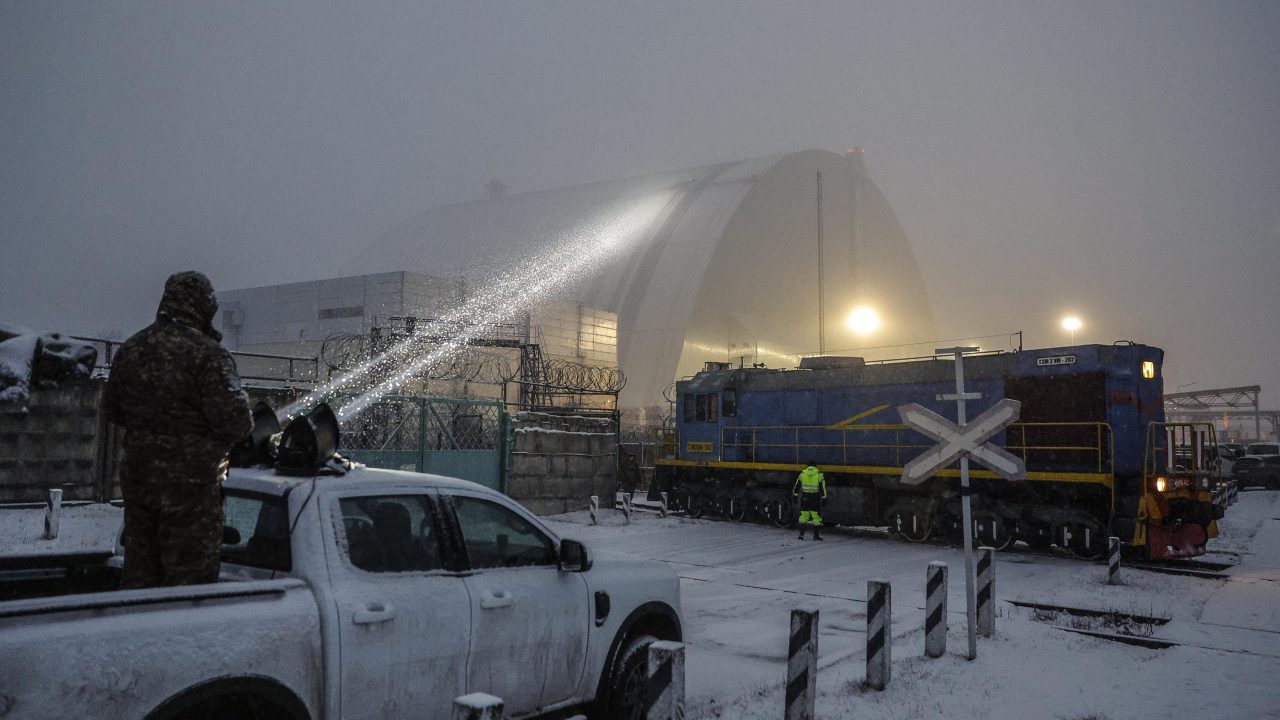
The 20 January incident revives concerns tied to a prior Russian drone strike on 14 February 2025, which damaged the New Safe Confinement (NSC) arch over the destroyed fourth power unit at Chernobyl. That attack involved a strike drone with a high-explosive warhead hitting the shelter, though the State Emergency Service reported normal radiation levels the following morning.
Ukrainian President Volodymyr Zelenskyy noted then that the drone flew at an altitude of 85 meters, evading radar detection. In response, Ukraine urged the IAEA to ramp up efforts against attacks on nuclear sites. Kremlin spokesman Dmitry Peskov denied any Russian involvement.
Restoration of the damaged confinement is a priority, with completion targeted by the end of 2026. As reported in December 2025 by DW, citing Sergey Kondratenko, Deputy Technical Director for Infrastructure at the State Specialized Enterprise “Chernobyl NPP,” Ukraine and the European Bank for Reconstruction and Development (EBRD) signed a grant agreement for international funding.
Experts from French firms Bouygues Travaux Publics and VINCI Construction Grands Projets, part of the Novarka consortium that built the NSC, are assessing repair options to restore functionality while considering costs. Kondratenko explained that the drone strike caused a fire, burning the waterproofing and damaging the membrane ensuring the arch’s tightness. Firefighters created 130 holes in the outer skin, totaling about 130 square meters, allowing moisture ingress that could corrode supporting structures.
Despite these issues, Kondratenko assured there is no current threat of radiation leakage.
Caption: A Ukrainian serviceman directs a light towards a damaged protective shelter over the remains of the reactor Unit 4 at the Chernobyl nuclear power plant (NPP), near the city of Chernobyl, Ukraine, 14 February 2025, amid the Russian invasion. Ukraine’s President Zelensky said on 14 February, that a Russian drone with a ‘high-explosive warhead’ struck the shelter covering the destroyed Unit 4 of the Chernobyl NPP overnight. A fire was extinguished and radiation levels are being monitored at the site, Ukrainian authorities said. EPA/SERGEY DOLZHENKO
Updated: January 20, 2026 - 17:20