 Edit
Austrian chancellor’s visit to Serbia underscores EU concerns over media freedom
As Serbia grapples with internal protests and external pressures, Austria serves as a key interpreter of Western Balkan dynamics for the EU.
Austrian Chancellor Christian Stocker visited Belgrade on 13 August to deliver a pointed message from the European Union: Serbia must address critical shortcomings in media independence and the rule of law to advance its EU integration.
The EU frequently makes use of Austria’s insight for interpretations regarding events in the Western Balkans.
The visit, which included meetings with Serbian President Aleksandar Vučić and Prime Minister Djuro Macut, underscored growing EU concerns about Serbia’s democratic backsliding, despite official discussions emphasizing bilateral ties, economic cooperation, and Serbia’s path to EU membership.
Context and purpose of the visit
Chancellor Stocker’s trip, which also included a stop in Montenegro, was strategically framed to avoid spotlighting Serbia alone, according to a source familiar with the discussions.
The inclusion of Montenegro was described as a diplomatic tactic to dilute the focus on Serbia’s domestic issues. The visit’s timing – mid-August, an unusual period for high-level diplomatic engagements, and its last-minute announcement signaled urgency. “Such visits rarely occur in August unless there’s a serious issue,” the source of the Serbian television Nova noted. “In Austria, such meetings are typically announced well in advance. This was organised overnight to convey the EU’s position on Serbia.”
The chancellor’s agenda included signing an economic cooperation agreement with Prime Minister Matsut and confirming Austria’s participation in EXPO 2027 in Belgrade.
However, the primary objective was to address Serbia’s deteriorating record on media freedom and judicial independence, issues that have stalled its EU accession process. For four years, Serbia has failed to open new chapters or clusters in EU negotiations, raising doubts about its commitment to EU values.
Serbia’s democratic challenges
President Vučić has consistently portrayed Serbia as a democratic state, claiming it is “more democratic than some EU leaders.”
However, ongoing anti-corruption protests, sparked by the tragic collapse of a railway station roof in Novi Sad in November 2024, which killed 16 people, tell a different story. These protests have mobilized Serbian citizens and the diaspora, particularly in Austria, where a significant Serbian community resides. The source alleged that Vučić’s administration has attempted to influence this diaspora for political purposes, including ahead of Austrian elections to bolster support for the far-right FPÖ party.
During Christian Stocker’s visit, masked supporters of Serbia’s ruling party, under police protection, reportedly attacked demonstrators with fireworks, highlighting tensions over freedom of expression.
The chancellor directly addressed these concerns, urging Vučić to respect independent media and uphold the rule of law. “I face critical questions daily,” Stocker told Vučić, as reported by Austrian outlet Kleine Zeitung. “This must be tolerated. This is media freedom.”
Meanwhile, on 14 August, the European Union strongly condemned all forms of violence in Serbia, including threats against journalists, and urged an immediate halt to any escalation of tensions.
The European Commission informed N1 that it is closely monitoring the situation in Serbia following several protests where demonstrators and journalists faced attacks and intimidation from ruling party supporters, with no apparent response from the police.
“The EU’s stance is unequivocal: the rights to peaceful assembly and freedom of expression must be upheld, and authorities are obligated to protect participants from harm or violence,” the European Commission stated in its letter to N1.
Associations deplore “the culmination of violence against journalists” at Serbia protests
Vučić’s response and press conference tensions
The press conference in Belgrade exposed further tensions.
When questioned about the protests and Serbia’s stalled EU integration, Vučić reacted defensively, accusing Austrian journalists of portraying him as a dictator. “I am not a dictator,” he repeated twice, prompting a measured response from Stocker, who emphasized the importance of enduring critical media scrutiny as a cornerstone of democracy.
Vučić’s outburst underscored why Serbia is increasingly viewed as a problematic EU partner. Beyond domestic issues, Serbia’s refusal to align with EU foreign policy – particularly its reluctance to impose sanctions on Russia, and the stalled Belgrade-Pristina Dialogue with Kosovo have further complicated its EU membership prospects.
Kosovo dialogue and regional stability
Stocker also pressed Serbia to re-engage in the EU-facilitated Belgrade-Pristina Dialogue, aimed at normalising relations with Kosovo, which unilaterally declared independence in 2008. Not ony Serbia, but also EU members Greece, Cyprus, Spain, Slovakia and Slovakia refuses to recognise Kosovo.
The dialogue, launched in 2011, has seen periodic progress but frequent setbacks, with tensions flaring in July 2025 after Kosovo arrested a Serbian official, prompting Serbia to suspend participation.
“There is no alternative to the dialogue process,” Christian Stocker stated, reaffirming Austria’s support for Serbia’s EU accession but stressing that progress hinges on reforms in transport, energy, rule of law, and media independence.
Austria’s role and economic ties
Austria, Serbia’s third-largest investor after China and the Netherlands, plays a significant role in the Western Balkans. Over 400 Austrian companies employ 22,000 people in Serbia, and Stocker emphasized the importance of economic stability for the region’s integration into the EU.
“We must not leave this region to actors like Russia,” he told Tanjug, highlighting Austria’s interest in preventing destabilization amid the war in Ukraine.
The chancellor also raised concerns about the Serbian diaspora in Austria, urging Vučić to refrain from leveraging it for political gain. “Serbs are part of Austrian society,” Stocker said, signaling that Belgrade’s attempts to influence the diaspora would not be tolerated.
Chancellor Stocker’s visit to Belgrade was not a routine diplomatic courtesy but a deliberate effort to convey the EU’s concerns about Serbia’s democratic trajectory.
While economic cooperation and EXPO 2027 provided a positive backdrop, the core message focused on media freedom, judicial independence, and the need for dialogue with Kosovo.
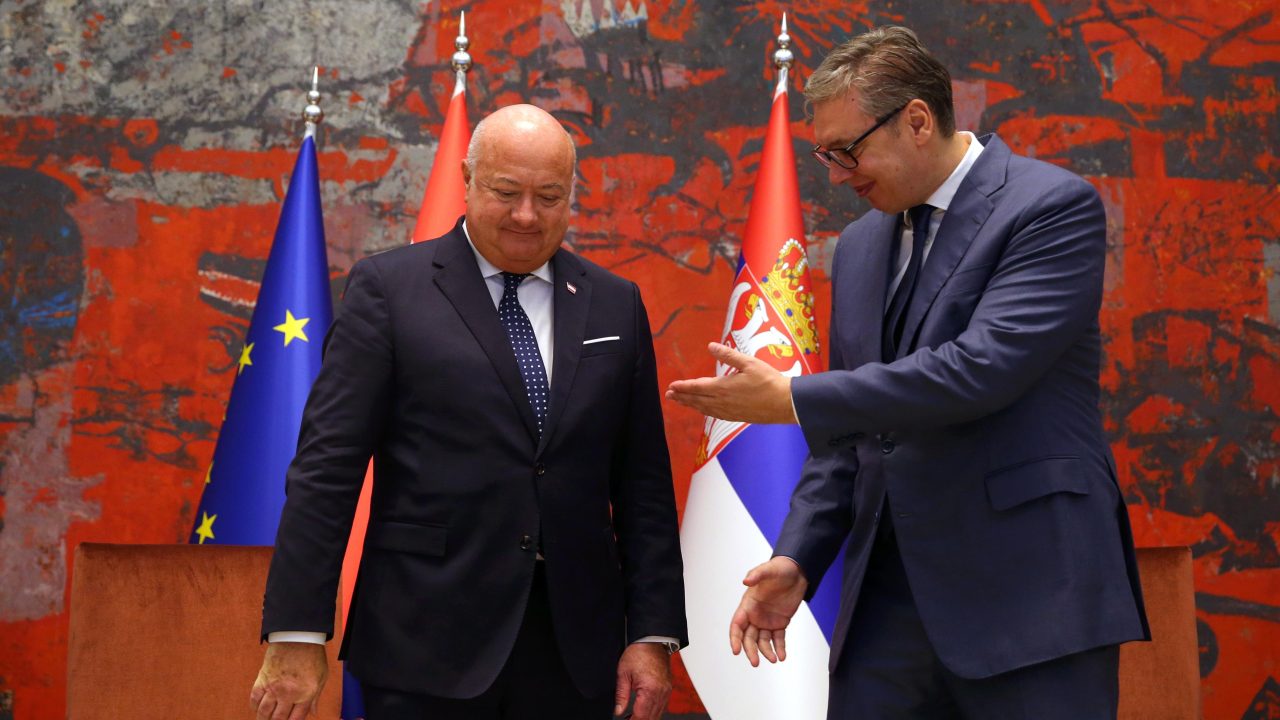
Caption: Serbian President Aleksandar Vucic (R) and Austria’s Chancellor Christian Stocker (L) talk during their meeting in Belgrade, Serbia, 13 August 2025. Chancellor Stocker is on an official state visit to Serbia. EPA/ANDREJ CUKIC
Updated: August 15, 2025 - 11:22