 Edit
Ukraine condemns Woody Allen’s Moscow film festival speech
In response, the Hollywood star strongly criticised Russia’s invasion of Ukraine, but defended his decision to speak at the event
Ukrainian authorities strongly condemned American film director Woody Allen’s participation, albeit virtual, in the Moscow International Film Week, branding it “a disgrace and an insult” to Ukrainian actors and filmmakers who suffered at the hands of Russian war criminals. The event was seen not just as a diplomatic misstep, but an affront to those directly impacted by ongoing aggression.
The festival, held since August 2024, is seen as Kremlin-aligned and intentionally brings together voices supportive of Putin, including moderator Fyodor Bondarchuk and Serbian director Emir Kusturica, who has openly backed the Russian president.
Following Allen’s appearance, a screening of his ‘Bullets Over Broadway’ comedy was canceled in Lviv, underscoring the backlash’s practical effects.
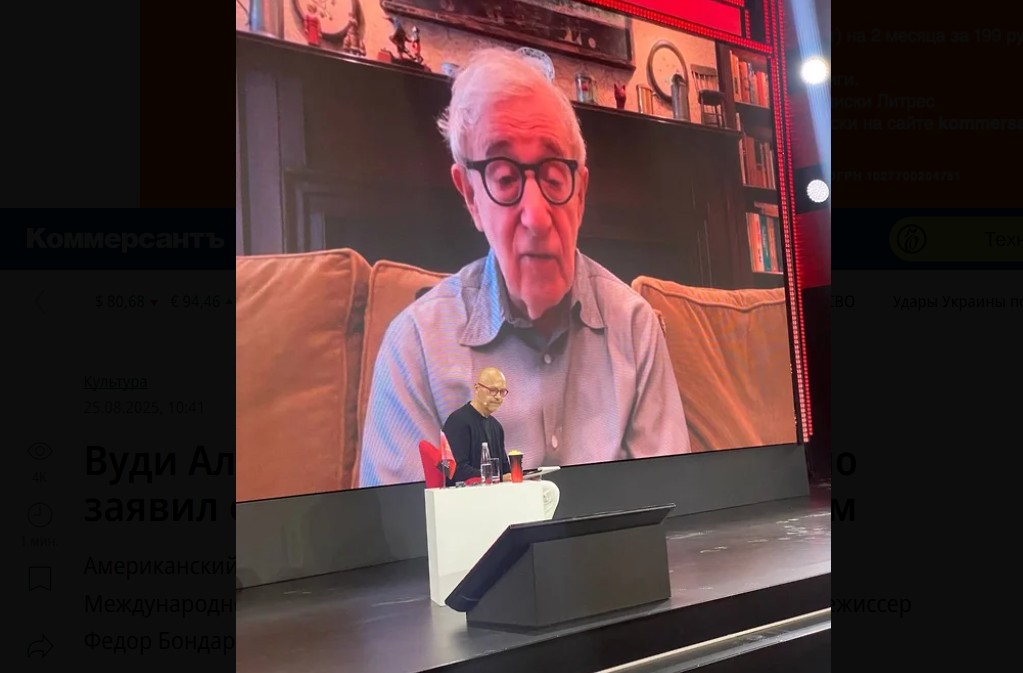
Allen joined via video link, the “Legends of World Cinema” session at Moscow International Film Week, moderated by pro-Kremlin director Fyodor Bondarchuk.
“The participation of Woody Allen in the Moscow International Film Week is a disgrace and an insult to the sacrifice of Ukrainian actors and filmmakers who have been killed or wounded by Russian war criminals in their ongoing war against Ukraine,” the ministry said on social media, adding that the director “has chosen to close his eyes to the atrocities Russia commits in Ukraine every single day for 11 years now”. “Culture must never be used to whitewash crimes or serve as a propaganda tool. We strongly condemn Woody Allen’s decision to bless Moscow’s bloody festival with his address”, the ministry stated.
In response, Allen strongly criticised Russia’s invasion of Ukraine, but defended his decision to speak at the festival.
“When it comes to the conflict in Ukraine, I believe strongly that Vladimir Putin is totally in the wrong. The war he has caused is appalling,” he said in a statement to the Associated Press. “But, whatever politicians have done, I don’t feel cutting off artistic conversations is ever a good way to help.”
Russian state TV showed Allen addressing a packed theatre on a giant screen, praising Russian cinema and recalling his past visits to the Soviet Union.
Kyiv also reacted by adding Allen to the controversial Myrotvorets (“Peacemaker”) database, which publishes details of individuals deemed a threat to Ukraine’s national security. The filmmaker was accused of “public support for Russian aggression” and of “conscious participation in a Russian propaganda event”.
The Ukrainian website Myrotvorets is operating since 2014. The site’s operation and transparency have long been controversial: it has published private data, raised legal and ethical concerns, and been referenced in border screening despite its unofficial status.
Restrictive measures
Since the start of the war in Ukraine, numerous European cultural institutions have adopted restrictive measures against artists who openly support or collaborate with official Russian institutions. For instance, the European Broadcasting Union (EBU) excluded Russia from the Eurovision Song Contest as early as February 2022, arguing that the participation of a Russian contestant would “bring the competition into disrepute”.
Similar steps were taken by leading opera houses and orchestras. The Metropolitan Opera in New York announced that it would no longer work with artists who express support for the Kremlin’s policies. This directly affected star soprano Anna Netrebko, who was forced to cancel performances at major venues in Germany and Austria after refusing to distance herself from Vladimir Putin. She is pursuing a case claiming national origin discrimination by the Metropolitan Opera, and as of the end of July, the case – which will proceed alongside Netrebko’s claim of gender discrimination, has yet to be scheduled for trial.
Russian conductor Valery Gergiev, a close associate of the Kremlin and a personal friend of Putin, lost his position as chief conductor of the Munich Philharmonic after refusing to condemn the invasion.
Putin’s fan club of stars
Despite the ongoing war in Ukraine, several Western celebrities have maintained or expressed support for Russian President Vladimir Putin, drawing criticism from various quarters.
Steven Seagal, the American action star, has been one of the most vocal supporters. He was granted Russian citizenship in 2016 and has since been appointed as a special representative for Russian-American humanitarian ties by the Russian Foreign Ministry. Seagal has publicly praised Putin, describing him as “one of the great living world leaders,” and has expressed his willingness to fight and die for Russia. He attended Putin’s inauguration in 2024 and has been seen at various events alongside pro-Kremlin figures, including the Night Wolves biker gang.
French actor Gérard Depardieu, who was granted Russian citizenship in 2013, has also been associated with Putin. However, in 2022, Depardieu publicly criticized Putin’s actions in Ukraine, calling them “crazy, unacceptable excesses” . Despite this criticism, his past associations with the Russian leader have kept him in the spotlight regarding this issue.
Sources: NBC News, The Kyiv Indepenent, AP, The Guardian, edited by k.n.
Caption: American filmmaker Woody Allen participated via video link in the Moscow International Film Week. The session with him was hosted by director Fyodor Bondarchuk, the organizers’ press office reported./MosKino Telegram channel
Updated: August 26, 2025 - 12:05