 Edit
Turkey slams maritime ban on Israel, escalating tensions amid Gaza war fallout
The move comes amid deepening rift over Gaza war and Ankara’s growing role in Syria which clashes with Israeli interests
Ankara has imposed a blanket ban on maritime traffic linked to Israel, barring ships under Israeli flag or ownership from docking at Turkish ports and prohibiting vessels under the Turkish flag from sailing to Israel.
The decision, coming just a week after Foreign Minister Hakan Fidan warned Jerusalem to halt actions undermining stability in Syria, marks the latest escalation in a relationship that has steadily deteriorated since the war in Gaza erupted in October 2023.
According to reports, the restrictions extend beyond Israeli-owned vessels to cargoes related to Israel, including transshipment containers. This means that no goods destined for, or originating from, Israel would be handled in Turkish ports. Authorities have also required shipping companies to sign declarations confirming their vessels are not engaged in Israel-related operations and do not carry military or sensitive cargo bound for the country.
The ban follows Turkey’s suspension of bilateral trade in May of last year, a decision that cut off exchanges worth around $7 billion annually. Ankara’s stance hardened further after the mass killing of civilians in Gaza, which Turkish officials have repeatedly described as “genocidal attacks.”
The timing is notable: only a week earlier, Ankara had signed a military cooperation agreement with Syria’s new leadership, pledging to provide battle systems and logistical support. This signals a recalibration of Turkey’s regional posture after the fall of Bashar al-Assad’s regime in December, for which Ankara played akey role. For Israel, the shift raises alarms, given that its own military strategy in Syria – seizing parts of Mount Hermon, striking Syrian army positions, and responding to attacks on Druze communities – is now complicated by a more assertive Turkey.
Foreign Minister Fidan has openly accused Israel of “pouring oil on the fire” to desabilise Syria.
“Security cannot be improved by undermining neighboring countries,” he warned, adding that destabilisation only risks igniting fresh crises across the region. Fidan has also laid much of the blame on Kurdish groups, supported by Washington and traditionally backed by Israel, whose push for a decentralized Syrian constitution has irritated Ankara.
Meanwhile, new Syrian President Ahmed al-Sharaa’s attempts to project openness toward Israel have been met with skepticism in Jerusalem. Despite his rhetoric, Israeli leaders point to continued anti-Israel slogans from Syrian troops on the Golan front lines as evidence of bad faith.
In practice, the new Turkish restrictions could complicate Israel’s already strained supply routes in the Eastern Mediterranean. Since 2023, Houthi attacks in the Red Sea carried out with Iranian backing have targeted vessels in solidarity with Palestinians, further pressuring Israel’s maritime lifelines.
For Ankara, the latest ban represents both a symbolic and practical break. It reinforces Turkey’s role as a vocal critic of Israeli policy, while aligning more closely with Syria’s post-Assad authorities. For Israel, it is another reminder that its isolation in the region is deepening, with Turkey now combining political rhetoric with concrete measures that directly bite into trade and logistics.
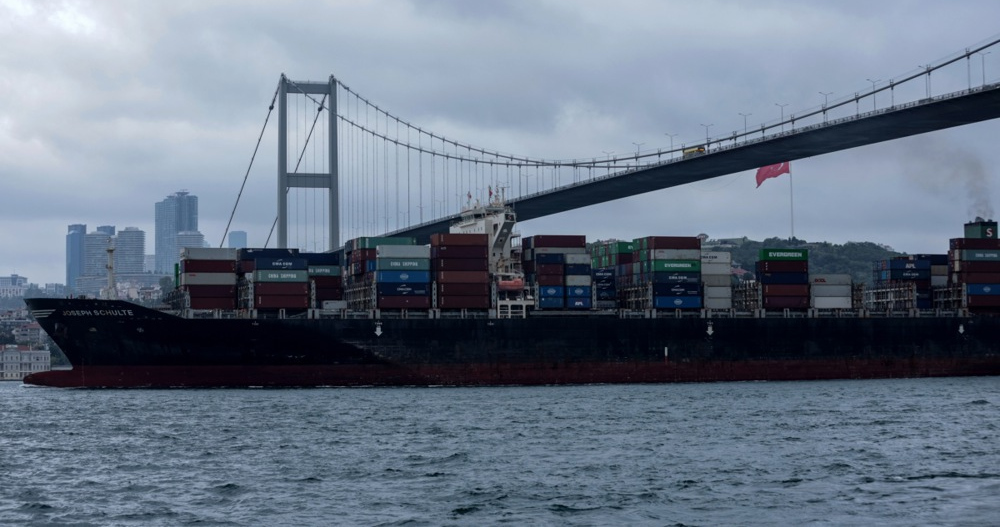
Caption: File photo. The Hong Kong-flagged Joseph Schulte, the first cargo ship to leave Ukraine’s Odesa port since the end of the grain deal despite Russian threats, sails under the 15 July Martyrs Bridge on the Bosphorus in Istanbul, Turkey, 18 August 2023. EPA/ERDEM SAHIN
Updated: August 22, 2025 - 12:19