 Edit
Bosnians commemorate 30th anniversary of Srebrenica genocide amid ongoing grief and denial
The dark episode remains a stark reminder of the consequences of ethnic hatred and the limitations of international peacekeeping
On Friday, 11 July, thousands gathered at the Srebrenica-Potočari Memorial Cemetery in Bosnia and Herzegovina to mark the 30th anniversary of the Srebrenica massacre, where Bosnian Serb forces systematically executed over 8,000 Muslim Bosniak men and boys during the 1992–1995 Bosnian War.
Recognised as Europe’s worst atrocity since World War II, the genocide continues to haunt Bosnia’s 3 million people, with approximately 1,000 victims’ remains still missing.
The sombre ceremony included the burial of the partial remains of seven newly identified victims, joining 6,750 others interred among rows of white gravestones.
Survivors, families, and dignitaries walked the cemetery, some praying, weeping, or sitting in silent reflection.
“I feel such sadness and pain for all these people and youth,” said Sabaheta from Gorazde, capturing the enduring trauma felt across Bosnia.
The massacre unfolded in July 1995 when Bosnian Serb forces, led by General Ratko Mladić, overran Srebrenica, a U.N.-designated “safe area” during the Bosnian War, which followed the disintegration of Yugoslavia. As Serb forces advanced, women and children sought refuge at a U.N. compound guarded by Dutch peacekeepers, while most men and boys fled through nearby woods.
Bosnian Serb death squads captured and killed the majority, executing some immediately and others in schools or warehouses over several days. Bodies were buried in mass graves, later exhumed and scattered in smaller pits to conceal the crime.
Background on the Srebrenica massacre and responsibility
The Srebrenica massacre was a culmination of ethnic cleansing campaigns by Bosnian Serb forces, driven by a nationalist agenda to create a homogenous Serb state amid the Yugoslav breakup. Ratko Mladić, the military commander of the Bosnian Serb Army, and Radovan Karadžić, the political leader of Republika Srpska, were the primary architects.
The International Criminal Tribunal for the Former Yugoslavia (ICTY) convicted both of genocide, war crimes, and crimes against humanity. Mladić, arrested in 2011 after years in hiding, was sentenced to life imprisonment in 2017, with the verdict upheld in 2021 by the U.N.’s International Residual Mechanism for Criminal Tribunals. Karadžić, apprehended in 2008, received a life sentence in 2019 following an appeal.
The role of Dutch U.N. peacekeepers, known as Dutchbat, remains a point of controversy. Stationed in Srebrenica to protect the “safe area,” the 400 lightly armed troops were outnumbered and underequipped against the advancing Bosnian Serb forces. Critics argue they failed to intervene effectively, allowing Serb forces to separate men and boys from women and children at the U.N. compound, facilitating the subsequent killings.
A 2002 Dutch government report acknowledged partial responsibility, leading to the resignation of the Dutch cabinet. In 2019, the Dutch Supreme Court ruled the Netherlands was partly liable for the deaths of approximately 350 men handed over to Serb forces, though compensation was limited. Survivors and families continue to criticize the peacekeepers’ inaction, viewing it as a failure of international protection.
International recognition and denial
The International Criminal Tribunal for the Former Yugoslavia and the International Court of Justice (ICJ) have both classified the Srebrenica massacre as genocide, defined under international law as acts committed with intent to destroy, in whole or in part, a national, ethnic, racial, or religious group.
The U.N. General Assembly reinforced this in 2024 by declaring 11 July an international day of remembrance for the Srebrenica genocide, prompting global commemorations in 2025. The international community, including the U.N., EU, and most Western nations, unequivocally recognizes the massacre as genocide, citing the systematic targeting of Bosniak men and boys.
However, Serb leaders in Bosnia’s Republika Srpska and Serbia frequently dispute the genocide label, the death toll of over 8,000, and the official narrative, perpetuating conflicting accounts of the Yugoslav wars. These denials fuel political divisions, hinder reconciliation, and obstruct Bosnia’s progress toward EU and NATO integration.
“This can never be forgotten. Who can say this wasn’t a genocide? Only a person without a soul,” said a woman called Sabaheta from the eastern town of Gorazde, as quoted by Reuters.
Commemoration and legacy
The anniversary included a three-day peace march with nearly 7,000 participants, retracing in reverse the 100 km route some Bosniak men took to escape the massacre. The march symbolises resilience and remembrance, honouring survivors and victims.
The ongoing identification of remains, facilitated by the International Commission on Missing Persons using DNA analysis, underscores the massacre’s scale, with new victims still being uncovered three decades later.
Edited by g.g.
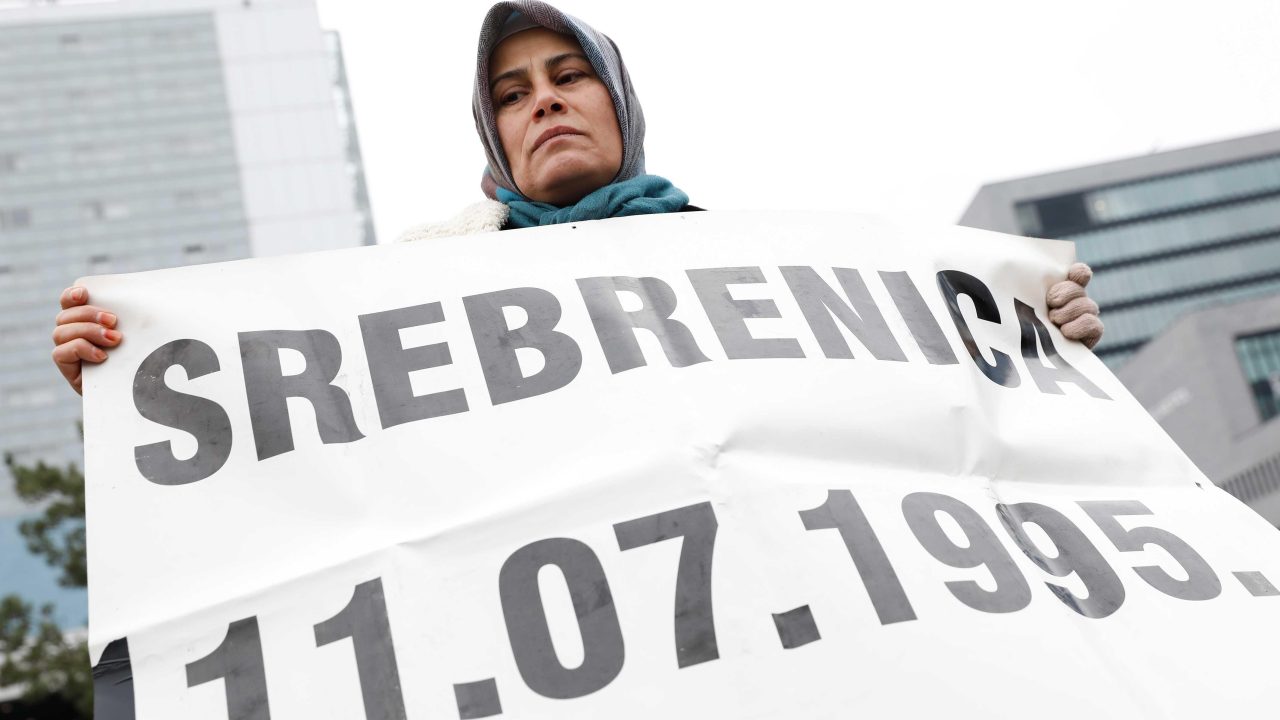
Caption. File photo. A woman protests outside the Yugoslav War Crimes Tribunal during the verdict reading against Bosnian Serb military chief Ratko Mladic in The Hague, The Netherlands, 22 November 2017. EPA/BAS CZERWINSKI
Updated: July 11, 2025 - 12:58