 Edit
NATO Summit in The Hague: a stage for Trump’s triumph as EU struggles to assert influence
The extravaganza appears designed to celebrate Trump’s supremacy, but it also exposes tensions and shortcomings
NATO leaders convened in The Hague on Wednesday (24 June) for a summit meticulously crafted to spotlight U.S. President Donald Trump’s dominance, with European allies endorsing a historic 5% GDP defence spending target to appease his demands and quell doubts about his commitment to the alliance.
Hosted by NATO Secretary General Mark Rutte, the summit underscores Trump’s outsized influence, as the EU’s fragmented response to global crises – exemplified by its tepid reaction to recent U.S. strikes on Iran – leaves it sidelined. While NATO aims to project unity against Russia’s threat, the summit’s focus on Trump’s agenda reveals a transatlantic dynamic where Europe bends to U.S. pressure, raising questions about the alliance’s balance of power.
The summit’s centrepiece is the adoption of a 5% GDP defence spending goal by 2035, a sharp increase from the current 2% guideline, allocating 3.5% to core military capabilities and 1.5% to broader security measures like cybersecurity and infrastructure.
The pledge, driven by Trump’s relentless calls for burden-sharing and Europe’s fears of Russian aggression post-2022 Ukraine invasion, represents a financial commitment of hundreds of billions annually. All 32 NATO members backed the statement, despite Spain’s initial resistance, which was overcome through a diplomatic compromise allowing Madrid flexibility in meeting the target.
NATO secures Spain’s agreement on 5% GDP defence spending goal, overcoming resistance
Secgen flattery
Trump made an unusual move on Tuesday by posting a private message in which Rutte lavished praise on him and congratulated him on “decisive action in Iran”.
“You will achieve something NO American president in decades could get done,” Rutte told Trump.
“Europe is going to pay in a BIG way as they should, and it will be your win.”
To satisfy Trump, Rutte has also kept the summit and its final statement short and focused on the spending pledge.
Trump’s ambiguous stance on NATO’s Article 5 mutual defence clause, which he described en route to The Hague as having “numerous definitions,” has heightened European anxieties.
Speaking to reporters aboard Air Force One, he said there were “numerous definitions” of the clause. “I’m committed to saving lives. I’m committed to life and safety. And I’m going to give you an exact definition when I get there,” he said.
This equivocation, coupled with his past threats to withhold protection from under-spending allies, casts a shadow over the summit, where European leaders hope the spending pledge will secure his loyalty.
EU’s diminished role
The EU leaders’ marginal presence at the summit highlights their struggle to assert geopolitical heft. The bloc’s delayed response to the U.S. strikes on Iran’s nuclear facilities on 21 June – over ten hours for statements from EU foreign policy chief Kaja Kallas and Council President António Costa – drew criticism for lacking substance.
EU’s delayed and vague response to U.S. strikes on Iran exposes diplomatic caution
French President Emmanuel Macron and German Chancellor Friedrich Merz have taken sharply contrasting positions on the Israel-Iran strikes, particularly regarding the U.S. and Israeli military actions against Iranian nuclear facilities in June 2025.
Macron has consistently urged restraint and opposed military actions aimed at regime change in Iran, warning that such moves could lead to regional chaos, citing historical examples like Iraq in 2003 and Libya. He labeled U.S. strikes on Iranian nuclear sites as “illegal” due to the lack of a legal framework under international law, despite acknowledging the legitimacy of neutralizing Iran’s nuclear threat.
Macron has emphasised diplomacy as the primary solution, advocating for a return to negotiations to address Iran’s nuclear and ballistic missile programs. He has tasked his foreign minister with leading a European initiative for a “demanding negotiated settlement” to end the conflict.
Merz has taken a more supportive stance toward Israel’s military campaign, describing it as doing the “dirty work” for Western allies by targeting Iran’s nuclear capabilities. He argued that ignoring Iran’s nuclear ambitions is not an option and saw no reason to criticize Israel or the U.S. for their actions.
Unlike Macron, Merz aligned with NATO chief Mark Rutte in viewing U.S. pre-emptive strikes as lawful, emphasizing the threat of a nuclear-armed Iran to Israel and the broader region.
Merz’s statements focus more on endorsing military action to curb Iran’s nuclear threat rather than prioritising diplomatic solutions, contrasting with Macron’s push for negotiations.
Trump’s over-optimistic claims and NATO dynamics
Trump’s summit narrative is buoyed by his recent claim of brokering a ceasefire between Israel and Iran, ending a 12-day conflict. However, his assertion of a “complete ceasefire” on June 23 was undermined by Iranian missile launches detected by Israel early Tuesday, highlighting his tendency for over-optimism.
Similarly, his claim that U.S. strikes “obliterated” Iran’s nuclear program was contradicted by a Defence Intelligence Agency assessment, reported by The Washington Post, indicating intact centrifuges and a minimal setback. This gap between rhetoric and reality risks eroding Trump’s credibility at the summit, where allies seek concrete assurances of U.S. commitment.
The summit’s design to celebrate Trump’s influence – evident in Rutte’s flattery and the spending pledge – reinforces his supremacy within NATO. Yet, it exposes tensions. European allies, wary of Trump’s conciliatory stance toward Moscow and reduced support for Ukraine, fear a U.S. pivot away from European security and keep their fingers crossed that Trump will not walk away from the summit as he did during the recent G7 meeting.
With Reuters, edited by g.g.
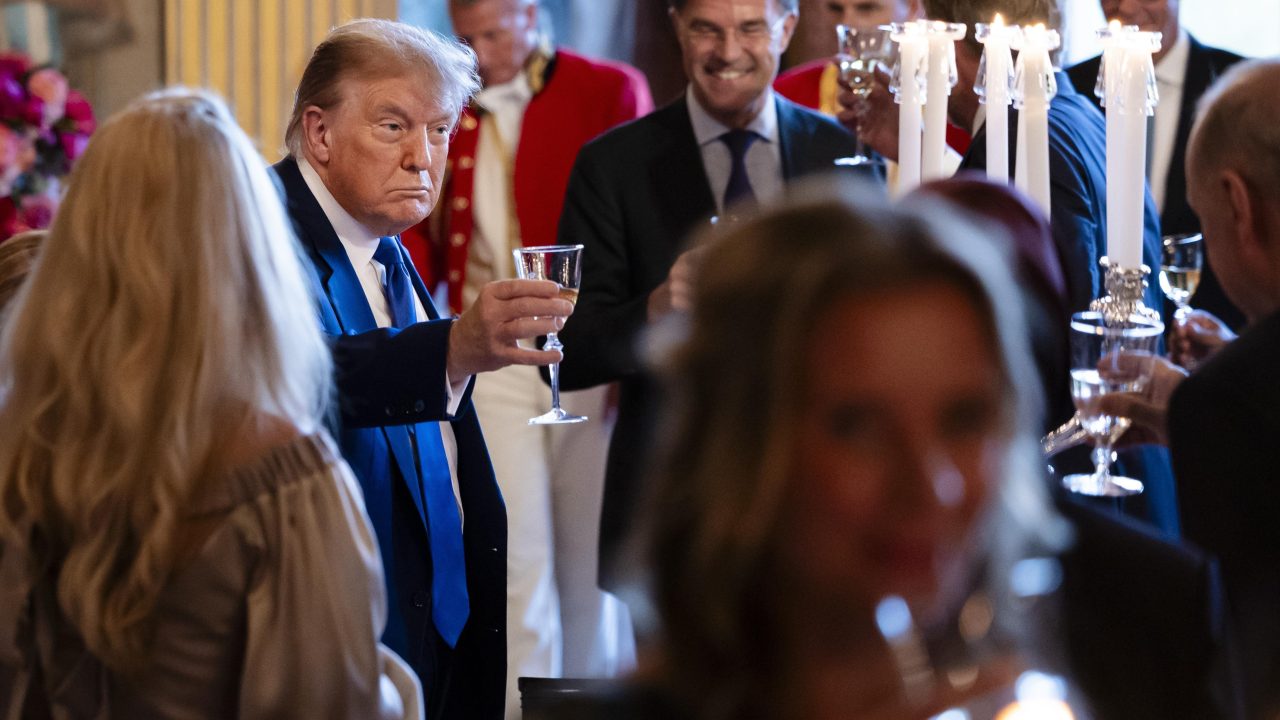
Caption: US President Donald Trump (L) at a dinner with heads of state and government at Paleis Huis Ten Bosch at the invitation of Dutch King Willem-Alexander, in The Hague, The Netherlands, 24 June 2025. The dinner marks the start of the NATO summit in The Hague. The Netherlands hosts the NATO Summit in The Hague on 24 and 25 June, the first such summit to be held in the country. EPA/REMKO DE WAAL / POOL
Updated: June 25, 2025 - 06:39