 Edit
Internal political struggles in Bosnia put at risk billion-euro EU funding
The culprit? A toxic brew of political chaos and the defiant stance of Bosnian Serb leader Milorad Dodik
Bosnia and Herzegovina stands at a critical crossroads, with over 1 billion euros in European Union (EU) funds on hold, risking the country’s economic and political future.
The core issue is a volatile mix of political chaos, nationalist rhetoric, and rogue leadership – particularly from Bosnian Serb leader Milorad Dodik, that has halted reforms essential for EU integration. Unlike its Western Balkan neighbors, Bosnia has yet to implement the comprehensive reforms required by the European Commission, leaving a significant €1.085 billion EU growth package out of reach.
Bosnia’s delicate peace, established in 1995, remains fragile. The country is divided between the Serb-dominated Republika Srpska and the Bosniak-Croat Federation, with a weak central government struggling to maintain cohesion.
At the heart of this storm is Milorad Dodik, president of the Republika Srpska entity, a man known for his venomous rhetoric and unapologetic provocations. Dodik’s attempts to amend Republika Srpska’s constitution threaten the Dayton framework, raising fears of renewed conflict. His vitriolic attacks, branding Bosniaks (the Muslim population of Bosnia) as “genetic liars,” echo the chilling words of war criminal Biljana Plavsic, who once called Bosnian Muslims “genetically defective” in 1993. Such rhetoric threatens to deepen ethnic divisions and fuel secessionist ambitions, risking the fragile multi-ethnic fabric of Bosnia.
Bosnia’s state police thwarted in attempt to arrest Serb leader Dodik
International efforts to stabilize Bosnia have been ongoing, but progress remains elusive. High Representative Christian Schmidt issued on 4 June a stark warning, urging political leaders to uphold the Dayton Agreement and accelerate reforms. Despite diplomatic pressure, efforts to form a functional state-level coalition have stalled amid political infighting, with Dodik’s Alliance of Independent Social Democrats pushing unconstitutional laws that undermine the Dayton peace agreement.
Schmidt publicly criticised Dodik: “He has crossed a red line and is no longer a constructive partner,” emphasising that sanctions are targeted at Dodik’s actions, not the Bosnian people. He called for urgent appointments of Constitutional Court judges and the adoption of a sustainable state budget to ensure upcoming elections meet international standards.
Dodik’s dangerous game
The crisis escalated when, on 12 March Bosnian prosecutors issued an arrest warrant for Dodik for ignoring a court summons. Dodik dismissed the warrant, asserting it was “null and void,” and has since evaded law enforcement, seeking refuge abroad. Convicted in absentia for defying international authorities overseeing Bosnia’s post-war governance,
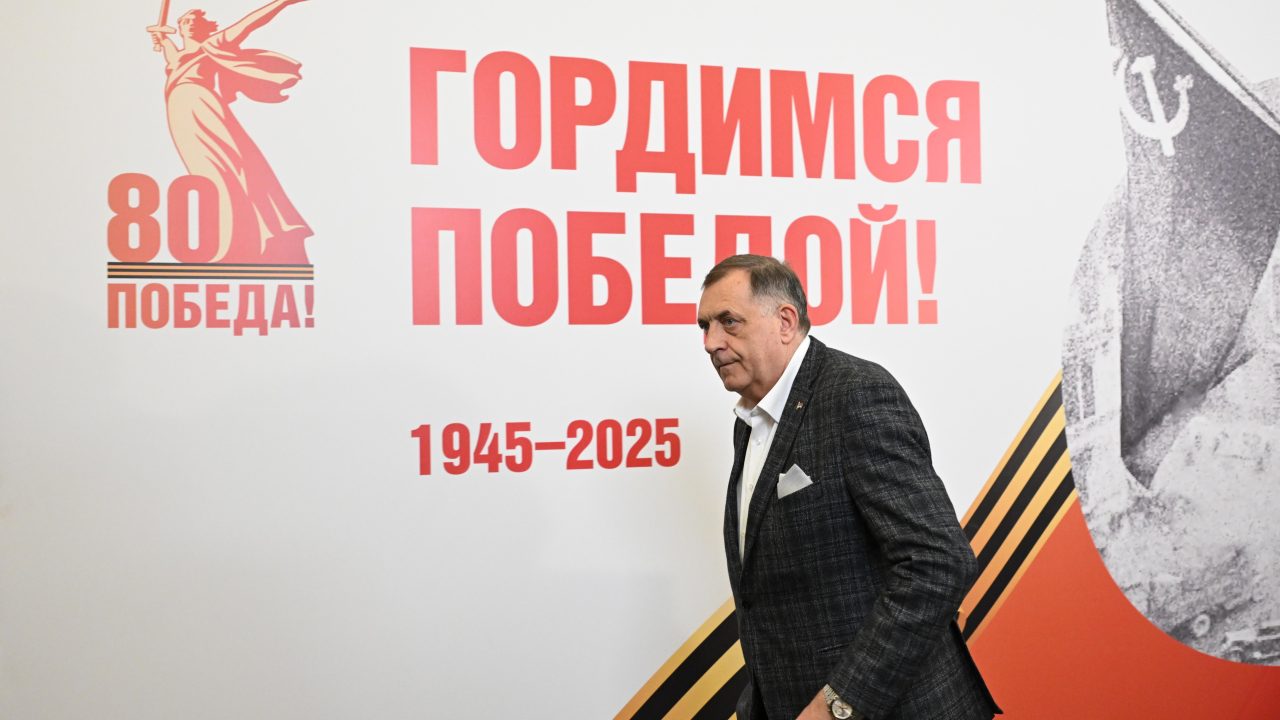
Dodik, who has run the entity since 2006, was convicted for having defied the envoy of the international community in Bosnia, a position created to ensure implementation of the Dayton agreement that ended the 1992-1995 war. Technically the supreme power in the country, the high representative has the power to impose or annul laws and sack officials. Sentenced to a year in prison and banned from office for six years, Dodik doubled down, passing laws to block state judiciary and police from Republika Srpska. Now, with an Interpol red notice looming, he’s fled to Moscow, cozying up to Russia and vowing to resist with Kremlin backing.
Dodik’s globe-trotting tells a tale of desperation. After slipping from Sarajevo to Belgrade, he popped up in Jerusalem for a photo-op with Israel’s Benjamin Netanyahu, claiming friendship and support. Days later, he resurfaced in Moscow on 4 June, evading arrest as Bosnian authorities. His strategy includes lobbying Russia to veto the extension of the EU peacekeeping mission at the United Nations in November.
The international community has responded decisively. EUFOR has deployed reserve forces to stabilize the country amid rising tensions, while key European nations – France, Germany, Italy, and the UK – condemned Dodik’s destabilizing tactics. The United States, through Secretary Marco Rubio, has criticized Dodik’s actions as a threat to regional stability.
Support for Dodik’s separatist stance comes from Russia, Serbia, and Hungary, which view his efforts as a means to reshape Bosnia’s political landscape. Serbian President Aleksandar Vučić has openly supported Dodik, criticizing Bosnia’s court rulings as “unlawful” and “anti-democratic,” further complicating regional diplomacy.
With EU funds contingent on reforms, Bosnia faces a stark choice: continue down a path of division and instability or seize the opportunity for unity and progress. The international community’s patience is waning, and time is running out. Will Bosnia’s leaders prioritize the country’s future, or will internal divisions and external influences push it further into crisis?
Bosnia’s political crisis underscores the perils of nationalist politics and the importance of steadfast international engagement. As Dodik and his allies push the boundaries of legality and sovereignty, the future of Bosnia – and its EU accession prospects – hangs in the balance. The coming months will be crucial in determining whether the country can overcome internal divisions and fulfill its European aspirations, or whether its trajectory will be marked by further discord and instability.
A handout photo made available by the photo host agency RIA Novosti shows the President of Republika Srpska Milorad Dodik arriving to attend the celebrations to mark the Victory Day in Moscow, Russia, 08 May 2025. Russia will mark the 80th anniversary of the victory in World War II over Nazi Germany and its allies on 9 May. [EPA/MAKSIM BOGODVID]
Updated: June 5, 2025 - 17:18