 Edit
Poland’s presidential cliffhanger: nation awaits, Brussels holds breath as campaigns close
This election is more than a personal duel, it encapsulates Poland’s struggle to define its identity and role in Europe
Poland’s tightly contested presidential election, set for Sunday (1 June), has descended into a highly personal and polarizing battle, with centrist frontrunner Rafal Trzaskowski of the ruling Civic Coalition squaring off against Karol Nawrocki, the candidate backed by the nationalist Law and Justice (PiS) party.
Beyond the personal attacks and media controversies, the outcome of this race carries profound implications for Poland’s relationship with the European Union, as well as its domestic trajectory on issues like judicial independence, democratic norms, and social rights.
Personal conduct under scrutiny
At a rally in the southern town of Chrzanow on Tuesday, Trzaskowski emphasized transparency, arguing that Poles know everything about his record as Warsaw’s mayor. “The President of the Republic of Poland cannot be someone about whom we learn something every day that not only puzzles us, but often terrifies us,” he declared, alluding to a cascade of media reports scrutinizing Nawrocki’s past. Allegations range from questionable property dealings – specifically, acquiring a flat from a pensioner under allegedly unfulfilled promises of care – to admissions of participating in organized brawls during his youth.
Nawrocki, a historian and amateur boxer, has defended his past, framing his involvement in mass fights between football hooligans as “fair competition, regardless of the form,” rooted in “the strength of my heart, the strength of my muscles, my fists.” He has denied wrongdoing in the property scandal, dismissing the accusations as “media lies” and pledging to donate the flat to charity. Yet, his behavior during a live debate – inserting a ‘snus’ tobacco pouch under his lip – drew further criticism, with a TVN-commissioned Opinia24 survey revealing 53% of respondents viewed the act negatively, perceiving it as unpresidential.
PiS has countered by accusing the government, aided by special services and liberal media, of orchestrating a smear campaign against Nawrocki. The government has firmly rejected these claims. Meanwhile, Trzaskowski has faced his own scrutiny, with questions raised about whether a series of attack ads against his opponent violated campaign spending rules. He, too, denies any impropriety.
EU stakes: a pivotal moment
Beyond the personal mudslinging, the election’s outcome will shape Poland’s alignment with the European Union, a critical issue given the country’s recent tensions with Brussels. A Trzaskowski victory would bolster the Civic Coalition’s efforts to advance reforms aligning Poland with EU standards, particularly on judicial independence, media freedom, and LGBT rights – areas where Poland has faced EU criticism and legal action, including the withholding of billions in recovery funds. His presidency could facilitate a thaw in relations, potentially unlocking EU support and reinforcing Poland’s integration into the bloc’s democratic framework.
Conversely, a Nawrocki win would likely perpetuate the PiS-aligned approach of the outgoing president, who frequently wielded veto power to block reforms perceived as infringing on national sovereignty. Nawrocki has signalled a conservative, nationalist stance, drawing inspiration from the policies of U.S. President Donald Trump. This could deepen Poland’s rift with the EU, risking further sanctions, strained trade relations, and a continued erosion of trust in institutions like the European Court of Justice, which PiS has often challenged. Such a path might embolden other populist governments in the region, complicating the EU’s cohesion at a time of geopolitical uncertainty, including Russia’s ongoing influence in Eastern Europe.
Polarisation and polling resilience
Despite the barrage of negative coverage, Nawrocki’s support remains robust. Polls, such as one by CBOS, indicate 99% of first-round Nawrocki voters intend to back him in the run-off, with Trzaskowski’s lead hovering within the margin of error. Andrzej Rychard, a sociologist at the Polish Academy of Science, attributes this resilience to Poland’s deep political polarization. “Many Law and Justice voters dismiss the allegations as untrue or decide that ‘even if it is true, it still does not bother me,’” he explains. Rychard notes that Nawrocki’s image as a self-made man from a humble background resonates with voters alienated by Poland’s urban elites, framing him as a relatable figure who gets things done.
Nawrocki’s campaign has leaned into this narrative, portraying Trzaskowski as an out-of-touch metropolitan liberal, mocking his fluency in five languages with the nickname ‘Bazur’ – a Polonized version of the French ‘bonjour.’ This tactic underscores a broader cultural divide: Nawrocki’s supporters see him as a patriot defending traditional Polish values, while Trzaskowski’s backers view him as a cosmopolitan bridge to Europe.
Voter perspectives and societal fault lines
The electorate’s split reflects these fault lines. “He has no idea about politics,” said Stanislaw, a 68-year-old market trader, echoing media allegations to explain his distrust of Nawrocki. In contrast, Jacek, a 73-year-old pensioner, praised Nawrocki as “a patriot, kind to people, an honest person, a strong person, which is exactly what we are missing.” Addressing the brawling controversy, Jacek shrugged, “Young people do those kinds of things,” highlighting a willingness among some to overlook past conduct in favour of perceived strength and authenticity.
A microcosm of broader tensions
This election is more than a personal duel; it encapsulates Poland’s struggle to define its identity and role in Europe. Trzaskowski represents a vision of Poland as a modern, EU-aligned democracy, committed to rule of law and progressive values. Nawrocki, backed by PiS, embodies a nationalist, conservative alternative, prioritising sovereignty and traditionalism over Brussels’ influence. The tight polls underscore a society split not just by politics, but by class, geography, and values – urban liberals versus rural conservatives, elites versus the working class.
The EU dimension amplifies the stakes. A Nawrocki presidency could escalate tensions, potentially isolating Poland further and weakening the EU’s ability to present a united front on issues like climate policy, migration, and security. Trzaskowski’s potential win, however, faces challenges: even with a cooperative president, implementing reforms against a PiS-influenced judiciary and parliament will be contentious, and EU patience may wane if progress stalls.
With Reuters, edited by g.g.
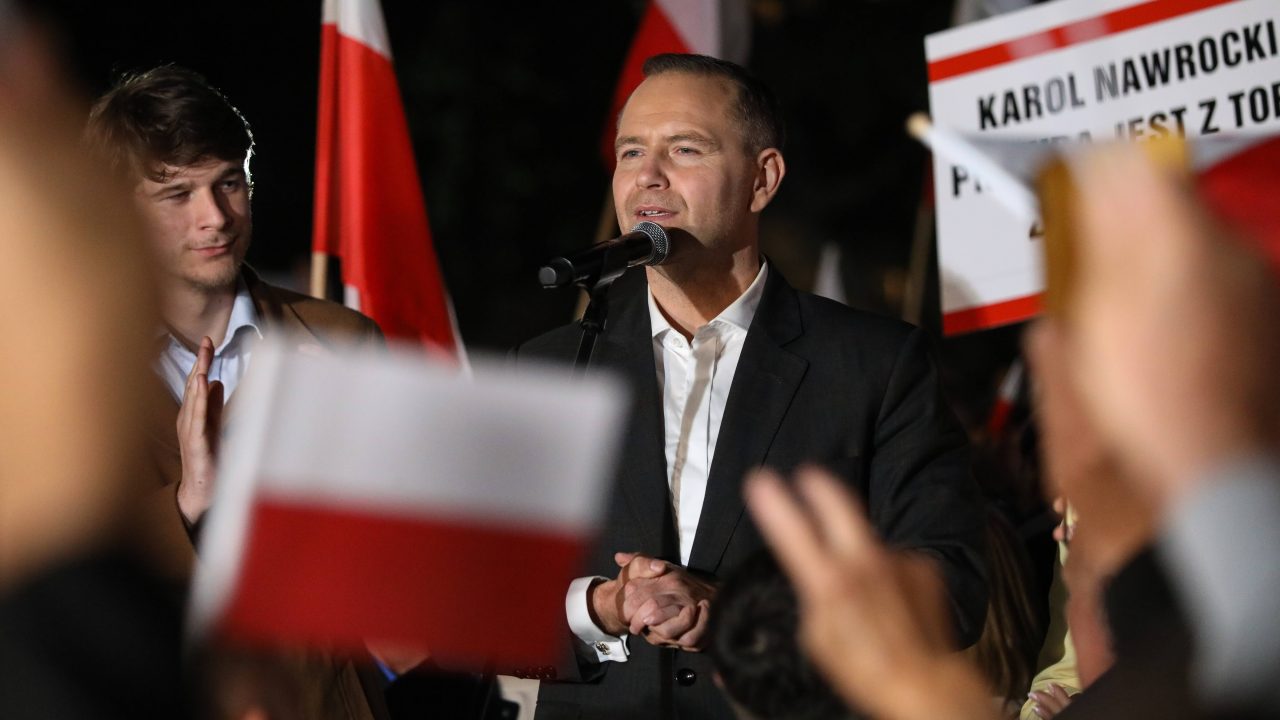
Caption: Head of the Institute of National Remembrance (IPN) and candidate in the 2025 presidential elections, Karol Nawrocki (C) and son Daniel Nawrocki (L) meet with local residents in Lapy, Poland, 30 May 2025. Karol Nawrocki will compete against Rafal Trzaskowski in the second round of Poland’s presidential elections runoff vote scheduled for 01 June, after neither candidate secured more than 50 percent of the vote in the first round on 18 May. [EPA-EFE/Artur Reszko]
Updated: May 31, 2025 - 06:34