 Edit
EU officials debunk myth of Russian economic strength amid sanctions
Military support for Ukraine could exhaust Russia’s battlefield reserves within 12–18 months
Russia’s economy is faltering, despite Kremlin propaganda claiming otherwise. Sustained Western sanctions and military support for Ukraine could exhaust Russia’s battlefield reserves within 12–18 months, according to a report by the Stockholm Institute for Transitional Economics (SITE).
Presented on 13 May at the EU Economic and Financial Affairs Council (Ecofin) in Brussels, the report was introduced by SITE Director Torbjörn Becker at the invitation of Swedish Minister of Economic Affairs and Finance Elisabeth Svantesson. Becker briefed journalists, including European Pravda, which also analysed the report to identify Russia’s economic vulnerabilities and recommended sanctions enhancements.
Debunking Russia’s economic myth
“First of all, the Russian economy is a small economy, and they have problems,” Elisabeth Svantesson told reporters at an Ecofin briefing. She stressed the need to counter Russian propaganda portraying a robust economy. “We have to understand that economics is part of the propaganda of war. It’s not something we economists are used to, but it certainly has a place in what’s happening now. So it’s important that we try to look at the state of affairs in perspective, and not just buy into Russian narratives. This is also part of the war we’re waging against Russia,” Becker confirmed.
Polish Finance Minister Andrzej Domanski, representing the EU presidency, emphasized in a letter to Ecofin the importance of analysing Russia’s economy to target its weaknesses with sanctions. “We seek to analyse the real state of the Russian economy, which is significantly different from the narrative promoted by Russian propaganda. We invited Mr. Torbjörn Becker… to present a detailed report on the economic reality of Russia,” he wrote. “This discussion will allow us to better shape punitive, financial and economic measures against Russia as we prepare to approve the 17th package of sanctions.”
Domanski told European Pravda, “The purpose of today’s discussion… was to get rid of the myth that everything is fine in the Russian economy. This is not true. We know that inflation is much higher than official data shows. We know that a growing share of the Russian budget is financed by taxes, not by revenues from the sale of oil or gas… If you know that the Russian economy is weakening, you know that sanctions are working, then this can encourage further action.” He added, “Our goal is clear – the aggressor must pay, and we are all… truly committed to doing more if needed.”
Russia’s economic dependence
Becker highlighted Russia’s reliance on energy prices. “Over the past 30 years, we can explain from 60% to 90% of the growth in Russian GDP by what is happening with international oil prices. Basically, if they are growing, then the Russian economy is growing. If oil prices are falling, the Russian economy is falling,” he told European Pravda. This dependence is “a truly fundamental mechanism for how the Russian economy works.”
He noted, “They tell us that we are weak and they are strong. I want to remind all of us here that… the Russian economy compared to the economies of the EU countries is only 12% of our economies. So even if they grow by 1–2% per year, it will take them 100 years before their economy becomes as big as ours.” Becker questioned Russia’s reported 9–10% inflation rate, given the Central Bank’s 21% discount rate. “Independent estimates indicate that inflation in Russia is approaching 20%, instead of the declared 9–10%,” the SITE report states, suggesting inflated GDP figures.
The report concludes, “Even under optimistic growth scenarios, Russia’s economic scale remains insufficient to match the capabilities of its Western adversaries in a protracted geopolitical rivalry. Thus, sufficient support for Ukraine… is not a question of resources, but a question of political leadership and will.”
Strengthening sanctions
European Commissioner for Economic Affairs Valdis Dombrovskis told European Pravda, “Russia’s main source of income is the export of fossil fuels.” The SITE report notes Russia’s shift to Asian markets, supported by sanctions circumvention and a shadow fleet. However, oil export revenues dropped in early 2025 due to tighter sanctions, though pipeline and liquefied gas exports to China and the EU (notably France and Belgium) have risen.
Dombrovskis advocated focusing sanctions on energy. “This is the area to focus on. We have long banned imports of Russian coal. Together with our G7 partners, we can set a price cap on Russian oil and work against Russia circumventing this cap with a shadow fleet. We have also… presented a strategy for Europe to gradually cut off Russian natural gas supplies, thus depriving Russia of this revenue,” he said. He noted that new consumers pay less than Europe did, underscoring the need for continued pressure.
Domanski agreed, stating, “The prospects of the Russian economy are very closely linked to the export of hydrocarbons. The most effective way to reduce the revenue stream for the Russian military machine is to restrict fossil fuel exports.” He added, “We are ready to work on continuing pressure on Russia… both from the point of view of introducing new sanctions and… combating the circumvention of existing sanctions.”
Russia’s war financing limits
The Russian economy may persist for years, but prolonged war and sanctions increase the risk of a devastating crisis. The war economy’s fiscal stimulus is unsustainable, relying on opaque financing and dwindling reserves. The SITE report warns, “Time will be on Russia’s side… unless the collective West… takes responsibility for… limiting the resources available to the Russian military machine. If sanctions are lifted prematurely, this will only give Russia time to replenish its reserves and create new weapons.”
The report concludes, “Russia continues to use all means to promote the narrative that it is strong… despite the fact that its economy is only a small fraction of the economies of Ukraine’s Western allies, and its reserves will run out within the next year or so.” Dombrovskis affirmed, “From the European Commission’s side, we are certainly ready to continue to put pressure on Russia, including by working on new sanctions.”
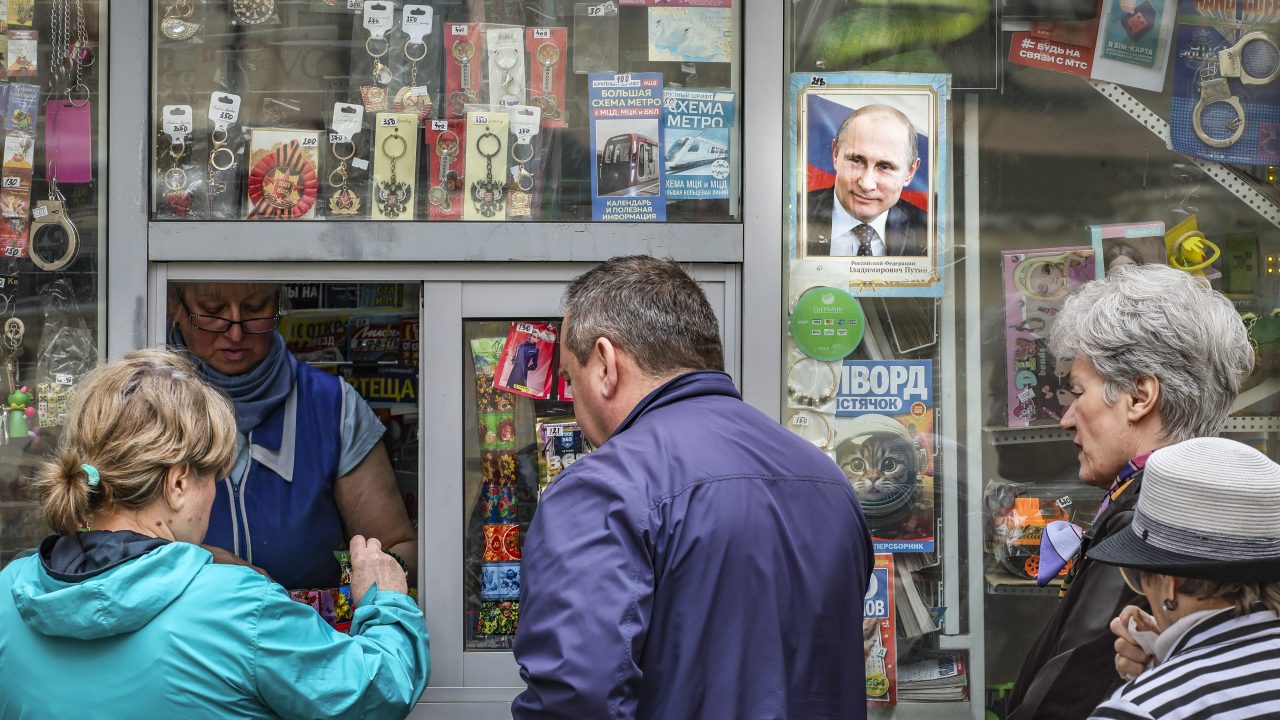
Caption: People queue at a street kiosk, with portrait of Russian President Vladimir Putin displayed for sale at the window in Moscow, Russia, 17 April 2025. [EPA-EFE/YURI KOCHETKOV]
Updated: May 15, 2025 - 06:15