 Edit
Western Balkan truckers threaten EU border blockades over Schengen stay cap
Drivers from four countries give Brussels until 14 September to ease 90-day limit or face coordinated closures
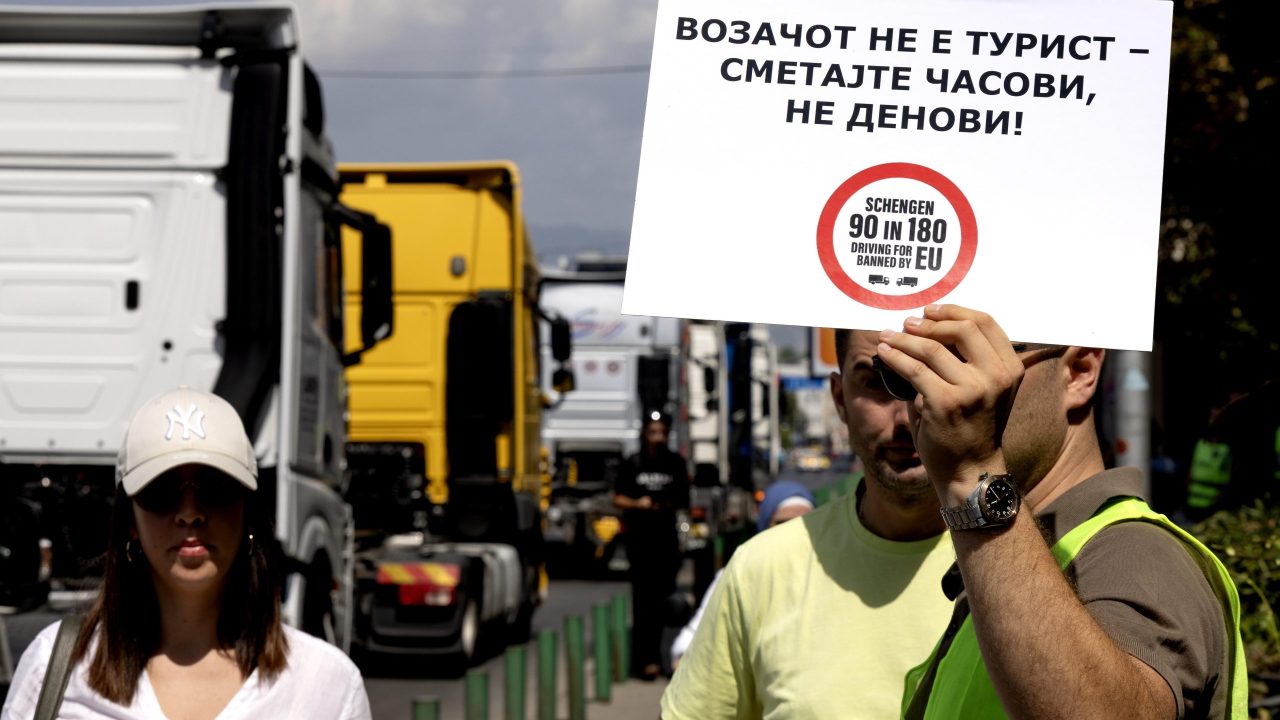
Hundreds of professional drivers gathered outside EU delegation offices in Belgrade, Sarajevo, Podgorica and Skopje on 31 August to protest the strict enforcement of Schengen’s 90-days-in-180 rule. They say the cap, now tracked digitally by the Entry/Exit System, leaves them unable to complete regular haulage runs into the EU without risking detention or deportation.
“We simply want to work and transport goods through the countries of the European Union,” Zijad Šarić of Bosnia’s Logistics Consortium told protesters. Associations are asking for an exemption for professional drivers or an increase to 125–130 days. If no progress is made they have pledged to block freight crossings from 14 September, repeating tactics used in January that caused an estimated €100 million a day in lost exports.
European Commission spokesman Markus Lammert said on 1 September that the 90-day rule itself will not change. He acknowledged that highly mobile workers such as truck drivers face difficulties and that the issue “has our full attention,” with possible bilateral arrangements under discussion. Drivers described the response as insufficient.
The Schengen short-stay regime (visa-free access or Type C visas) contains no dedicated professional category that exempts itinerant workers such as truck drivers from the 90-days-in-180 rule. Drivers from the Western Balkans therefore enter under the same tourist-style conditions as holidaymakers, even though their presence is required for paid cross-border haulage. That mismatch was a central complaint at the 31 August protests: “We come for work, not for holidays.” Associations argue that treating professional drivers as ordinary visitors forces them to burn through their allowed days on the job, after which they risk being turned back or deported, and they are calling for either a specific work-related exemption or a longer authorised period that reflects the nature of their occupation rather than leisure travel.
Caption: North Macedonia’s truck driver holds a placard ‘The driver is not a tourist – calculate the hours, not the days’ during the protest in front of the Delegation of the EU in Skopje, North Macedonia, 31 August 2026. Western Balkan truck drivers organize protests on August 31 ahead of potential border blockades on September 14, to oppose strict EU Schengen stay limits. EPA/GEORGI LICOVSKI
Updated: September 1, 2026 - 17:43