 Edit
Slovenia’s Janša blocks joint EU condemnation of West Bank E1 settlement plans
The new Slovenian prime minister clearly emerges as Netanyahu’s best ally in Brussels, replacing Viktor Orbán
Ljubljana has weakened the EU’s response to Israel’s controversial settlement expansion in the West Bank, raising questions over whether Slovenian Prime Minister Janez Janša is becoming the exponent of Benjamin Netanyahu inside the EU.
Israel’s decision to advance a settlement project in the strategic E1 area of the occupied West Bank, which critics say would cut the territory in two and further undermine the two-state solution, was due to be met with a statement “on behalf of the European Union and its 27 member states” on 23 August.
Seven Western leaders condemn Israel’s E1 settlement tenders
That statement was ultimately blocked after Slovenia withheld its support, according to Slovenian media. Instead, EU foreign policy chief Kaja Kallas issued a statement in her own name, a lower-level diplomatic response that does not require the unanimous backing of all 27 member states.
Kallas condemned Israel’s plans to advance construction in the West Bank E1 area, while also noting that “we (the EU) note the recent charges brought by the Israeli prosecutors against some perpetrators of such [West Bank] violence”.
The Slovenian Foreign Ministry confirmed that Ljubljana had withheld its support after consultations, arguing that another EU statement was unnecessary because the bloc had already made its position clear.
“Our position remains unchanged: Slovenia supports respect for international law and the agreed solution of two countries, which takes into account the legitimate interests of both parties,” the ministry said.
The government argued that the proposed EU27 statement “would not bring added value at the moment”, pointing to conclusions adopted by the European Council in June and a statement issued by a group of European leaders on 20 August.
The proposed statement concerned Israel’s decision to launch a tender for 1200 homes for Israeli settlers in the occupied West Bank as part of the controversial E1 project. Under EU diplomatic practice, a joint statement requires the agreement of all 27 member states.
When unanimity cannot be reached, the EU’s External Action Service can instead issue a statement by the high representative, without claiming to speak on behalf of the member states collectively.
Similar situations have occurred during previous disputes over Israel and the Palestinian Islamist movement Hamas, with Hungary under Prime Minister Viktor Orbán having previously opposed some EU statements critical of Israel.
Janša and Israel
The Slovenian government’s decision comes against the backdrop of Prime Minister Janez Janša’s contacts with prominent Israeli settler figures. Slovenian broadcaster TV Slovenija highlighted a meeting between Janša and Yossi Dagan, an Israeli settler leader who publicly opposes the two-state solution and supports Israeli claims over the West Bank.
According to reports cited by the broadcaster, Janša and Dagan met in Ljubljana and discussed the situation in the West Bank. Kallas’ statement condemned Israel’s tender for 1,200 housing units in the occupied West Bank, warning that the E1 project “severely harms the possibilities for the rescue of two countries”.
The project envisages around 3,400 residential units across roughly 12 square kilometres. According to Kallas, its implementation would divide the West Bank into two parts and further undermine the prospects for a two-state solution.
Israel’s settlement plans were also condemned last week in a joint statement signed by leaders from several European and other countries, including Germany, Austria, the United Kingdom, Canada and Australia. European Commission President Ursula von der Leyen joined that statement.
Slovenia lifts entry ban on Netanyahu as Janša government reverses Israel policy
Opposition accuses Janša of helping Netanyahu
Slovenia’s opposition has sharply criticised the government’s decision, describing it as a break with the country’s previous foreign policy.
“The veto of Slovenia on the joint statement of the European Union on illegal Israeli settlements in the West Bank is a shameful foreign policy decision of the government of Janez Janša,” the opposition Freedom Movement (Svoboda) said.
The party said the decision “destroys the international reputation of our country” and questioned “what will Janez Janša be forced and willing to do for his friend Benjamin Netanyahu” and “how much this settlement of bills will cost Slovenia”.
Svoboda also accused Janša of “returning the services to the government of Netanyahu and settling the bills for assistance in the election campaign”.
The party pointed to a series of measures and announcements, including the opening of the Israeli embassy in Ljubljana, discussion of moving Slovenia’s embassy to Jerusalem, planned arms deals and the withdrawal of proposed sanctions against senior Israeli officials. “All these were obviously only small advance payments,” Svoboda said, adding that “the main account is yet to come”.
“Our country therefore has a prime minister who will not defend the interests of Slovenia in Brussels, but will defend the interests of Israel,” the party said, describing the veto as evidence that Janša was bringing “Israeli interests and Israeli influence to power” in Slovenia.
The Left party also condemned the decision as “extremely dangerous, morally discarded and historically shameful”. Nataša Sukič, an MP from the Left, accused the Slovenian right of applying double standards.
“When it comes to Russian aggression, we insist quite correctly that the occupation of foreign territory cannot and should not become legitimate. However, when it comes to the decades-long brutal colonization of Palestine and the genocide of the Palestinian people, the principles miraculously dissipate,” she said.
Sukič also called for answers over whether Slovenian foreign policy decisions were influenced by alleged past dealings involving structures around the Black Cube affair. “The public has the right to know whether Janša with the diplomatic weight of Slovenia is paying bills for allegedly his personal intelligence godparents,” she said.
The Social Democrats (SD) said the government’s decision represented a complete reversal of the previous government’s policy and “cannot be eliminated by silence or general explanations”. They accused Janša’s government of helping Netanyahu’s policy of expanding Israeli settlements in the occupied West Bank, which they said was pushing Palestinians out, increasing segregation and making a two-state solution increasingly difficult.
The SD also stressed that Israeli settlements are illegal under international law and called on the government to explain why Slovenia had blocked the EU position and who was responsible for the decision.
Slovenia’s role inside the EU questioned
Slovenian MEP Matjaž Nemec (S&D/SD) said Janša was not only breaking EU unity but also weakening Slovenia’s diplomatic standing. He warned that Slovenia was “apparently taking on the role of ‘inner player’ for Israeli interests within the EU institutions instead of promoting common European values and international law”.
MEP Vladimir Prebilič (Greens/Prerod) described the decision as reckless because of its potential long-term consequences for Slovenia’s role internationally. He said “the government does not speak here on behalf of Slovenia” and vowed that “we will not allow it to undermine the fundamental moral values on which we have built our country, as well as the European Union” on the international stage.
MEP Irena Joveva (Renew/Freedom) also criticised the decision, arguing that Janša’s support for Netanyahu was already well known but that blocking a common EU statement represented a new step.
“The fact that Janez Janša wholeheartedly supports Benjamin Netanyahu is nothing new,” she wrote. “But this time it wasn’t just Jansa’s support for Netanyahu’s policy. It was an active prevention for the European Union to clearly condemn it – for a change of unity.”
Joveva said Orbán had until recently been regarded as Netanyahu’s main ally inside the EU, but that Janša had now “apparently taken on this title without hesitation”. She accused the prime minister of turning Slovenian foreign policy “upside down” within weeks.
Slovenian president urges consistency
Slovenian President Nataša Pirc Musar also called on the government to support the EU joint statement on the further expansion of Israeli settlements in the occupied West Bank. “The same principles apply in the assessment of violations of international law, regardless of which country is violating them,” she said.
Pirc Musar said the expansion of Israeli settlements in the occupied West Bank violates international law, undermines the two-state solution and reduces the prospects for lasting peace.
“International law is not a matter of political choice, and there should be no double standards in its respect. The same goes for everyone,” she added.
“Slovenia from its own historical experience has a good understanding of the importance of sovereignty and territorial integrity, so it must be particularly consistent in their advocacy.”
Settlement expansion under Netanyahu
Israel has established around 160 settlements in the West Bank and East Jerusalem since occupying the territories during the 1967 Middle East war. Around 3.3 million Palestinians live alongside them, according to the source text.
Successive Israeli governments have allowed the settlements to grow despite sustained international opposition. Their expansion has accelerated since Netanyahu returned to power at the end of 2022 at the head of a right-wing coalition backed by settler interests, and since the start of the Gaza war following Hamas’ 7 October 2023 attack on Israel.
Israeli settlements in the occupied territories are considered illegal under international law and have been described by international bodies as constituting a war crime.
Black Cube, an Israeli private intelligence company, has repotertedy helped Janša win the elections against opponent Robert Golob, an outstanding critic of Netanyahu.
Sources: TV Slovenija, EUObserver
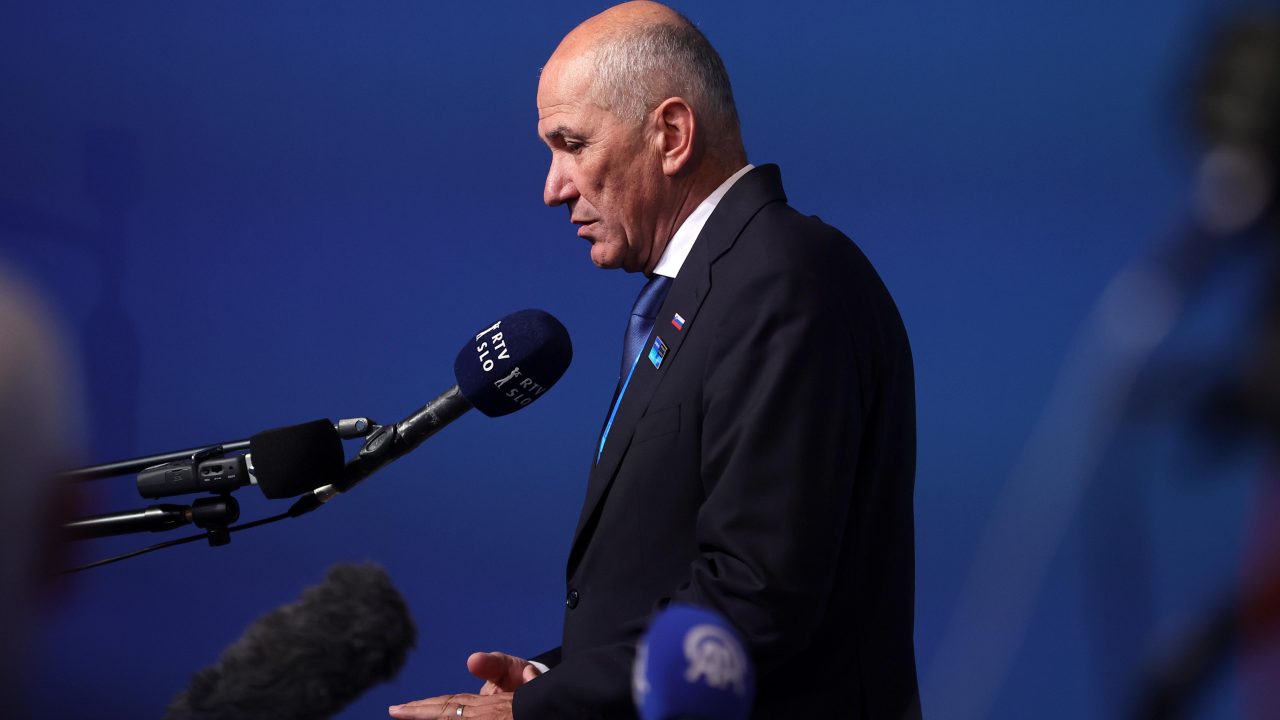
Caption: Slovenian Prime Minister Janez Jansa speaks to the media at the 2026 NATO summit in Ankara, Turkey, 8 July 2026. EPA/NECATI SAVAS
Updated: August 27, 2026 - 11:53