 Edit
Russian bases in Syria downgraded, Damascus claims control of Tartous and Hmeimim
The military facilities would be repurposed as joint training and qualification centres under new arrangements
Syria and Russia reached a memorandum of understanding to settle the future of Russian bases at Tartous and Hmeimim following 18 months of intensive negotiations, the Syrian foreign ministry said on Sunday, according to the Syrian state news agency SANA.
The ministry said the Syrian state would take over management of civilian facilities, including Hmeimim airport and the commercial berth at Tartous port, allowing them to be gradually integrated into the country’s civilian administration. Military facilities would be repurposed as joint training and qualification centres under new arrangements preserving the interests of both sides, with the transition to be completed within three months.
In a separate statement, Syria’s General Authority for Ports and Customs said Syria would take over the commercial sites previously operated by Russia at Tartous port, including Pier No. 4 and its associated warehouses and facilities. Reuters had reported earlier that Russia was seeking to establish a commercial logistics hub at Tartous using that pier, a restricted zone outside the naval base, while keeping operations under Syrian oversight.
Russia’s naval facility at Tartous and Hmeimim air base have long been Moscow’s principal military footholds in the Mediterranean and Middle East. Their future has been the subject of negotiations with Syria’s new leadership since former President Bashar al-Assad was ousted in December 2024.
Deep roots in Soviet-era ties
Russian (and previously Soviet) military presence in Syria dates back decades. The Tartous naval facility originated from a 1971 agreement between the Soviet Union and Syria under Hafez al-Assad. It served as a logistics and repair point for the Soviet Navy’s 5th Operational Squadron in the Mediterranean, providing a counterweight to the U.S. Sixth Fleet. After the Soviet collapse, the site remained a low-level Russian support point.
Russia dramatically expanded its footprint after intervening in the Syrian civil war in September 2015 to prop up Bashar al-Assad against opposition forces. It established the Hmeimim (also spelled Khmeimim) air base adjacent to Latakia’s Bassel al-Assad International Airport that same year under a bilateral treaty granting free, indefinite use. In 2017, Moscow secured a 49-year lease for expanded use of Tartous with sovereign jurisdiction elements, and both sites were designated for permanent Russian groupings.
From these coastal bases, Russian aircraft conducted extensive operations supporting Assad’s forces. The facilities also facilitated logistics for Russian activities further afield in the Middle East and Africa. At their peak, they represented Moscow’s only significant military outposts outside the former Soviet space.
Assad’s fall and a diminished Russian position
The rapid rebel offensive that toppled Assad in December 2024 – led by forces under Ahmad al-Sharaa (formerly known as Abu Mohammed al-Jolani of Hayat Tahrir al-Sham) – caught Moscow off guard. Assad and his family received asylum in Russia. The new Syrian leadership moved quickly to distance itself from Assad’s other key backers, particularly Iran and Hezbollah, while opening channels to Turkey, Arab Gulf states, and Western countries.
Russia’s ability to respond forcefully was constrained by its ongoing war in Ukraine, which began with the full-scale invasion in 2022. The conflict has absorbed vast military, economic, and logistical resources, leading to a reduced Russian presence in Syria even before Assad’s fall. Aircraft and personnel had already been partially redeployed, and Moscow’s support for Assad during the final rebel offensive was limited compared to earlier years of intensive airstrikes.
Analysts have noted that the Ukraine war forced Russia into a reactive posture across the Middle East. The loss of Assad dealt a strategic and reputational blow: it undermined Moscow’s image as a reliable partner capable of protecting client regimes and complicated its broader power-projection ambitions via the Mediterranean. Russian forces scaled back significantly after December 2024, with troop numbers estimated in the low hundreds to around 1,000 – far below earlier peaks.
Despite the setback, Moscow moved pragmatically to engage the new authorities. Syrian President Ahmad al-Sharaa visited Moscow (including meetings with Vladimir Putin in late 2025 and early 2026), and both sides pursued talks to redefine the relationship on more transactional terms rather than the previous patron-client dynamic. Russia sought to retain access to the bases for Mediterranean operations and potential logistics support elsewhere, while Syria prioritized sovereignty over key civilian infrastructure and reduced foreign military dominance.
A new, more limited arrangement
The August 2026 memorandum formalizes a reorganization after those extended negotiations. By converting the military sites into joint training and qualification centres and transferring civilian assets (airport and commercial port facilities) to full Syrian control, Damascus asserts greater authority while allowing a residual Russian role. The three-month transition period underscores the structured nature of the handover.
The deal reflects Russia’s narrowed ambitions in the region. Constrained by the demands of the Ukraine conflict, sanctions, and resource limitations, Moscow has shifted from expansive military intervention toward preserving a modest foothold. For Syria’s new leadership, the arrangement balances continuity in technical and training cooperation with the assertion of national control—part of a broader effort to diversify international partnerships and avoid over-reliance on any single external power.
Russia has not issued an immediate detailed public comment on the memorandum. The bases’ transformation marks a significant recalibration of one of Moscow’s most enduring overseas military positions, shaped by both the upheaval in Syria and the enduring pressures of the war in Ukraine.
Edited by g.g.
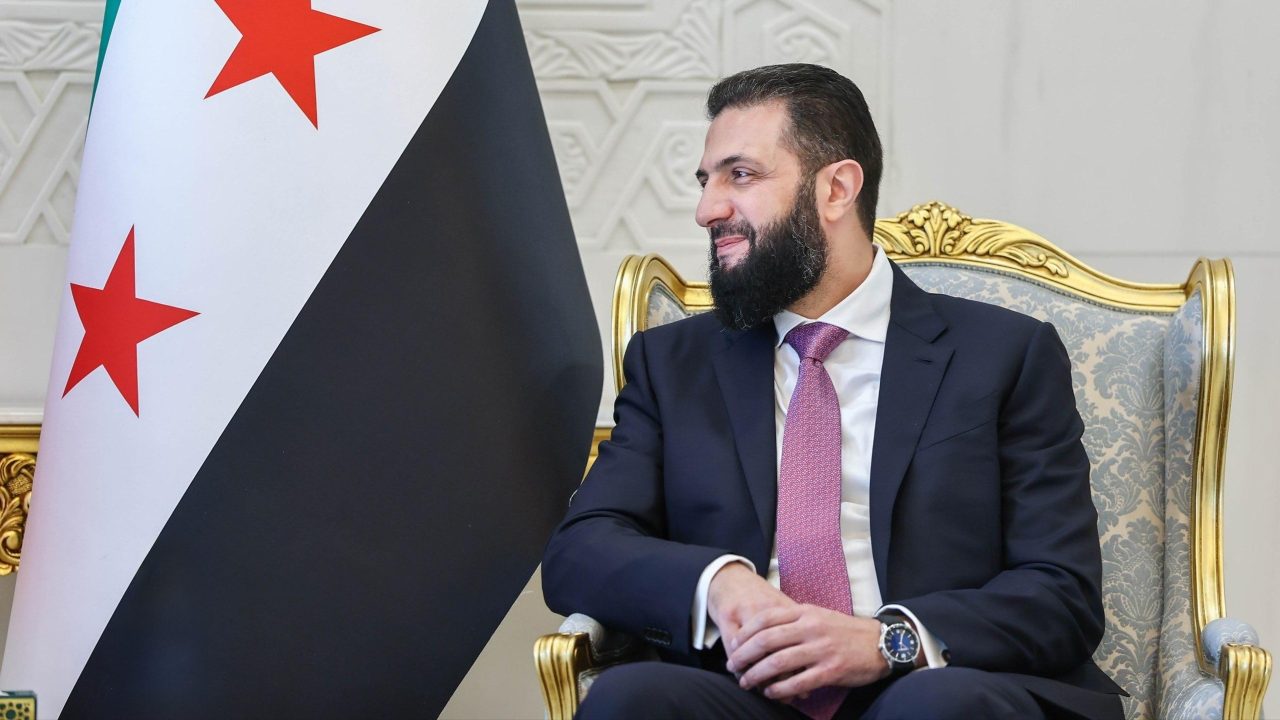
Caption: A handout photo made available by the Syrian Presidency shows Syrian President Ahmad al-Sharaa meeting with French President Emmanuel Macron (not pictured) at the People’s Palace in Damascus, Syria, 7 July 2026. EPA/SYRIAN PRESIDENCY / HANDOUT
Updated: August 10, 2026 - 06:26