 Edit
A view from Belgrade: Ethnic cleansing is not a political position
A single sentence on television has damaged Serbia’s diplomatic efforts and the very people the state is obliged to protect
Snežana Paunović did more than insult Albanians. She humiliated Serbia, damaged its interests, and showed how quickly political nostalgia for the 1990s can return to the highest levels of the state, writes Orhan Dragaš.
Dr. Orhan Dragaš is the founder and director of the International Security Institute based in Belgrade.
I listened several times to the words of Snežana Paunović, Serbia’s Minister of Public Administration and Local Self-Government, and each time I was equally appalled. A member of the Serbian government publicly declared that, had she been in Slobodan Milošević’s position, she would have “ethnically cleansed Kosovo in 1998”. She then tried to explain that she had not meant killing Albanians, but that anyone who did not sufficiently regard themselves as a citizen of the Federal Republic of Yugoslavia should have been forced to leave Kosovo and go to their “mother country”. When the condemnation followed, the minister did not retract her words. She said that she stood by her views, that she had belonged to the same political party for 34 years and that she did not care what her critics thought. Her subsequent appearance did not soften the original statement. It made it even more disturbing, because it showed that this was not a clumsy remark made in the heat of the moment, but a considered political conviction.
Ethnic cleansing is not a metaphor, a turn of phrase, television hyperbole, or a loose description of a political idea. In United Nations documents, the term refers to the creation of an ethnically homogeneous area through force or intimidation in order to remove members of a particular group. Killing is not the only instrument of such a policy. Threats, deportations, forced displacement, the seizure of homes, the destruction of property and the creation of fear that drives people to flee are its very essence. When the minister says that she would not have killed the Albanians but would instead have sent them to Albania, she is not rejecting the idea of ethnic cleansing. She is describing it precisely.
It is particularly alarming that such words come from the minister responsible for public administration and local government. It is through public administration and local institutions that the state encounters its citizens every day. This is where documents are issued, children registered, rights exercised, property protected, and people discover whether they are truly equal before the law. Serbia’s Constitution guarantees equality and prohibits discrimination on the grounds of nationality. Yet the minister in charge of part of the system responsible for upholding that equality has publicly declared that she would measure a person’s right to belong to the state according to a test of ethnic loyalty and would remove from their homes those who failed it.
According to the 2022 census, which did not cover the territory of Kosovo, 61,687 citizens of Serbia identified themselves as Albanian. Most live in Preševo, Bujanovac and the surrounding municipalities in the south of the country. They are not guests whose length of stay is determined by the state. They are citizens of Serbia, people whose rights do not depend on how loudly they proclaim their loyalty to the country, whether they support its government or how they understand their own national identity. After Snežana Paunović’s words, every Albanian in Serbia has the right to ask whether a member of the government regards them as an equal citizen or as someone who might one day be shown the road to the border.
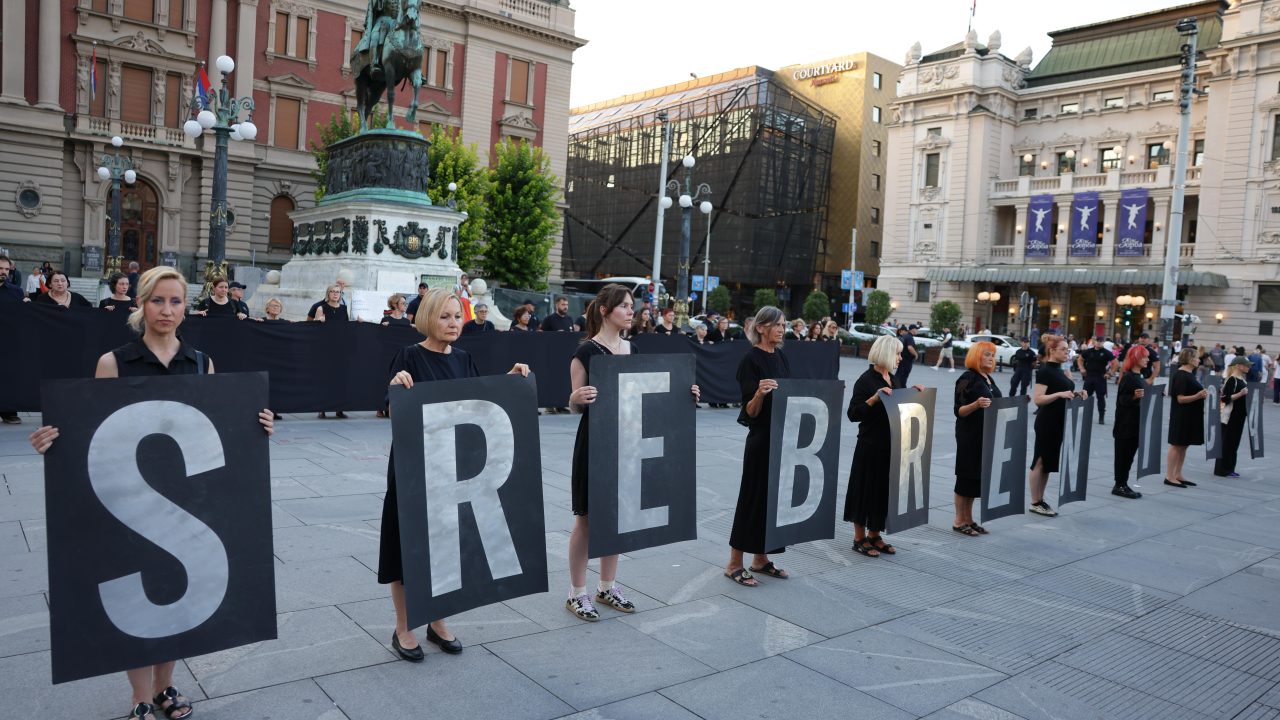
The 1990s began with precisely this kind of political sorting of human beings. Before the columns of refugees appeared, there was talk of unreliable peoples, historic territories, ethnically desirable areas and citizens who ought to move to the places someone else had declared to be “theirs”. The words then acquired uniforms, checkpoints, camps, buses and trucks. They left behind a devastated Vukovar, a besieged Sarajevo, a divided Mostar, mass graves, Srebrenica, burned villages and millions of people who woke one morning without a home, a city or the life they had once known. Many did not live to see the next morning.
More than 140,000 people were killed in the wars across the former Yugoslavia, and almost four million were expelled or displaced. In Bosnia and Herzegovina alone, around 100,000 people were killed and approximately 2.2 million were forced from their homes. Entire families disappeared within days. Generations grew up as refugees. States were impoverished, cities destroyed, and societies poisoned for decades, while the hatred manufactured by politicians continued to live long after the last shots were fired.
Members of different armies and armed groups committed crimes, and the victims included Serbs, Bosniaks, Croats, Albanians, Roma and members of other communities. Every crime demands condemnation, and every victim demands dignity. At the same time, the policies pursued under Milošević’s rule dragged Serbia into wars, sanctions, international isolation, economic devastation and, finally, bombing. Milošević was indicted before the Hague Tribunal for deportations, killings, persecution and other crimes connected with Kosovo, Croatia and Bosnia and Herzegovina. The proceedings ended without a verdict because of his death in 2006. Serbia continued to pay the political and human price of his rule long after he was gone.
The most dangerous part of Snežana Paunović’s statement was contained in a single word, “would”. With that word, she stopped talking about the past and revealed what she herself would do if she had the power. She presented the catastrophe of the 1990s as unfinished business and a missed opportunity. In her explanation, the problem with Milošević’s policy was not the persecution of a population, but that the persecution had not been carried out thoroughly enough. Such a position, expressed in 2026 by a member of the Serbian government, is an insult to every citizen who has spent the past quarter century trying to pull this country out of the ruins left by a policy to which the minister now publicly declares her loyalty.
Grave crimes were committed against Albanian civilians in Kosovo in 1998 and 1999, and more than 900,000 Albanians were forced to leave their homes. After Serbian forces withdrew and international missions arrived, killings, attacks and the expulsion of Serbs, Roma, Ashkali, Gorani and other non-Albanians began. Around 200,000 members of those communities left Kosovo. Thousands of families of every nationality still live with the consequences of disappearances, killings, stolen property and the impossibility of returning home. Acknowledging crimes against Albanians does not diminish the suffering of Serbs. Condemning the persecution of Serbs gives no one the right to advocate the persecution of Albanians. Only a serious state can tell the truth about every victim while rejecting collective revenge as a political program.
That is why Ivica Dačić’s reaction shocked me even more. As president of the Socialist Party of Serbia (SPS), he could have shown that his party understood at least some of the consequences of the policies of the 1990s. As Deputy Prime Minister, he had a duty to protect the standing of the institution to which he belongs. As Minister of the Interior, he had a duty to defend the constitutional order and the security of every citizen of Serbia. Instead, he described the criticism of Snežana Paunović as “shameful and hypocritical” and tried to justify her words by invoking the suffering of Serbs in Kosovo. In doing so, he elevated the scandalous conduct of one minister into a position publicly defended by the Deputy Prime Minister.
Dačić knows very well that political speech can have real and legal consequences. In 2018, the Appeals Chamber of the UN Mechanism in The Hague delivered a final judgement in the case of Vojislav Šešelj for his speech in Hrtkovci on 6 May 1992, in which he incited the expulsion of the Croatian population. He was found responsible for instigating deportation, persecution through forcible displacement and other inhumane acts in the form of forced transfer, all as crimes against humanity. He was sentenced to ten years in prison. That case shows that the words of politicians, when delivered with authority and directed against a particular community, can become the immediate prelude to persecution and to the loss of safety, property and home.
Dačić’s invocation of Serbian suffering is also an affront to Serbian victims, because it turns their pain into a justification for the expulsion of others. Serbs who were forced to leave Peć, Prizren, Đakovica or Priština receive no justice from a minister who imagines a Kosovo without Albanians. Their property will not be returned, the missing will not be found, monasteries will not become safer, and return will not become easier because a member of the government speaks the language of collective retribution. Such words help precisely those circles in Priština that seek to portray Belgrade as a permanent threat to Albanians and to dismiss every Serbian demand for the protection of the Serb community as a disguised territorial or ethnic claim.
Serbia is already engaged in a difficult struggle to ensure the safety of Serbs in Kosovo, protect their rights, preserve local communities, enable the return of the displaced, and safeguard religious and cultural heritage. Snežana Paunović’s statement makes that struggle harder. Every opponent of Serbia will now be able to point to the fact that a minister in Belgrade openly imagines a Kosovo cleansed of Albanians, while the leader of her party defends her. A single sentence on television has damaged the state’s diplomatic efforts and the very people the state is obliged to protect.
The European Union has already stated that there is no place in Europe for language that justifies or advocates ethnic cleansing, and that such statements contradict Serbia’s obligations in the process of normalizing relations with Priština. That reaction is not the result of hostility toward Serbia. Serbia harms itself when a member of its government advocates the expulsion of a population and the Deputy Prime Minister attacks her critics instead of sanctioning her. The European path is not merely a matter of technical chapters, legislation, funds and meetings in Brussels. It requires the most basic assurance that those in power will not divide citizens into those who belong to the state and those who should be sent across its borders.
The Prime Minister’s silence after such an appearance cannot continue without consequences. Đuro Macut must state whether a member of his cabinet was speaking on behalf of the Serbian government. If she was not, he must take concrete action. A ministerial office is not a private platform, and a government is not a collection of individuals free to announce personal plans to alter the ethnic composition of a territory before television cameras and then invoke their party credentials when the public demands accountability. Every day without a clear response turns Snežana Paunović’s statement from a personal scandal into a burden carried by the entire government.
Serbia must decide what kind of country it wants to be. A state that belongs to all its citizens does not examine blood, ancestry, or political sentiment before recognizing a person’s right to a home. A state that respects its own victims does not seek comfort in fantasies of persecuting others. A state that wants a European future cannot keep in government a person who publicly regrets that Slobodan Milošević did not expel even more people.
Snežana Paunović did more than insult Albanians. She humiliated Serbia, damaged its interests, and showed how quickly political nostalgia for the 1990s can return to the highest levels of the state. Ivica Dačić compounded the problem by defending her. The government now has only one responsible course of action. It must unequivocally reject her words and show that there is no place in its ranks for advocates of ethnic cleansing. Anything less would mean that Serbia, even after more than 140,000 deaths and almost four million people driven from their homes, has still failed to grasp the cost of a policy that decided who was allowed to remain in their own house.
Kosovo declares Serbian minister persona non grata over ethnic cleansing remarks
Caption: Activists hold a black banner marking the 31st anniversary of the Srebrenica genocide in Belgrade, Serbia, 10 July 2026. More than 8,000 Muslim men and boys were executed in the 1995 killing spree in Srebrenica, Bosnia and Herzegovina, considered the worst atrocity of Bosnia’s 1992–95 war, after Bosnian Serb forces overran the town. EPA/ANDREJ CUKIC
Updated: July 16, 2026 - 05:59