 Edit
Romanian PM resigns, breaks rank with the pro-Western coalition
Accoring to analysts, PSD voters have more in common with the far-right candidate
Romanian Prime Minister Marcel Ciolacu resigned on Monday (5 May), a day after a far-right opposition leader won the first round of the presidential election re-run and the governing coalition candidate crashed out of the race.
Ciolacu said his centre-left Social Democrats (PSD) would withdraw from the pro-Western coalition – effectively ending it – while cabinet ministers will stay on in an interim capacity until a new majority emerges after the presidential run-off. Hard-right eurosceptic George Simion decisively swept the ballot on Sunday, with a stunning 41% of votes, and will face Bucharest Mayor Nicusor Dan, an independent centrist, in the 18 May run-off.
Far-right firebrand George Simion stuns Romania with 41% in presidential first round
The Social Democrats had formed a coalition government with the centrist Liberals and ethnic Hungarian UDMR to help keep the European Union and NATO state on a pro-Western course. A governing majority that cordons off the far right in the legislature cannot be formed without it.
“This coalition is no longer legitimate,” Ciolacu told reporters after a party meeting. “The next president was going to replace me anyway, that’s what I’ve read”, he said, in what can be interpreted as an assumption that Simion will be president.
Romania’s president has a semi-executive role that includes commanding the armed forces and chairing the security council that decides on military aid. The president can also veto important EU votes and appoints the prime minister, chief judges, prosecutors, and secret service heads. Romania already has an interim president until the May 18 run-off. An interim government cannot issue decrees or introduce policies.
A Simion victory could isolate Romania, erode private investment, and destabilize NATO’s eastern flank, where Bucharest plays a key role in providing logistical support to Ukraine as it fights a three-year-old Russian invasion, political observers say. It would also expand a cohort of eurosceptic leaders in the European Union that already includes the Hungarian and Slovak prime ministers at a time when Europe is struggling to formulate its response to U.S. President Donald Trump.
“The problem now isn’t that Romania is in a hard place, but that the European Union is should George Simion win,” said Cristian Pirvulescu, a professor at the Bucharest National School of Political Science and Public Administration. “The anti-European group within the EU will become more substantial, which could even lead to a change of course for (Italy’s PM) Giorgia Meloni.”
Implications of Ciolacu’s resignation
Ciolacu’s resignation and the PSD’s decision to withdraw from the governing coalition mark a seismic shift in Romania’s political landscape, plunging the country into even worse uncertainty ahead of the 18 May run-off. By declaring that the PSD will not endorse either George Simion or Nicusor Dan, Ciolacu has effectively fragmented the pro-Western coalition’s voter base, creating a structural advantage for Simion. The PSD, which secured the most seats in the 1 December 2024, parliamentary election, commands a significant portion of Romania’s electorate, particularly among left-leaning and rural voters. Its neutrality risks splitting the centrist and pro-EU vote, as PSD supporters may either abstain or, in some cases, gravitate toward Simion’s nationalist rhetoric, which resonates with discontent over economic challenges and perceived establishment failures.
This move reflects Ciolacu’s acknowledgment of the coalition’s eroded legitimacy following the electoral rebuke of their joint candidate, Crin Antonescu, who failed to advance to the run-off. However, it also signals a strategic retreat, as the PSD seeks to distance itself from a potentially toxic association with a faltering pro-Western coalition while preserving its influence in future government formation talks.
Political scientist Cristian Pirvulescu notes that “PSD voters have more in common with the far-right candidate” on issues like economic protectionism and skepticism of EU bureaucracy, which could inadvertently bolster Simion’s chances. Simion’s 41% in the first round, coupled with his strong diaspora support (61% of overseas votes), positions him as the frontrunner, especially if PSD voters do not consolidate behind Dan.
The collapse of the coalition also paralyses governance at a critical juncture. An interim government, constrained from issuing decrees or enacting policies, leaves Romania vulnerable to economic instability, given its EU-high budget deficit of 8% of GDP. Investors, already wary of Simion’s promises of nationalisations and preferential treatment for Romanian companies, may further retreat, threatening Romania’s role as a stable NATO and EU member. Simion’s alignment with Trump’s “Make America Great Again” movement and his opposition to military aid for Ukraine could strain Romania’s commitments to NATO, particularly its logistical support for Kyiv via the Black Sea port of Constanta.
What to expect from the run-off
The 18 May run-off pits Simion, a 38-year-old ultranationalist leading the Alliance for the Union of Romanians (AUR), against Nicusor Dan, a 55-year-old independent centrist and Bucharest mayor. Simion’s campaign, fuelled by online platforms like TikTok and a promise to “restore Romanian dignity,” has capitalised on widespread frustration with mainstream parties. His pledge to appoint banned far-right candidate Calin Georgescu as prime minister—potentially through a referendum, snap elections, or coalition-building—further galvanises his base but alarms pro-Western observers. Georgescu’s prior campaign, marred by allegations of Russian interference, underscores the stakes of a Simion victory, which could tilt Romania toward the Eurosceptic orbit of Hungary and Slovakia.
Nicusor Dan, running on a pro-EU “Honest Romania” platform, faces an uphill battle. His 20.89% in the first round reflects a narrower base, primarily urban and reform-minded voters. To win, Dan must unify disparate voter groups, including PSD supporters, Liberals, and the ethnic Hungarian UDMR base, while countering Simion’s populist appeal. However, the PSD’s neutrality complicates this task, as does Dan’s rivalry with mainstream parties, which may discourage their voters from backing him.
Political analyst Sergiu Miscoiu suggests that “Simion has a bigger pool of votes than Dan at the moment,” particularly given his ability to absorb supporters of other far-right candidates like Victor Ponta, who finished fourth with 1.22 million votes.
External factors will also shape the run-off. The United States, critical of Romania’s annulment of the 2024 election, has deployed election observers, signalling heightened scrutiny. U.S. Vice President JD Vance’s accusation that Romania’s actions undermine democratic values could embolden Simion’s narrative of resisting foreign interference. Meanwhile, the EU, wary of a growing Eurosceptic bloc, may pressure Romanian authorities to ensure a transparent election, especially after TikTok’s role in past interference allegations prompted closer cooperation with the platform.
After the publication of this article, the European People’s Party, the largest force in the European Parliament, denounced the Romanian Socialist Party’s decision not to support the pro-European presidential candidate, Nicușor Dan, in the second round of the Romanian presidential election.
“The decision of the Social Democratic Party of Romania is simply unacceptable. I expect a clear commitment from them to back the only pro-European candidate. In the face of rising extremism across Europe, there is no room for political games,” said Manfred Weber MEP, the Chairman of the EPP Group in the European Parliament in a statement.
Sources: Hotnews, Reuters, Euractiv.ro, EPP website
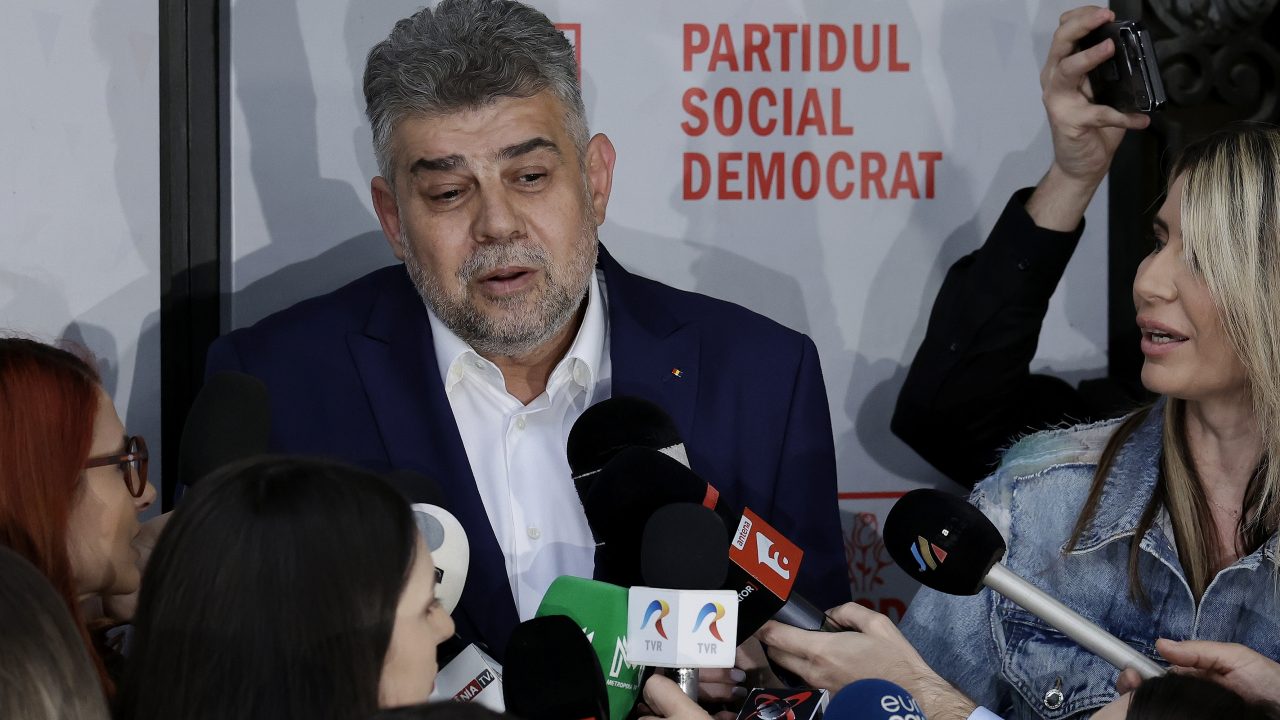
Caption: Romanian Prime Minister Marcel Ciolacu (C) announces his resignation to TV reporters after the first round of presidential elections held on Sunday, in front of the PSD party headquarters in Bucharest, Romania, 5 May 2025. [EPA-EFE/ROBERT GHEMENT]
Updated: May 6, 2025 - 14:39