 Edit
The NATO summit did not resolve the contradictions between allies: it exposed them
For the current U.S. administration, Europe is treated as a strategic liability, an economic competitor, and, at times, a political adversary
Trump’s renewed claims over Greenland and his broader rhetoric toward Canada raise an uncomfortable question: how sustainable is transatlantic cooperation when Washington increasingly views its closest partners through a competitive, even revisionist lens, asks Günter Seufert.
Günter Seufert is the former Founding Director of the Centre for Applied Turkish Studies at the German Institute for International and Security Affairs. He wrote this op-ed in personal capacity. His other opinion articles can be found here.
Europe’s leaders emerged from the NATO summit projecting confidence. German Chancellor Friedrich Merz called the meeting “consistently positive,” insisting that NATO is “more European than ever” while remaining firmly transatlantic. The alliance, he argued, is “unmatched in strength” and, above all, united. The final declaration, with its renewed “ironclad commitment” to Article 5, seemed to support that narrative.
It is a comforting message. It is also misleading.
Behind the language of unity, NATO is fragmenting along three critical fronts: Ukraine, the North Atlantic, and the Middle East. What appears outwardly as cohesion increasingly masks diverging priorities, unequal burdens, and a growing strategic rift between Europe and the United States.
Start with Ukraine. European allies have indeed increased defence spending significantly – by more than €100 billion. But this aggregate figure obscures deep imbalances. Poland and the Baltic states are carrying a disproportionate share, spending between 4.7 and 5.3 percent of GDP on defense, while others – including major economies – remain clustered around or below the two percent threshold. Germany, at 2.7 percent, now spends more than France and the United Kingdom, but even this shift does not resolve the broader problem of uneven commitment.
More importantly, the United States is stepping back. The €140 billion in military aid pledged to Kyiv for 2026 and 2027 will be financed entirely by Europe and Canada. Washington is no longer contributing. Even within Europe, the burden-sharing formula remains unresolved after France and the United Kingdom rejected proposals to tie contributions to economic weight. The result is clear: what is presented as a unified commitment to Ukraine rests on politically fragile ground.
A second, largely overlooked front lies in the North Atlantic and the Arctic. Canada’s decision to procure German-Norwegian Type 212CD submarines – framed in Ankara summit as a model of transatlantic cooperation – points to the growing strategic importance of this theater. Plans to integrate submarine operations among Canada, Germany, and Norway suggest a deeper alignment among like-minded allies.
Yet this, too, exposes fractures. Donald Trump’s renewed claims over Greenland and his broader rhetoric toward Canada raise an uncomfortable question: how sustainable is transatlantic cooperation when Washington increasingly views its closest partners through a competitive, even revisionist lens? The alliance may be expanding operational coordination in the Arctic, but politically, its cohesion is far from assured.
It is, however, the third front – Iran – that most starkly reveals NATO’s internal divisions. The alliance is not formally engaged in the conflict, but the war has already drawn in its members in uneven and contradictory ways. The United States is conducting extensive operations from European bases, with thousands of sorties launched from the continent. European governments have supported these efforts indirectly, including through commitments to secure the Strait of Hormuz.
But beyond this, unity collapses. Poland and the Baltic states have aligned themselves openly with Washington and Israel. Others, including Germany and the United Kingdom, provide logistical support while avoiding direct involvement. Spain, Italy, and neutral Switzerland have refused even that, denying access to their territory. Turkey, meanwhile, has closed its airspace and barred operations from Incirlik altogether.
Trump’s response has been revealing. He has openly attacked key European allies while praising Turkey for staying out of the war. The message is unmistakable: alignment with U.S. priorities is no longer expected as a matter of alliance solidarity, but demanded selectively – and judged politically.
Taken together, these trends point to a fundamental shift. For the current U.S. administration, Europe is no longer simply a partner. It is increasingly treated as a strategic liability, an economic competitor, and, at times, a political adversary. Washington is disengaging from Europe’s core security concerns – most notably Ukraine – while simultaneously reshaping the terms of transatlantic cooperation to its own advantage.
Nowhere is this more evident than in defense industrial policy. The United States is pressing European allies to spend more on defense, but not to build European capacity. Instead, it is capturing demand for its own defense sector. The recent Tomahawk missile deal is emblematic: rather than deploying the system in Europe, Washington withdrew and sell it now to Germany instead. European defense spending may have doubled between 2018 and 2025, but imports of U.S. weapons have risen even faster, from €8.7 billion in 202 to €47 billion in 2025.
The implication is difficult to ignore. As the United States reduces its military footprint in Europe, it is deepening Europe’s structural dependence on American defence industries. Europe is being asked to take on greater responsibility for its own security – while becoming less capable of exercising strategic autonomy.
The NATO summit in Ankara did not resolve these contradictions. It exposed them. The alliance remains formally intact, but its internal logic is shifting. Unity, increasingly, is performative. Divergence is structural.
The question is no longer whether NATO is still united. It is whether the appearance of unity can be sustained as the underlying reality continues to erode.
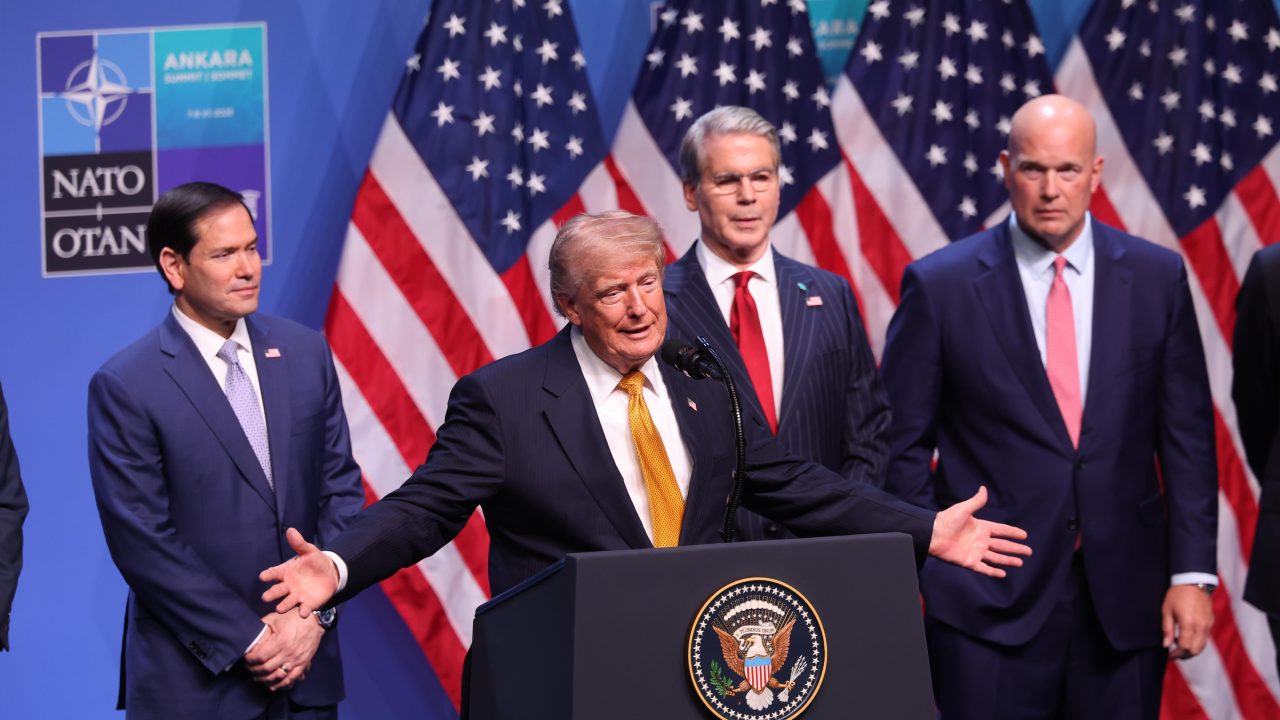
Caption: US President Donald Trump (C) speaks during a press conference at the 2026 NATO summit in Ankara, Turkey, 8 July 2026. The NATO Summit took place on 7-8 July. EPA/GEORGI LICOVSKI
Updated: July 11, 2026 - 05:53