 Edit
Mine waste heaps: Poland’s hidden fortune in the EU’s critical raw materials race
Legacy waste sites are emerging as a potential domestic source of critical raw materials - if Poland and its Visegrad neighbours can move fast enough to exploit them
Poland has no proven primary deposits of rare earth elements, yet it may be sitting on millions of tonnes of material that could prove just as valuable: vast coal-mine waste heaps scattered across its industrial landscape.
As the European Union pushes to secure supply chains for the green and digital transitions, these legacy waste sites are emerging as a potential domestic source of critical raw materials – if Poland and its Visegrad neighbours can move fast enough to exploit them.
The stakes are high. China dominates global production and processing of rare earths and other strategic minerals essential for electric motors, wind turbines, semiconductors, and defence electronics. While U.S. President Donald Trump launched a diplomatic offensive in early 2025 to lock in alternative supplies, Warsaw has remained relatively quiet on the issue – even as Polish Academy of Sciences researchers and the Polish Geological Institute warn that time is running out.
EU framework offers tools, but national delivery lags
At the heart of Europe’s response is the Critical Raw Materials Act (CRMA), which Poland is transposing through draft legislation designed to create stable national rules for strategic projects, market monitoring, and reporting. The law aims to implement the EU’s broader push to diversify supplies, accelerate permitting for strategic projects, and boost both primary extraction and secondary recovery from waste.
Poland also operates a National Critical Raw Materials Exploration Programme (budget: 180 million PLN / ~€42 million until 2032) run by the Polish Geological Institute. Rare earths sit in the programme’s third-tier priority group, behind platinum-group metals, copper, and helium. By comparison, Spain’s similar initiative is funded at over €180 million – highlighting funding disparities within the single market.
In March 2026, the Polish Prime minister established a team to update the national raw materials policy and explore financing mechanisms. Poland participates in the European Critical Raw Materials Board and the ResourceEU platform, which aggregates demand for items such as permanent magnets and lithium without constituting full joint procurement.
The paradox: critical materials in coal and waste
Dr. hab. Łukasz Kruszewski of the Polish Academy of Sciences’ Institute of Geological Sciences makes a striking claim: Poland’s greatest potential for rare earths and associated critical elements (germanium, antimony, caesium, cobalt) lies not in new mines but in existing coal seams and the waste heaps left behind by decades of mining.
“Coal can be burned as fuel, but it can also be used as a raw material to recover elements that underpin energy technologies,” Kruszewski explains. He points to dysprosium, once a key component in wind-turbine magnets, and to Lublin coal, which co-occurs with germanium and gallium – both critical for semiconductors – along with cobalt
Other promising sites include the Tajno massif, copper-polymetallic deposits near Legnica in Lower Silesia, and historic uranium fields around Kowary enriched in rare earths, particularly yttrium.
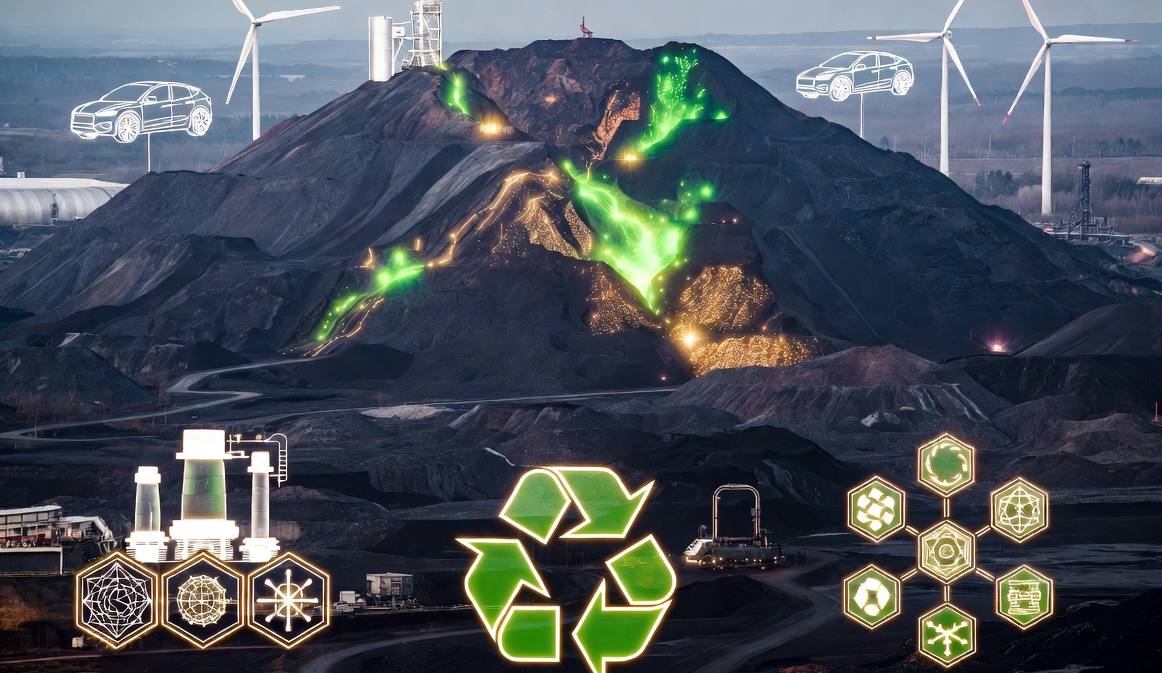
The real treasure, however, may be the hałdy – the iconic black spoil heaps of Upper Silesia. Numbering over 200, some contain tens of millions of tonnes of material. While local communities sometimes view them as regional symbols (such as the famous “Szarlota” heap in Rydułtowy), from a raw-materials perspective they represent untapped secondary deposits.
Technical and economic feasibility
Exploiting them is not straightforward. Dust, spontaneous combustion risks (real for perhaps 0.5% of heaps), and the need for extensive sampling (hundreds of samples per site) pose challenges. Yet Kruszewski, who has worked with the EIT’s Remining group on mining waste recycling, argues the costs are manageable and the volumes transformative.
Small concentrations do not necessarily mean uneconomic operations when multiplied by tens of millions of tonnes, he notes. Technological progress continues to lower viability thresholds. Methods adapted from gold leaching – using carbonate solutions that rare earths readily bind to – could extract materials with minimal disturbance to the heap itself, avoiding the environmental disasters associated with older cyanide-based techniques.
Biological extraction using bacteria is another avenue under study at the University of Warsaw. A U.S. example from Virginia, where researchers developed an economically viable recovery process for rare earths and cobalt from coal waste in just two years, demonstrates that innovation can close the gap quickly.
Recycling takes centre stage
EU policy increasingly emphasises the circular economy. The Battery Regulation (2023/1542) mandates rising recycling rates for lithium and cobalt, reaching 50–95% by 2031. End-of-life wind-turbine magnets and electronic waste offer additional streams. A planned rare-earth processing facility in Puławy, developed by Grupo MKANGO with Grupa Azoty, has been designated a strategic project with operations eyed for 2027–2028.
Barriers remain
Despite the potential, systemic obstacles persist. Mining companies have shown little interest in cooperation. Researchers report limited contact between scientific work and government decision-making beyond the Geological Institute’s efforts. Regional cooperation within the Visegrad Group — essential given shared geological realities — remains more aspiration than reality.
As Europe races to secure its raw-materials future, Poland’s waste heaps represent both an environmental liability and a strategic opportunity. Whether EU policies such as the CRMA and battery rules translate into on-the-ground progress will depend on bolder national prioritisation, increased funding, and genuine industry engagement. The window to turn yesterday’s waste into tomorrow’s strategic advantage is narrowing.
The article in Polish by EUalive’s partner Focus Europe Poland can be found here.
Caption: AI-generated illustrative image [EUalive]
Updated: June 30, 2026 - 12:36