 Edit
Shadowy billion-dollar Quantum AI Data Centre to rise on disputed Romanian land
Administrative shortcuts and suspiciously low land prices fuel concerns over a massive U.S.-Romanian project in a quiet Transylvanian commune
A billion-dollar project to build one of Europe’s most advanced quantum artificial intelligence data centers has emerged in the small commune of Luna, on the border of Cluj and Mureș counties in Romania.
The ambitious initiative, backed by American investors and Romanian construction interests with deep military connections, has drawn attention not only for its cutting-edge technology but also for the network of political, diplomatic, and business relationships that made it possible. The development raises questions about land valuation, transparency, and the intersection of strategic interests between Romania and the United States.
The proposed Quantum AI Data Centre would consume enormous amounts of electricity, potentially rivaling the entire consumption of a city like Craiova. Yet it is planned for a rural area with just 4,800 inhabitants. The project was publicly announced at the end of May by Senate President Mircea Abrudean, despite his lack of an executive government role. Over the past two years, a series of local administrative decisions, the arrival of investors with military backgrounds, and high-level political contacts have aligned to pave the way for this massive undertaking.
Undervalued land and rapid concessions
The story begins with a large plot of land in Luna that the Cluj County Council once hoped to develop into a technological park. In 2019, when the land was still classified as extra-urban pasture, it was evaluated at a modest value for the proposed Tetarom V industrial park. That plan was later abandoned due to funding shortages. Subsequently, the land’s status changed to an industrial zone and was incorporated into the commune’s urban area.
Between February and September 2024, Luna City Hall organised auctions to concession portions of this 115-hectare area. Strikingly, the starting prices were based on the outdated 2019 pasture valuation rather than current urban industrial values. Three separate decisions by the local council approved 49-year concessions. An intermediary company, Doma Cult SRL from Câmpia Turzii, secured 84 hectares through two of these auctions. Critics, including a competing bidder, later challenged the process in court, arguing the prices were unrealistically low compared to market rates for urban land in the area.
By 2025, control of Doma Cult shifted dramatically. Through a capital increase, Ubitech Construcții, part of the Romanian Leviatan Group, acquired a 90% stake. This positioned Leviatan, tasked with coordinating and executing the data center’s construction, to control the land where the project would rise. The site, strategically located near the Transilvania Highway and close to the Câmpia Turzii military base, was soon fenced off, evoking the secretive atmosphere of a high-security installation.
Local officials, including Mayor Aurel Giurgiu, defended the transactions as properly conducted and dismissed legal challenges as politically motivated. However, a 2025 report from the Cluj Court of Auditors highlighted irregularities in how the commune managed and registered its public assets, including land worth tens of millions of lei.
High-level political and diplomatic support
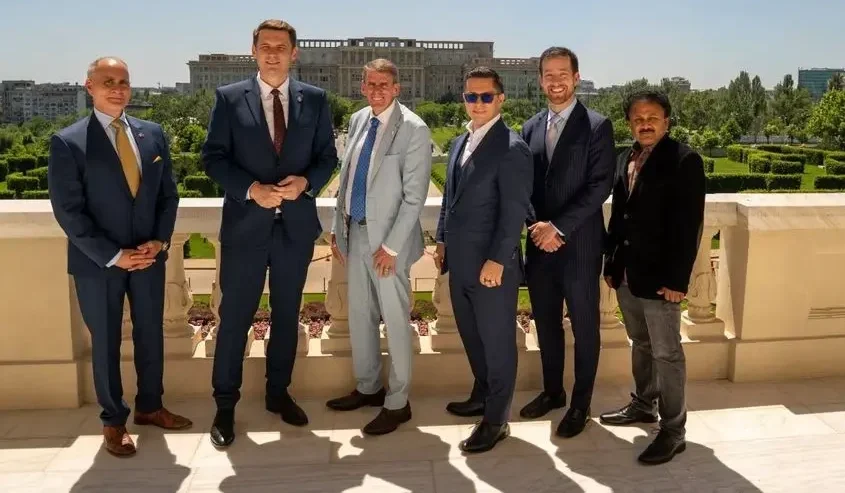
The project gained significant visibility through Mircea Abrudean, President of the Senate and second in the line of state leadership. On 27 May Abrudean announced the deal on social media, describing it as a cornerstone of the strategic partnership between Romania and the United States. He shared photos of himself shaking hands with DriverAI founder Cary Tantlinger and revealed he had advocated for the project in Washington earlier that year during an Interparliamentary Security Forum visit coordinated with President Nicușor Dan.
Abrudean’s involvement stems from his past roles, including leadership of the Tetarom Board of Directors, which had overseen the original evaluation of the Luna land, and his position as head of Prime Minister Nicolae Ciucă’s chancellery. He maintains that his support was limited to promoting the investment as a senator from Cluj County and denies any direct role in site selection or negotiations. His office emphasized that DriverAI made institutional contacts independently.
On the same day as Abrudean’s announcement, DriverAI issued its own press release confirming the partnership. Notably, no comprehensive memorandum of understanding or detailed public agreement outlining responsibilities and implications had been signed at the time of the announcement. DriverAI indicated it was working with the Romanian government to designate the project as a strategic investment, potentially unlocking state aid, EU funds, and other incentives for advanced computing and AI infrastructure.
Military networks and the Leviatan connection
At the heart of the Romanian side stands Leviatan Group, a conglomerate of companies specializing in complex construction, led by Cătălin Podaru, a former Romanian Army officer. The group’s businesses experienced rapid growth after 2020, securing significant contracts with the Ministry of National Defence, particularly at military bases like Câmpia Turzii and Kogălniceanu. These contracts were often classified. On the very day the Quantum AI project was announced, Podaru was elected president of ROMDEF, the new Romanian Defence Industry Employers’ Association.
The American partner, DriverAI LLC, registered in Arizona in July 2024, is a relatively new entity with limited public track record in major data center projects. Led by Cary Tantlinger, it positions itself in advanced computing, AI, and related fields. The company highlights partnerships with experienced professionals from major tech and defence firms and plans to finance the project primarily through private institutional investors while seeking additional public support.
Bridging the two sides is David Carstens, a former U.S. Army military intelligence officer and head of the Military Liaison Office at the U.S. Embassy in Bucharest from 2018 to 2023. Carstens joined Leviatan Group’s advisory board shortly before the land auctions began and leads Carstens Consulting Global Inc., which provides project management and institutional coordination for the initiative. His extensive military and diplomatic experience in the region makes him a pivotal figure in aligning Romanian and American interests.
The convergence of these elements – undervalued public land, politically connected contractors with military ties, high-level diplomatic endorsements, and a nascent American tech firm, has created a project of unprecedented scale for Romania. While proponents see it as a leap into the future of quantum AI and strengthened transatlantic cooperation, the lack of full transparency, questions over land pricing, and dense web of personal and institutional connections continue to cast a shadow over the development. As the project advances, scrutiny over its governance, true costs, and strategic implications is likely to intensify.
The article by Bianca Felseghi in Romanian with EUalive’s partner media PressOne.ro can be found here.
Caption: Mircea Abrudean, alongside the heads of the companies involved in the creation of the Quantum AI Data Centre. From left to right, David Carstens, from CCG Inc., Cary Tantlinger, CEO and founder of DriverAI, Mircea Abrudean, President of the Senate, Cătălin Podaru, President and CEO of Leviatan Group, Jacob Weinberg and Jegadesan, both from DriverAI. Photo source: Facebook / Mircea Abrudean (PressOne.ro)
Updated: June 30, 2026 - 09:58