 Edit
Ireland puts “One Europe roadmap“, security and Ukraine at heart of its presidency agenda
The Irish presidency invoked a traditional Irish proverb to underscore the presidency's overarching message: "There is strength with unity"
Cutting red tape, boosting Europe’s economic competitiveness, strengthening defence capabilities and maintaining unwavering support for Ukraine will be the defining priorities of Ireland’s presidency of the Council of the European Union. Dublin seeks to steer the bloc through an increasingly volatile geopolitical and economic landscape.
Launching the presidency programme, Irish Prime Minister Micheál Martin presented an agenda centred on delivering the “One Europe, One Market” roadmap, deepening the Single Market and reinforcing Europe’s security and global influence at a time of mounting international tensions and intensifying competition from global rivals.
🇪🇺 🇮🇪 Ireland will hold the Council presidency from July until the end of December 2026.
Ireland’s presidency website was launched today, unveiling its programme and priorities.
Curious to learn more? Visit the website now 👉 https://t.co/zZZUb86jRO@Ireland2026eu pic.twitter.com/4mFe7OWaqV
— EU Council (@EUCouncil) June 10, 2026
“In our term, we will work to deliver the ‘One Europe, One Market’ Roadmap which sets out the steps the EU urgently needs to take in areas such as: simplifying regulation for businesses and citizens deepening our single market, championing fair and open trade, reducing energy prices and decarbonising our economy, and driving the AI and digital transformation for the benefit of all”, Martin said, outlining priorities including regulatory simplification.
The Irish leader also pledged to work with EU partners to improve online safety for children, while stressing that the bloc must strengthen its ability to protect citizens and democratic institutions in an increasingly volatile security environment.
“We live in a time of increased threat and conflict. The European Union needs to work harder to protect our citizens, our democracies and our European way of life,” Martin said.
The Irish presidency invoked a traditional Irish proverb to underscore the presidency’s overarching message: “As the Irish proverb says: ní neart go cur le chéile. There is strength with unity.”
Martin, leader of the centre-right Fianna Fáil party and one of Ireland’s most experienced political figures, former history teacher, returned as Taoiseach (prime minister) in early 2025 under the country’s coalition government. A long-standing advocate of EU integration, he has consistently backed stronger European cooperation on competitiveness, trade, security and support for Ukraine.
Unwavering backing for Ukraine
A central pillar of Ireland’s presidency programme will be maintaining support for Ukraine as Russia’s full-scale invasion enters its fifth year.
Neutral Dublin has committed to ensuring that Kyiv continues to receive the financial, military and political support necessary to defend itself and sustain its economy. The presidency programme also emphasises the need to maintain pressure on Russia while supporting efforts towards a “just and lasting peace”.
“We will continue to offer unwavering support to Ukraine, whose people have shown such courage and determination in defending their country,” The Irish EU presidency programme said. “They deserve a just and lasting peace.”
Alongside Ukraine, the Middle East will remain a major foreign policy priority. The Irish presidency will support EU efforts to advance a two-state solution between Israel and the Palestinians, while helping to coordinate humanitarian assistance for Gaza and responding to worsening conditions in the West Bank.
Dublin also intends to support EU engagement aimed at promoting peace and stability in the Gulf region, Lebanon and Syria, where ongoing conflicts continue to generate broader regional and international consequences.
Beyond immediate crises, Ireland plans to strengthen relations with key strategic partners, including the United Kingdom, the United States and Canada, while expanding engagement with countries across Africa, Latin America and the Asia-Pacific region.
Defending European values
Ireland also intends to advance the EU accession prospects of candidate countries, arguing that enlargement remains a strategic tool for promoting stability, security and prosperity across the European neighbourhood.
Ireland would work to protect “freedom, democracy, equality, the rule of law, and respect for human rights and dignity”, while ensuring that the EU remains an influential actor in promoting global peace and security.
Security and defence move higher up the agenda
Reflecting the deteriorating international security environment, defence and security issues feature prominently throughout the Irish programme.
The presidency will seek to advance work on a proposed new European Security Strategy and support the development of critical defence capabilities. Dublin also plans to push forward initiatives on military mobility, joint defence procurement and the evolution of the EU’s Common Security and Defence Policy.
Cybersecurity, resilience against hybrid threats and maritime security will receive particular attention as member states seek to strengthen Europe’s preparedness against emerging risks.
The programme signals Ireland’s intention to support a more coordinated and inclusive European defence agenda while ensuring that the Union remains capable of responding effectively to multiple simultaneous crises.
Trade, economic security and competitiveness
Competitiveness will form the backbone of Ireland’s economic agenda. Building on the “One Europe, One Market” roadmap, the presidency will prioritise measures aimed at strengthening the Single Market, reducing regulatory burdens and improving conditions for businesses, particularly small and medium-sized enterprises.
Ireland will also pursue an ambitious trade policy agenda centred on defending the multilateral trading system and advancing reform of the World Trade Organisation.
Implementation of the EU-US Trade and Investment agenda is expected to be a major focus, alongside ongoing negotiations with Malaysia, the Philippines, Thailand and the United Arab Emirates.
At the same time, Dublin plans to advance work on the EU’s economic security framework following the publication of the December 2025 Joint Communication on Strengthening Economic Security.
Financial integration will also feature prominently. The presidency will seek progress on the Savings and Investments Union and the Digital Euro, initiatives designed to deepen European capital markets, strengthen the banking sector and mobilise investment to support long-term growth.
Innovation, housing and industrial resilience
Ireland’s programme places significant emphasis on innovation as a driver of European competitiveness.
Negotiations on the next Horizon Europe research framework programme and the proposed European Innovation Act are expected to be among the presidency’s flagship files. Dublin argues that research and innovation must play a greater role in strengthening Europe’s economic resilience, security and prosperity.
The Irish presidency will also focus on improving the competitiveness of the European space sector, which it identifies as a strategic growth industry.
Housing affordability is another area where Ireland intends to push for progress. The presidency will seek to advance initiatives under the European Affordable Housing Plan, including proposed legislation aimed at accelerating housing delivery and improving access to affordable homes across the bloc.
Economic coordination through the European Semester process will continue, with Ireland advocating sound fiscal policies that support both debt sustainability and investment.
EU foreign policy chief Kaja Kallas visited Dublin on the occasion of the preparations for the Irish presidency. Her visit coincided with mounting outrage over revelations that an Irish-based refinery has continued shipping vast quantities of aluminium to Russia throughout Moscow’s full-scale invasion of Ukraine.
Kaja Kallas’s Dublin visit: Ireland faces heat over aluminium exports to Russia
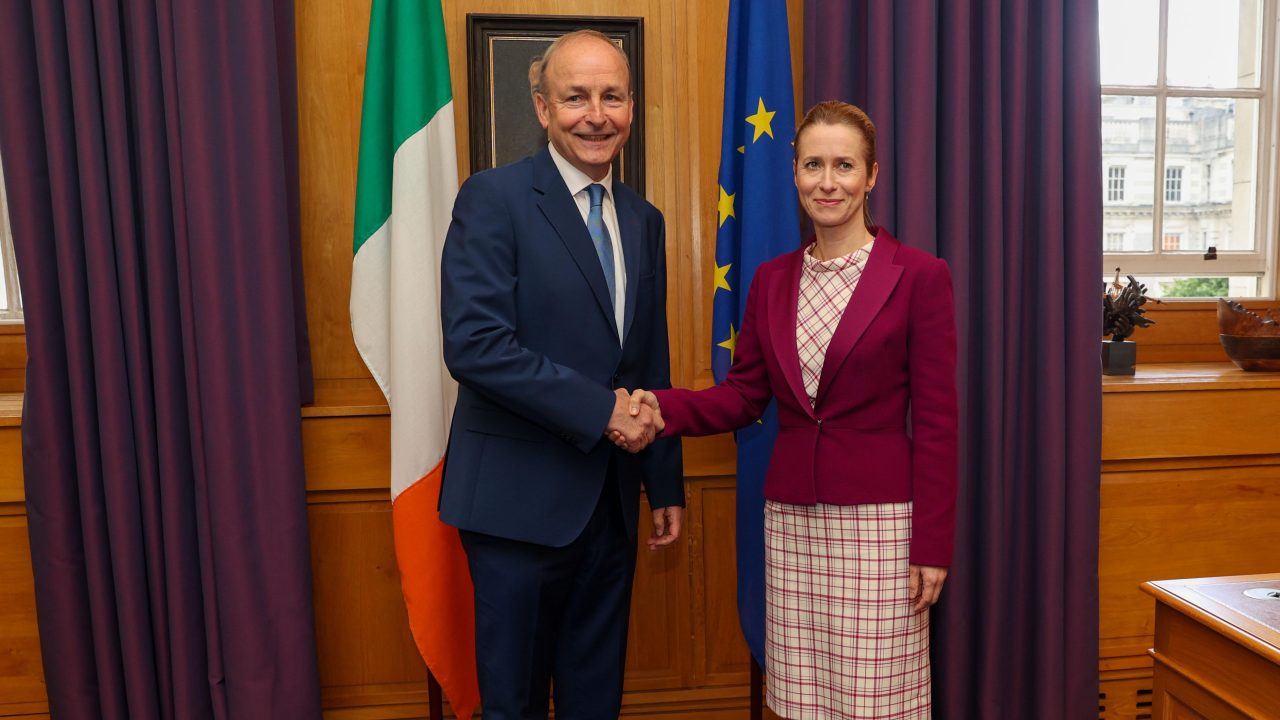
Caption: A handout photo made available by the Government Information Service of Irish Taoiseach Micheál Martin (L) meeting Kaja Kallas, High Representative of the European Union for Foreign Affairs and Security Policy, in Government Buildings, in Dublin, Ireland 9 June 2026. EPA/HANDOUT
Updated: June 11, 2026 - 05:39