 Edit
NATO eastern flank and Nordic allies pledge stronger deterrence at Bucharest B9 summit
Leaders back higher defence spending, more support for Ukraine and expanded NATO presence from the Black Sea to the Arctic
Leaders of the Bucharest Nine (B9) countries and the Nordic allies pledged to strengthen NATO’s eastern flank, increase defence spending and deepen support for Ukraine during a summit in Bucharest dominated by concerns over Russia’s long-term threat to European security.
The joint declaration adopted at the summit described Russia as “the most significant and direct long-term threat to the security of Allies” and called for a more robust collective defence posture stretching from the Black Sea to the Arctic region.
The meeting, hosted by Romanian President Nicușor Dan and co-chaired by Polish President Karol Nawrocki, brought together leaders from the B9 format and Nordic NATO members less than two months before the NATO summit in Ankara. All five Nordic countries (Finland, Sweden, Norway, Denmark, Iceland) were represented at the Bucharest gathering.
NATO Secretary General Mark Rutte, Ukrainian President Volodymyr Zelenskyy and U.S. Undersecretary of State for Arms Control and International Security Thomas DiNanno also attended the B9 event.
In their final declaration, the participating states reaffirmed their commitment to what they described as “NATO 3.0”, centred on a stronger European pillar within the transatlantic alliance and greater defence contributions from European allies.
“United in the face of profound security threats and challenges, in particular the long-term threat posed by Russia,” the declaration stated, adding that allies were increasing investments in defence while working toward the target of allocating 5% of GDP to security and defence-related spending.
The statement stressed the need for NATO to maintain a strong forward defence posture on its eastern flank, including fully resourced defence plans, improved military mobility and the expansion of NATO fuel pipeline systems toward eastern member states.
The allies also condemned what they described as Russia’s “highly confrontational actions” against NATO members and partners, including sabotage operations, cyberattacks, hybrid activities and repeated airspace violations near the eastern flank.
Particular attention was given to strengthening air and missile defence systems, including protection against drones and unmanned aerial systems, which have become increasingly central to modern warfare following Russia’s invasion of Ukraine.
The declaration also highlighted the strategic importance of protecting maritime infrastructure and freedom of navigation, welcoming NATO initiatives such as Baltic Sentry, Eastern Sentry and Arctic Sentry aimed at expanding allied presence in vulnerable regions.
Speaking at the opening of the summit, Nicușor Dan said the meeting was taking place in a “dynamic international climate” close to areas where allied territory faces direct pressure.
“We are close to Ukraine, close to the Black Sea and close to places where allied territory is threatened,” the Romanian president said, adding that the purpose of the meeting was to align allied visions ahead of the Ankara summit.
Dan argued that European NATO members must assume a larger share of responsibility for collective defence while accelerating the development of a stronger transatlantic defence industrial base.
He also stressed that support for Ukraine and Moldova should move beyond political declarations and become more operationally effective.
“Our security depends on their security,” he said.
Nawrocki warned that Russia’s war against Ukraine should not be viewed as an isolated conflict but as a broader challenge to the Euro-Atlantic order.
“Nobody can say they were not warned,” the Polish president said. “Russia’s conflict is not isolated. It is a threat to the entire North Atlantic order.”
He argued that the eastern flank should no longer be treated as NATO’s periphery but rather as one of its strategic centres of gravity.
“From the Black Sea increasingly toward the north of the continent, unity among our countries is essential,” Nawrocki added.
The summit also served as a platform for renewed military cooperation with Ukraine.
Addressing the leaders, Volodymyr Zelenskyy proposed bilateral drone agreements between European states and Ukraine, arguing that the combination of European industrial capacity and Ukrainian battlefield experience could significantly strengthen the continent’s security architecture.
“I believe we all need bilateral drone deals,” Zelenskyy said, adding that only Ukraine currently possesses the practical expertise gained from adapting military technologies during full-scale war.
The Ukrainian president noted that warfare technologies now evolve “every day” and argued that possessing equipment alone is no longer sufficient without operational experience and rapid adaptation capabilities.
He also pointed to the EU SAFE programme as an opportunity to modernise Europe’s defence industry and integrate Ukrainian know-how into broader European rearmament efforts.
According to Zelenskyy, around 20 countries are already discussing drone cooperation agreements with Kyiv at different levels.
The joint declaration reaffirmed support for Ukraine’s sovereignty and territorial integrity within its internationally recognised borders and backed a “just and lasting peace” based on international law and credible security guarantees.
The allies welcomed ongoing U.S.-led peace efforts and called for increased pressure on Russia to engage meaningfully in negotiations.
At the same time, the statement expressed concern about developments in the Middle East and voiced support for allied efforts to protect freedom of navigation in the Strait of Hormuz.
The declaration also highlighted closer NATO-EU cooperation and stronger engagement with key regional partners, including Moldova, amid growing concerns over Russian influence and destabilisation efforts across Eastern Europe.
Hungary, however, attached what it described as a “constructive abstention” to the declaration, stating that Budapest could not support parts of the agreed language and that “any decision on the use of this agreed language in the future will be taken by the future Government of Hungary”.
No public statement specifies exactly which parts Hungary objects to. However, the paragraph on “strengthening engagement with key partners, including the Republic of Moldova” is the most likely point of sensitivity, given Hungary’s historically cautious stance on Moldova (and past friction over minority rights and Russian influence issues).
Hungary and Bulgaria, both in the midst of forming new administrations following their recent decisive elections, were represented at ambassador level.
Sources: Umbrela Strategica, Espress, Ukriform
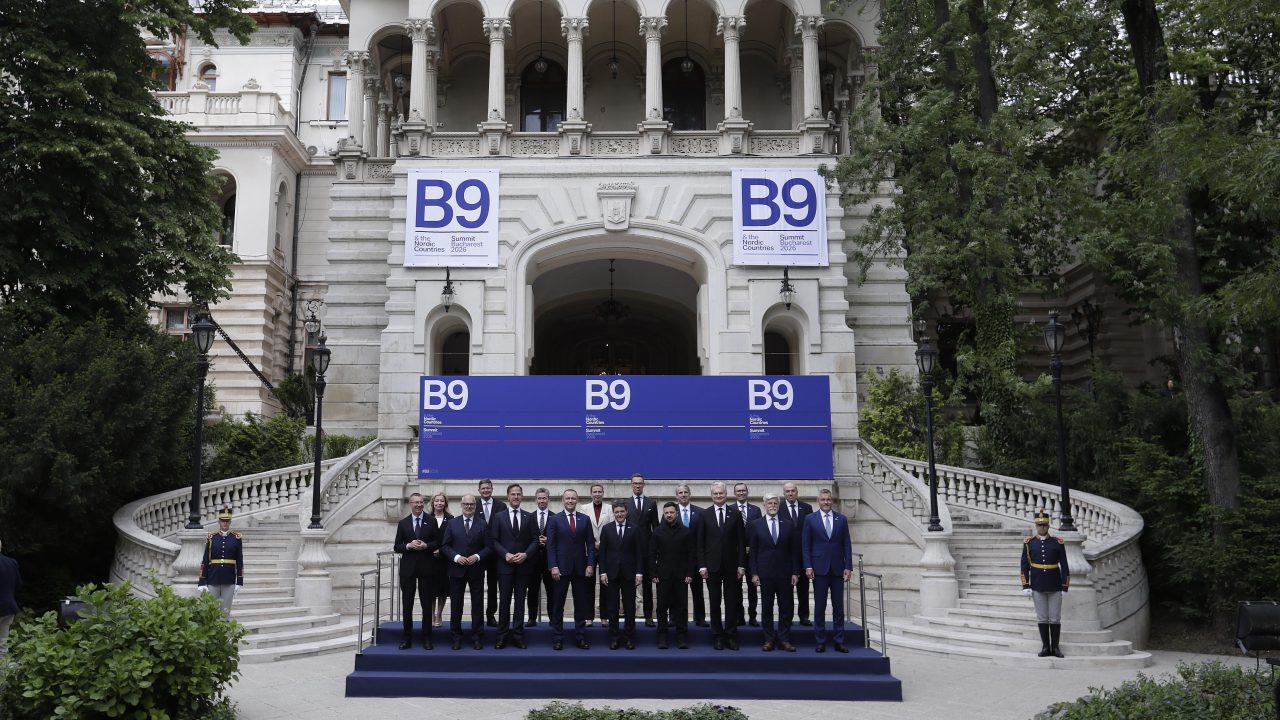
Caption: Romanian President, Nicusor Dan (C), Ukrainian President, Volodimir Zelensky (C-R), Polish President Karol Nawrocki (C-L) and NATO Secretary General, Mark Rutte (5-L), together with B9 and Nordic countries heads of national delegations pose for a family photo at the Bucharest Summit of B9 (Bucharest Nine) and Nordic countries in Bucharest, Romania, 13 May 2026. The Bucharest Nine (B9) is a joint initiative by Romania and Poland, including NATO’s Eastern Flank members: Bulgaria, the Czech Republic, Estonia, Hungary, Latvia, Lithuania and Slovakia. EPA/ROBERT GHEMENT
Updated: May 13, 2026 - 19:06