 Edit
Europe can achieve defence autonomy within a decade, German report says
The Kiel Institute study argues that Europe’s main obstacle is political fragmentation rather than lack of money or technology
Europe could achieve a high degree of defence autonomy within the next decade if it overcomes chronic fragmentation in its military and industrial structures, according to a new report by the German think tank Kiel Institute for the World Economy.
The analysis comes as the EU and European governments intensify efforts to reduce dependence on the United States in both defence production and military capabilities, particularly after U.S. President Donald Trump announced plans to gradually scale back the American military presence in Europe, including troop deployments and missile systems.
Despite being collectively the world’s second-largest military spender, Europe remains strategically dependent on Washington across the entire military operational chain, the report argues.
The study, titled “Sparta 2.0”, identifies ten priority areas in which Europe should invest, including military cloud computing, air defence, command-and-control systems, secure communications and satellite reconnaissance.
The cost of the proposed programmes is estimated at between €150 billion and €200 billion by 2030, rising to around €500 billion over the next decade, or roughly €50 billion annually. According to the authors, this would amount to about one-third of the projected annual increase in European defence budgets, 10% of expected NATO European defence spending by the end of the decade, or approximately 0.25% of European GDP when including the United Kingdom and Norway.
However, the report argues that higher spending alone will not guarantee greater independence. The central problem is not the quantity of investment, but Europe’s ability to convert spending into interoperable systems, industrial production, advanced technologies and effective military capabilities.
In this context, European strategic autonomy and the creation of an independent conventional deterrence capability are “not a question of costs or technological capacities”, but rather depend on political priorities, leadership, industrial coordination and the willingness to move beyond the fragmentation that has long characterised European defence policy.
Among the report’s authors, Thomas Enders links the analysis directly to Germany’s evolving military priorities, including information superiority, multidomain operations and long-range strike capabilities.
Germany’s defence surge: anticipating a leaner U.S. footprint in Europe
“Sparta 2.0 provides the industrial and technological framework to achieve these objectives and demonstrates that a high degree of European independence can be reached within a few years at a financially manageable cost,” Enders said. He argued that the real bottleneck is neither money nor technology, but political willingness to “act as Europeans” and implement decisions rapidly.
The report suggests that significant progress towards European defence sovereignty could be achieved within three to five years, while broad autonomy across most sectors could be reached within five to ten years. Key programmes are designed to reach initial operational capability by 2029 and are aligned with the planning cycle of the German armed forces, the Bundeswehr.
Rather than proposing a new overarching EU defence structure, the authors advocate the creation of “resilient leading coalitions”. Germany, France, Poland and the United Kingdom would coordinate strategic programmes, long-range conventional capabilities and discussions on nuclear policy. Northern European countries, the Baltic states and the Netherlands would focus on maritime autonomy, Baltic and North Sea security and electronic warfare. Germany, alongside other partners, could also take a leading role in air defence and counter-drone systems.
For René Obermann, another contributor to the report, the issue goes beyond defence spending and touches directly on Europe’s geopolitical credibility.
“Those unable to organise their own defence cannot assume responsibility for it,” Obermann argued, describing European sovereignty as a prerequisite for strategic credibility and freedom of action.
The report also stresses that Europe already possesses a substantial technological and industrial base. European companies are considered competitive in areas such as tactical command software, military cloud infrastructure and autonomous systems. The challenge, according to the authors, lies in transforming technological expertise into operational military capabilities through coordinated political action and institutional execution.
The study points to Ukraine as evidence that rapid innovation is possible. Ukraine’s Delta battlefield management system, cited in the report, was developed in just 18 months and is described as among the most efficient systems of its kind outside the United States.
A central part of the report focuses on Europe’s fragmented defence industrial architecture. According to the authors, 70% of European defence spending is concentrated among the continent’s ten largest contractors, compared with less than 30% in the United States. At the same time, Europe operates 14 different tank platforms, 15 different fighter aircraft models and fragmented command systems.
This lack of consolidation reduces economies of scale and means Europe obtains between 30% and 40% less capability per euro invested compared with a more integrated state structure, the report says.
The authors therefore argue that new defence funding should not simply be channelled into existing programmes, but directed towards new production facilities, suppliers and emerging technologies. The report estimates that each euro invested in areas such as software, artificial intelligence and space technologies could generate up to €1.50 in economic value.
“The question is not whether to invest, but how to direct these investments to strengthen Europe’s ability to act, consolidate technological leadership and create industrial value within Europe,” said Nico Lange.
According to the report, if new defence spending is used strategically to promote sovereignty, technological innovation and rapid implementation, Europe could significantly strengthen both its defence capabilities and its deterrence capacity.
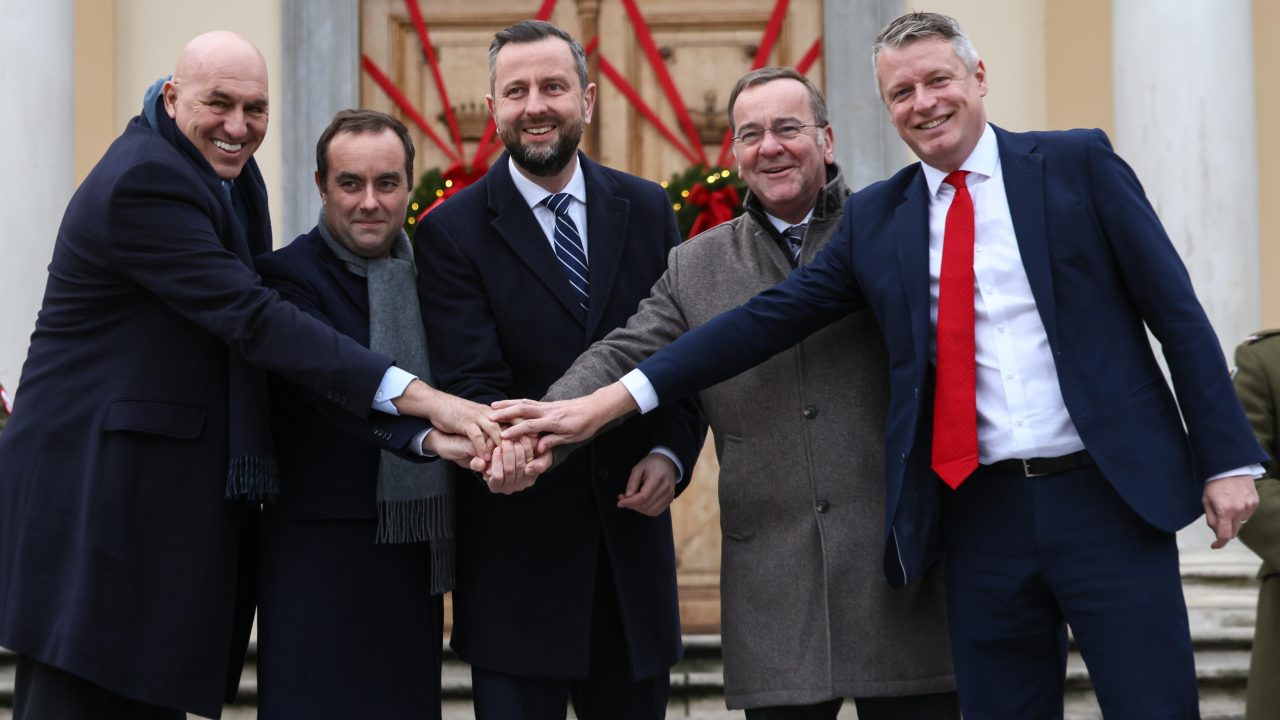
Caption: File photo. Polish Defence Minister Wladyslaw Kosiniak-Kamysz (C), German Defence Minister Boris Pistorius (2R), British Parliamentary Under-Secretary of State in the Ministry of Defence Luke Pollard (R), French Defense Minister Sebastien Lecornu (2L) and Italian Defence Minister Guido Crosetto (L) shake hands during an official welcome ceremony at the representative center of the Ministry of National Defense in Helenow near Warsaw, Poland, 13 January 2025. The defence ministers met to discuss the allied security system, defence spending, support for Ukraine and cooperation between the arms industries. EPA/LESZEK SZYMANSKI
The full article in Italian by EUalive’s partner FocusEurope.it can be found here.
Updated: May 8, 2026 - 11:02