 Edit
EU age verification app ready as Europe moves to curb children’s social media access
In the transatlantic context, Europe's move stands out as a model of unified, privacy-first leadership that contrasts sharply with the U.S. decentralised, state-by-state patchwork
On Wednesday the European Commission announced that its European Age Verification App is technically ready and will soon be rolled out to the public, marking a concrete step forward in the EU’s ambitious drive to protect minors from social media harms while positioning Europe as the global pacesetter in digital regulation – especially when contrasted with the more fragmented approach across the Atlantic.
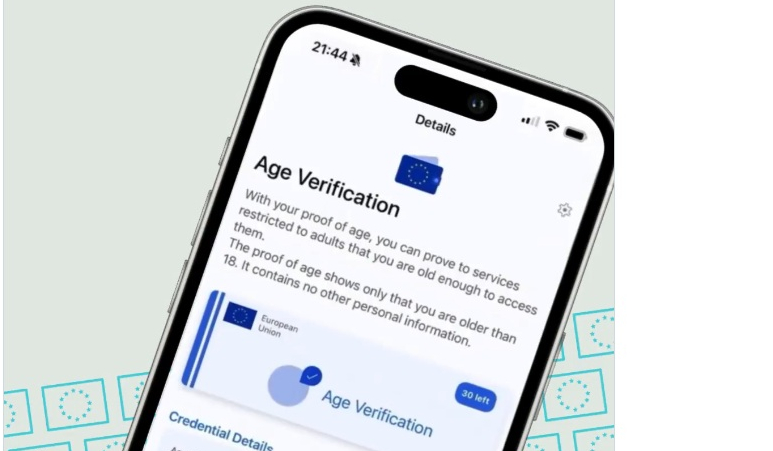
The app, developed under the umbrella of the Digital Services Act (DSA), allows users to prove their age anonymously by uploading a passport or national ID card. It generates a privacy-preserving token (fully open-source and compatible with phones, tablets, and computers) that confirms eligibility for age-restricted services without revealing any other personal data or enabling tracking – explicitly designed to avoid the privacy pitfalls of Big Tech’s own data-collection practices.
European Commission President Ursula von der Leyen hailed the launch: “We are moving ahead with full speed and determination on the enforcement of our European rules. We are holding accountable those online platforms that do not protect our kids enough… This app gives parents, teachers, caretakers a powerful tool to protect children, because we will have zero tolerance for companies that do not respect our children’s rights.”
It is for parents to raise their children. Not platforms.
The European Age Verification App is ready ↓ https://t.co/EumEPEJOI7
— Ursula von der Leyen (@vonderleyen) April 15, 2026
This initiative comes amid surging momentum across Europe. At least a dozen countries – including non-EU members like Britain and Norway – have already passed or are advancing laws imposing minimum social media ages of 13 to 16. The European Parliament backed a resolution in November 2025 calling for a bloc-wide minimum age of 16, and a final decision on binding EU legislation is expected this summer following recommendations from a new expert panel on child safety online. The Commission is also creating a European coordination mechanism to harmonize the patchwork of national schemes, ensuring consistency rather than fragmentation.
In the transatlantic context, Europe’s move stands out as a model of unified, privacy-first leadership that contrasts sharply with the United States’ decentralised, state-by-state patchwork. While roughly half of U.S. states have enacted or are advancing age-verification requirements – often focused on pornographic sites, addictive feeds, or social media – there is no comprehensive federal framework comparable to the DSA. Bills such as the Kids Online Safety Act (KOSA) have stalled amid fierce debates over free-speech implications and privacy risks, and critics warn that U.S. efforts risk turning age gates into de facto surveillance tools without the EU’s emphasis on anonymization and open-source standards.
The EU’s approach builds on its proven track record – think GDPR’s global ripple effects – and explicitly frames child protection as a systemic risk issue under the DSA, requiring Very Large Online Platforms to assess harms and deploy proportionate safeguards. Transatlantic dialogues highlight shared goals on protecting minors, but Europe is moving faster and more cohesively, even as U.S. officials (including some state governors and, reportedly, former President Trump) express interest in similar restrictions. This divergence risks friction with U.S.-based tech giants, yet it also creates space for cooperation: EU guidelines on age-verification principles are already influencing global discussions, and experts note unprecedented alignment on “safety by design” and risk-based regulation.
Challenges remain – Australia’s 2025 social media ban for under-16s triggered a VPN-download surge, underscoring bypass risks – but the EU’s app is explicitly positioned as a user-friendly, rights-respecting “barrier” that empowers families without handing platforms more data. By harmonizing standards across 27 member states plus allies, Europe is not only curbing children’s exposure to addictive algorithms, harmful content, and mental-health risks; it is once again exporting its regulatory model transatlantically, forcing platforms to adapt to the strictest rules on the planet and setting the benchmark for democratic digital governance in 2026 and beyond.
With Reuters, edited by g.g.
Caption: The age verification app [@vonderleyen on X]
Updated: April 16, 2026 - 06:41