 Edit
Oil prices surge above $100 despite historic IEA reserve release as Hormuz crisis deepens
Described as the biggest drawdown in the agency’s history, the move was intended as a short-term bridge to offset lost supply and prevent further runaway prices
Global oil prices surged above $100 a barrel on Thursday despite the International Energy Agency’s announcement of its largest-ever coordinated release of 400 million barrels from strategic reserves, underscoring the market’s deep anxiety over prolonged supply disruptions from the escalating U.S.-Israel war with Iran.
Brent crude futures climbed more than 9% to $100.22 per barrel in early trading, while U.S. crude reached $95.41, building on overnight increases and reflecting a volatile week where prices had briefly touched near $120 before pulling back.
The IEA’s decision, confirmed Wednesday by its 32 member countries – including a major U.S. contribution of 172 million barrels starting next week – aimed to stabilize markets rattled by the conflict. Described by the agency as the biggest such drawdown in its history (surpassing the 182.7 million barrels released after Russia’s 2022 invasion of Ukraine), the move was intended as a short-term bridge to offset lost supply and prevent further runaway prices.
Yet the release failed to calm traders, who focused instead on intensifying attacks on shipping in and around the Strait of Hormuz, the critical chokepoint handling about one-fifth of global seaborne oil and a substantial share of liquefied natural gas. Iranian forces have escalated operations, striking multiple commercial vessels – including fuel tankers and cargo ships – with projectiles, drones, and explosive-laden boats, while reports confirm Iran has begun laying naval mines (with U.S. Central Command destroying 16 Iranian mine-laying vessels on Wednesday to counter the threat).
Traffic through the strait has plummeted, with major Gulf producers like Iraq, Saudi Arabia, Kuwait, and the UAE slashing output as storage fills and exports stall; Iraqi oil terminals have halted operations entirely, and incidents include burning tankers leaking oil off Basra.
Iranian oil keeps flowing
Iranian crude oil has continued to flow through the Strait of Hormuz at a near-normal pace even as Tehran-linked attacks on ships in the narrow waterway have decimated exports from other Gulf countries, a Reuters review of tanker tracking data showed.
Iran has exported about 13.7 million barrels of crude oil since Israel and the U.S. launched attacks on the country on 28 February, according to analysis from TankerTrackers.com, a maritime intelligence company that specializes in tracking the so-called shadow fleet, a network of vessels used to transport oil and gas from countries under Western sanctions.
“I’m surprised, given their successful seizures of Venezuela-related vessels this past December, that the U.S. did not initiate a similar campaign prior to starting this conflict, or has not done so at this time,” said David Tannenbaum, a director at consulting firm Blackstone Compliance Services.
However, U.S. efforts to stop Iran-linked tankers could unleash more attacks on vessels passing the Strait of Hormuz, Next Barrel oil and shipping analyst Matias Togni said.
So long as Iran is moving its vessels through the region, Iran has an incentive to keep the Strait of Hormuz open at least to some degree, said James Lightbourn, shipping financier and founder of Cavalier Shipping, maritime investing and advisory business.
“If the U.S. were seizing tankers, it would give Iran less to lose by shutting the strait entirely (such as with mines),” Lightbourn said.
Analysts warn that the uncertainty for the coming weeks remains extreme. The IEA release is seen as covering only a few weeks of lost supply at best, leaving markets vulnerable if the conflict drags on without a clear resolution.
With Reuters, edited by g.g.
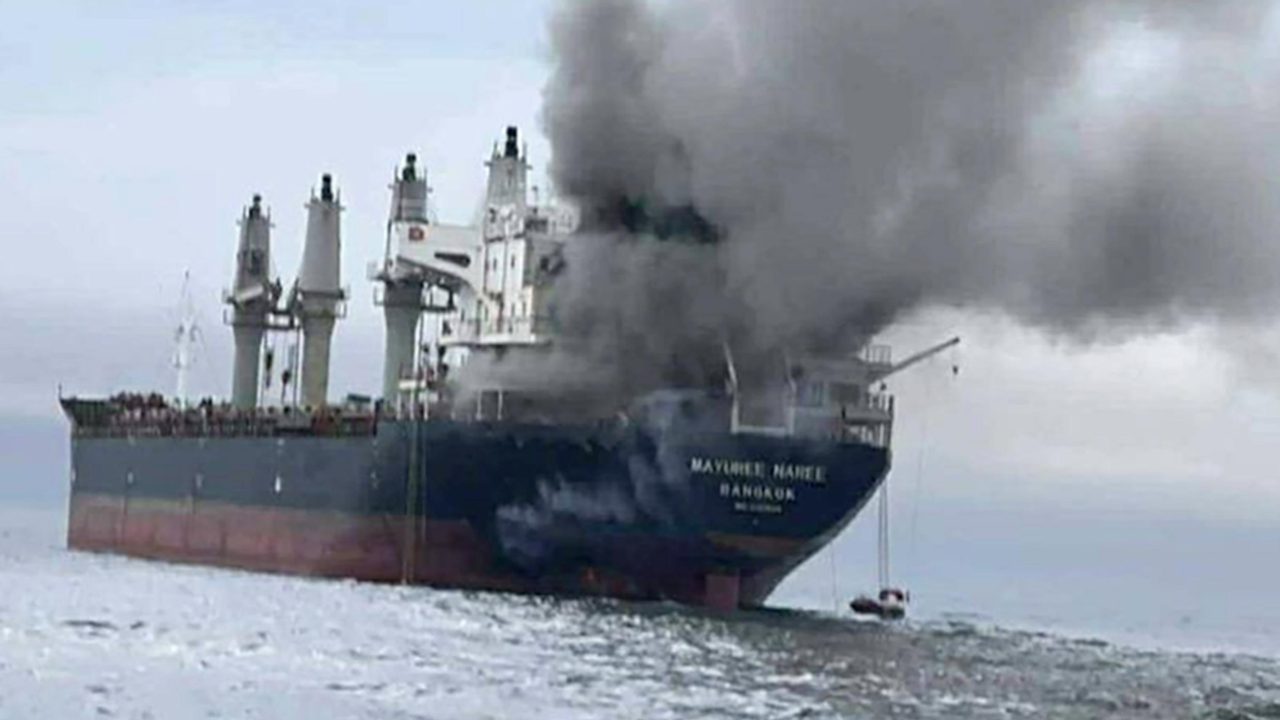
Caption: A handout photo made available by the Royal Thai Navy shows the Thai-flagged cargo ship Mayuree Naree on fire after being hit by Iranian missiles in the Strait of Hormuz, Iran, 11 March 2026 (issued 12 March 2026). According to the Royal Thai Navy, 20 Thai crew members were rescued by Oman’s navy while three remain missing. EPA/ROYAL THAI NAVY / HANDOUT
Updated: March 12, 2026 - 07:06