 Edit
Marta Kos: Putin will never have a veto on Ukraine’s EU future
The European Commission is preparing options to revise enlargement rules, as the existing ones were designed for a different era
As Russia’s war reshapes Europe’s security architecture, EU Enlargement Commissioner Marta Kos says Brussels must rethink how it admits new members – without allowing Vladimir Putin to determine Ukraine’s fate. In Kyiv, she made clear that despite war, reforms and trust remain the decisive factors, and Moscow will never hold a veto over Ukraine’s accession.
“We live in a reality where there is no international order,” European Commissioner Marta Kos said in Kyiv, reflecting on how dramatically the geopolitical landscape has changed since Russia’s full-scale invasion of Ukraine.
In an interview with EUalive’s partner European Pravda during her fifth visit to Ukraine as Commissioner, Kos described standing again on the Maidan as an emotional moment. She admitted she cannot explain how Russians “deliberately kill people just because they wanted to choose their own way”, and questioned what Europe might have done wrong to allow war to return to the continent.
Her answer was blunt. There is, she said, “there is, obviously, in people in different parts of the world, there is a lot of animal stuff, when they are led by the worst”, as some leaders are guided by the worst instincts. Yet she framed her role in stark political terms: helping to defeat “Putin’s system”, which she said seeks to subjugate its neighbours and prevent them from building developed economies and democracies.
Kos acknowledged that the European Union’s current enlargement methodology was designed for a different era – peacetime, gradual reforms and a stable international environment. Today’s world, she argued, is shaped by the logic of spheres of influence pursued by the U.S., China and Russia, and by external actors who want both EU candidates such as Ukraine and the EU itself to fail.
For that reason, the European Commission is preparing options to revise enlargement rules. Any changes will require the support of all 27 member states. Discussions are ongoing and could take several months, touching on decision-making, financing and values. While changing the EU treaties would be extremely difficult, Kos noted that mechanisms exist that have not yet been used.
Despite the debate on methodology, she stressed that Ukraine’s accession process has not stopped. Member states have already defined entry criteria, particularly in the field of rule of law. She also pointed to 10 reform priorities agreed with Deputy Prime Minister Taras Kachka in Lviv, many focused on anti-corruption, as a way to restore trust after setbacks in July last year.
Trust, Kos made clear, is central. When reforms were rolled back, she said she received countless calls from international financial institutions, member states and colleagues in the Commission asking “why?”. Even if laws are corrected later, rebuilding confidence is harder. Without full trust, even routine steps raise questions.
Yet she also highlighted what reassures her: Ukrainian civil society. She recalled watching Ukrainians protest government actions even under martial law, aware of the risks. Public support for EU membership – currently 72%, according to a poll she cited, is another key factor. Still, she warned that enlargement cannot happen against the will of EU citizens, making it essential to explain to member states why Ukraine’s accession is in the EU’s own interest.
On democratic standards under martial law, Kos said restrictions must be justified and proportionate. Democratic institutions – parliament, separation of powers, media freedom and ultimately free and fair elections – remain essential foundations.
Addressing concerns about whether Ukraine can join the EU while the war is ongoing – and whether a prolonged conflict would effectively give Vladimir Putin a veto over Kyiv’s European future, Kos was unequivocal: Putin will never have a veto on the future of Ukraine.
Occupation complicates the process, she acknowledged, but flexibility exists. The EU granted candidate status while part of Ukraine was already occupied, partly in response to that occupation.
Kos dismissed the term “hybrid negotiations” for the so-called frontloading process, describing it instead as Ukraine aligning with EU law. There will be no bargaining over EU legislation, she said: either the acquis is adopted or membership is not possible. An assessment of progress will appear in the enlargement report due in November.
Ukraine and Moldova, which applied and began the process together, are for now moving in tandem. Accession remains merit-based, however, and paths could diverge depending on reform speed. Among candidate countries, Kos sees four leaders: Montenegro, Albania, Ukraine and Moldova.
She praised Ukraine’s initial pace, calling it very fast, but expressed concern that parliamentary dynamics could slow reforms. Delays of a few months are not tragic, she said, but longer stagnation would require a response.
Kos also drew a pointed comparison with the Western Balkans, arguing that Ukraine is currently outperforming long-standing candidates in the pace of reforms. “If you compare what Ukraine and the Western Balkan states are doing, you are much better in carrying out these reforms. Despite the fact that you are at war,” she said.
Ultimately, Kos argued that Ukraine has already changed the EU. Enlargement was once viewed mainly through economic lenses – GDP and funding. But Ukraine has reminded Europeans that the Union was founded for peace, freedom, prosperity and security. Thanks to Ukrainians, she said, Europe has rediscovered what it means to risk losing peace and freedom – and why security must again be at the centre of the European project.
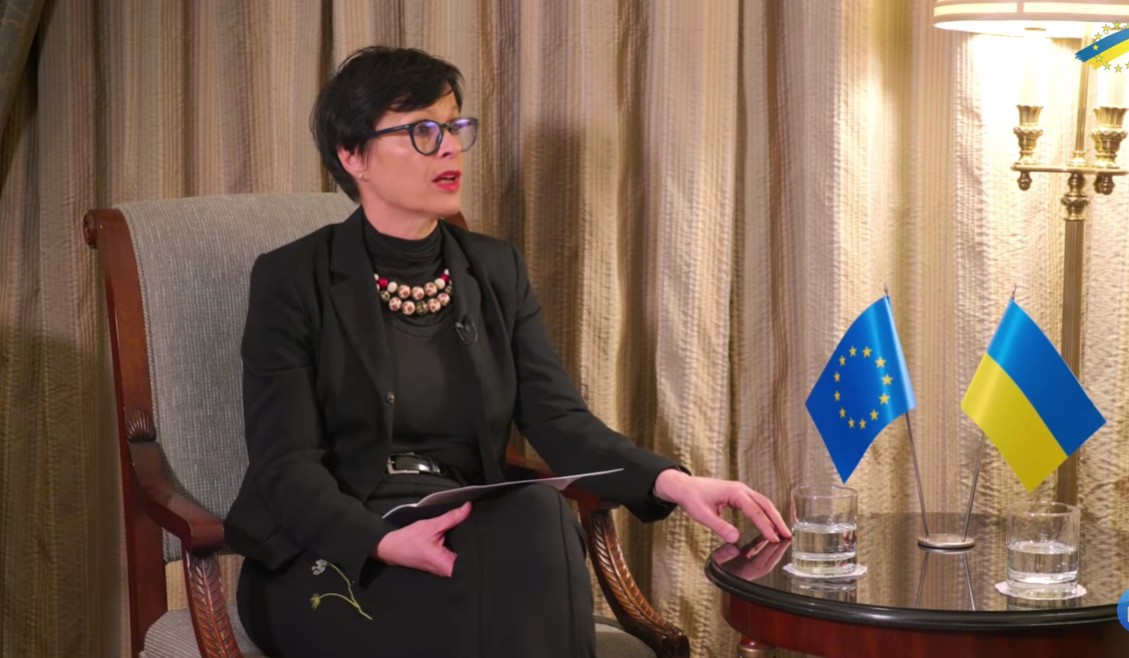
Caption: Still image from the interview conducted by Sergiy Sydorenko, Editor of European Pravda, with European Commissioner Marta Kos in Kyiv. 24 February 2026.
Updated: February 28, 2026 - 08:43