 Edit
Romania’s President invited to inaugural meeting of Trump’s Peace Council
The country’s potential participation could signal a shift for EU nations, many of which have been reluctant to engage
Romanian President Nicușor Dan has received a personal invitation to attend the first meeting of the Peace Council, an international body established by U.S. President Donald Trump to oversee global peacekeeping initiatives, with an initial focus on the Gaza ceasefire and reconstruction. The announcement comes as Romania weighs its potential involvement, highlighting ongoing consultations with the United States to align the council’s charter with Romanian legal and international obligations.
In a statement posted on his Facebook page on Sunday, President Dan expressed Romania’s support for U.S.-led peace efforts but emphasized that participation remains under review. “I have received an invitation to participate in the first meeting of the Peace Council, which will take place in Washington on 19 February. As I have said before, Romania welcomes the efforts of the US administration aimed at promoting peace,” he wrote. He added that Bucharest initiated discussions with Washington last month to explore revisions or interpretations of the council’s statute for full compatibility with Romania’s commitments.
The decision on attendance, Dan noted, will follow further talks on the event’s format, particularly for non-member countries interested in joining subject to amendments. Romania is not currently a member, though it received a proposal to join earlier. This cautious approach reflects broader European hesitancy toward the council, which has drawn mixed reactions since its formation.
A controversial Peace Council
The Peace Council, also referred to as the Board of Peace in some sources, was formally established on 22 January, during the World Economic Forum in Davos, Switzerland.
The signing ceremony involved representatives from fewer than 20 countries, primarily from the Middle East (such as Saudi Arabia, Qatar, and the United Arab Emirates) and South America (including Argentina and Paraguay). From the European Union, only the prime ministers of Hungary and Bulgaria participated, while non-EU European nations like Armenia, Azerbaijan, Turkey, and Kosovo were also present.
Notably absent were key U.S. allies in Western Europe, underscoring divisions in transatlantic relations under the Trump administration.
President Trump, who chairs the council for life according to its draft statute reviewed by Reuters, described the group positively during the event: “I really like this group. I like all its members. Can you believe that? Usually, I have two or three members that I don’t like. Here, I don’t see any like that.”
The council’s primary mandate, authorized by the UN Security Council, is to monitor the implementation of the Gaza ceasefire agreement, address governance issues, and facilitate reconstruction efforts.
However, Trump has indicated it could expand to resolve broader global conflicts.
Membership has grown to 27 nations since its inception.
Belarus became the first to join on 20 January, with self-proclaimed President Alexander Lukashenko signing the accession document at Trump’s invitation.
Russian President Vladimir Putin has expressed willingness to contribute, proposing the use of frozen Russian assets held in the U.S.
Ukraine has also been invited but is still evaluating the proposal, according to sources.
Details on the 19 February meet
The upcoming inaugural meeting on 19 February in Washington, D.C., marks a significant step for the council.
Hosted at the U.S. Institute of Peace, which Trump recently renamed in his honor, the session is described as both the council’s first official gathering and a donor conference to secure funding for Gaza’s reconstruction.
U.S. officials aim to advance the second phase of the Gaza ceasefire agreement, which includes dismantling Hamas military infrastructure, as per reports.
Plans for the summit remain in early stages and could evolve, but the White House began extending invitations to dozens of countries on 6 February, to gauge leader availability and logistics.
Israeli Prime Minister Benjamin Netanyahu is scheduled to meet Trump at the White House on 18 February, the day before, potentially setting the agenda for discussions on Gaza’s future.
Multiple international outlets, including Axios, Bloomberg, and The New York Times, have confirmed the date and focus, citing U.S. officials and diplomats from member states.
The event underscores Trump’s ambition to reshape global diplomacy, bypassing traditional institutions like the UN in favor of a U.S.-led framework.
EU leaders are set to convene for an informal retreat this week, on 12 February, at the historic Alden Biesen Castle in Belgium. While the official agenda centers on internal economic reforms – drawing on contributions from figures such as Mario Draghi and Enrico Letta – the discussions are widely expected to touch on broader strategic challenges, including the increasingly complex and strained transatlantic relationship.
This article is based on reporting from European Pravda, supplemented with details from Digi24, Axios, Bloomberg, edited by g.g.
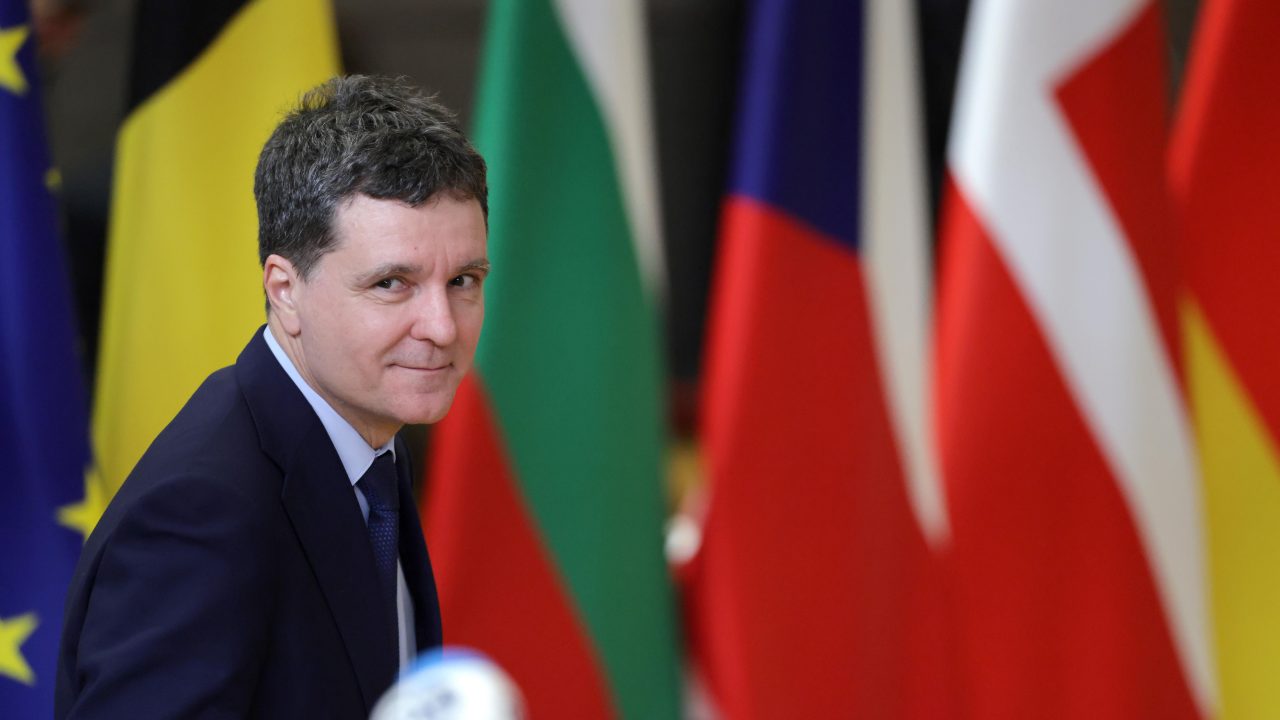
Caption: Romania’s President Nicusor Dan arrives for an informal meeting of the members of the European Council in Brussels, Belgium, 22 January 2026. EU leaders are holding an emergency informal summit to address an escalation in transatlantic tensions regarding Greenland and new US trade threats. EPA/OLIVIER MATTHYS
Updated: February 9, 2026 - 07:41