Edit
Vučić’s digital army and minimalist conscription: anything goes before elections
Critics in Croatia and elsewhere interpret the acquisitions of advanced military equipment as potential drivers of an arms race
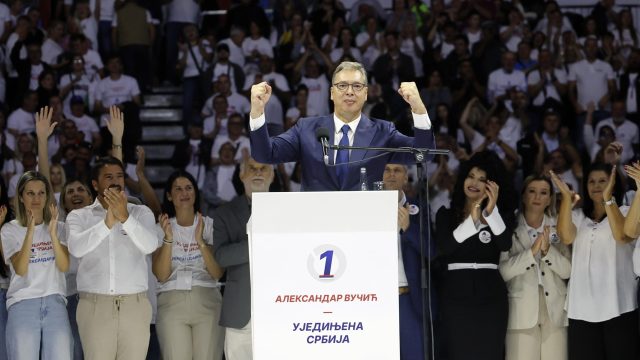
Serbian President Aleksandar Vučić used the conclusion of the Victory 2026 tactical exercise on 13 September to announce accelerated work on a “digital army” and the firm start of short mandatory military service, framing both as essential steps for national strength just weeks before the 25 October snap elections in which he aims at the post of prime minister.
Speaking at the Pešter training ground, Vučić presented the moves as a dual investment in security and civic responsibility while seeking to tighten his grip on Serbian politics after nearly two years of sustained student-led protests.
The president described systems already under development in which a combat vehicle that locks onto a target instantly transmits a digital signal to missile artillery, enabling engagement at the push of a button without verbal reports or delays. “Speed of decision-making is what gives the most modern armies their advantage. We need to reduce that time to the absolute minimum,” he told reporters. The exercise itself featured robotic unmanned ground vehicles, aerial drones, and robot dogs armed with RPG launchers, Zolja anti-tank weapons, and machine guns operating against a simulated settlement emptied of people. Strong winds complicated aviation and precision fire, yet Vučić rated the performance “very good” and emphasised the substantial financial investment behind the display. He stressed that the effort aims to reduce soldiers’ exposure to danger while preserving the indispensable human factor.
A networked force takes shape amid political pressures
Vučić positioned the digital army as a long-term transformation rather than an overnight change. Once a target is identified, information flows digitally to rocket and artillery units so that engagement occurs with minimal human intervention in the kill chain. Chief of the General Staff Milan Mojsilović, who attended the event, described the results as the product of years of steady investment and noted that such operational proficiency cannot be improvised. Both men repeatedly cast the modernisation as defensive, insisting Serbia seeks only to safeguard its own skies and territory and has no intention of threatening others.
The demonstration also highlighted Serbia’s diversified procurement strategy. Digitised multi-barrel rocket systems, including the Israeli Elbit PULS capable of striking targets at ranges approaching 300 kilometers, appeared alongside domestic and imported drones. These capabilities sit within a broader portfolio that includes Chinese air-defence systems and combat drones, French Rafale fighters ordered to replace aging Soviet-era aircraft, and recent adaptation of Chinese CM-400AKG supersonic missiles for the MiG-29 fleet. Serbia has raised military spending to roughly 2.6 percent of GDP and aims for a substantial increase in equipment through both foreign purchases and expanding domestic production. The approach produces a hybrid force that draws technology from multiple directions while Belgrade continues to balance traditional ties with Russia, growing cooperation with China, and formal aspirations toward European Union membership.
This rapid buildup has unsettled neighbors still marked by the wars of the 1990s. Critics in Croatia and elsewhere interpret the acquisition of advanced missiles, drones, and air-defense systems, together with occasional nationalist rhetoric about a broader Serbian cultural space, as potential drivers of an arms race. Vučić and his government counter that the investments merely restore Serbia’s ability to protect itself after years of underfunding and that the digital emphasis prioritizes precision and reduced risk to personnel over any expansionist agenda.
Conscription as civic rite and political signal
On the question of mandatory service, Vučić confirmed that preparations will be complete for a March start. The term will last only 75 days – a period he openly called “nothing” in pure duration, yet he argued it will make a big difference. In his words, young people will gain a sense of responsibility, seriousness, and dedication that he likened to a rite of passage into adulthood. The presence of barracks in border towns such as Priboj, Pirot, and Sombor, he added, would function like factories, stimulating local economies and social cohesion. The short service model is presented as a pragmatic compromise that delivers national benefits without imposing a heavy burden on recruits or the state budget.
The timing of these announcements is inseparable from the domestic political calendar. After prolonged student protests that challenged his authority, Vučić is positioning himself to call snap elections for 25 October, with the aim of converting military modernisation and patriotic messaging into renewed electoral strength and, potentially, a dual role as prime minister. The digital-army narrative and the reintroduction of conscription supply concrete symbols of resolve and continuity that can be deployed on the campaign trail.
Kosovo remained an unavoidable undercurrent. With a verdict expected for Hashim Thaçi and other former Kosovo Liberation Army commanders at the Specialist Chambers in The Hague, Vučić stated that he expects KFOR to maintain the safety of residents in Kosovo and Metohija. He cited correspondence with NATO Secretary General Mark Rutte and expressed confidence that neither European nor American authorities would tolerate violence, while acknowledging the delicacy of the moment. He also reiterated the government’s position that recent claims of a sonic weapon used against protesters were unfounded and that circulating recordings had been manipulated.
According to critics, calling 75 days “nothing” while elevating it into a rite of responsibility is classic symbolic politics. It is long enough to generate photo opportunities and a sense of shared duty, short enough to avoid serious fiscal or social costs. In the same breath, Vučić manages Kosovo sensitivities and dismisses protest-related claims, keeping the security narrative tightly controlled.
Vučić is not merely modernising the armed forces; he is instrumentalising modernisation and a minimalist draft as tools of political re-legitimisation. The digital-army spectacle and the short service together offer concrete symbols of resolve and continuity that deflect attention from domestic discontent, reassert the primacy of the security state, and convert defense spending into electoral capital. Whether the technology ultimately reduces risk to Serbian soldiers is secondary to its immediate utility in tightening his grip ahead of the October vote.
Vučić’s 15-day robot army: Chinese machines, Serbian guns, Western alarm
Sources: BETA, Vreme, Politika.rs, Deutsche Welle, Reuters
Caption: Serbian President Aleksandar Vučić used the conclusion of the Victory 2026 tactical exercise on 13 September to announce accelerated work on a “digital army”. (Aleksandar Vučić’s Facebook page)
Updated: September 14, 2026 - 09:00