Edit
Vucic and Trump: united in targeting universities in authoritarian power play
Both in the U.S. and in Serbia, those in power try to subdue academia, a perennial stronghold of critical thought
Across the Atlantic, two leaders with a knack for consolidating power are turning their sights on a common target: universities. In the United States, President Donald Trump’s administration is waging a multi-front assault on Harvard University, the nation’s oldest and wealthiest academic institution, accusing it of fostering “woke” ideology and antisemitism. In Serbia, President Aleksandar Vucic’s regime is tightening its grip on state universities, threatening their autonomy with a new higher education law that echoes the repressive tactics of Slobodan Milosevic’s era.
Though continents apart, these campaigns share a striking playbook: weaponizing funding, legal pressures, and nationalist rhetoric to subdue academia, a perennial stronghold of critical thought and dissent.
The parallels between Trump and Vucic are stark. Both leaders frame universities as hotbeds of dangerous ideologies, whether “woke” liberalism or anti-government dissent, and justify their interventions as necessary to restore national values.
Both wield funding cuts as a blunt instrument, targeting the financial lifelines of institutions that depend on public support. Trump’s freeze on Harvard’s $3 billion in grants and contracts mirrors Vucic’s salary cuts in universities, which undermine the scientific mission of Serbian universities.
Both also exploit legal and administrative tools, visa revocations, tax threats, police interrogations, and stacked working groups to intimidate and control.
Vucic’s crackdown in Serbia
In Serbia, Vucic’s regime is targeting state universities, which have become epicenters of student and citizen protests against his increasingly authoritarian rule, following the tragic incident at the Novi Sad railway station.
Like US president Donald Trump, Vucic is using financial levers to punish dissent. A controversial financing act, passed without consultation, ties 87.5% of professors’ salaries to teaching and only 12.5% to research, slashing incomes during non-teaching periods.
This has left academics struggling to survive, a clear reprisal for supporting student blockades. Belgrade University, ranked among the top 1.9% globally, faces inspections, smear campaigns labeling figures like Rector Vladan Djokic as “enemies of the state”, and police interrogations. SNS allies, like MP Vladimir Djukanovic, have even proposed defunding state universities entirely to create a government-controlled “national university”.
At the heart of the protests, a proposed higher education law, billed as a reform for “rational and sustainable financing”, has sparked fears that it will dismantle university autonomy, reviving memories of the 1998 “Seselj’s Law” under Milosevic. That law, named after war criminal Vojislav Seselj, allowed the government to appoint university leaders and purge dissenting academics, with over 200 professors losing their jobs for refusing to comply.
The new Vucic’s law drafting is led by a working group under Education Minister Dejan Vuk Stankovic, packed with loyalists of Vucic’s Serbian Progressive Party (SNS). Seven of its ten professor members backed the SNS in past elections, and most oppose the student-led occupations of campuses.
Serbian voucherization
Protesters, rallying on May 23 under the slogan “Let’s Defend the University”, demanded the group’s dissolution, an end to education “voucherization”, and the reversal of a punitive bill. The voucher system, which would let students choose between state and private universities, could starve critical but less “marketable” programs.
The reform means that students would receive vouchers and be able to decide on whether to enroll in a state or private college, i.e. which to pay. This would probably have a devastating effect on a large number of colleges and study courses essential to the functioning of the state, as they would not survive in the market without state funding because they are unpopular – this primarily applies to schools that educate teachers, like the School of Philosophy and a number of natural science schools.
Vucic has hinted at what might be expected by announcing that the new law “will distribute money to schools in a different way”. On 16 May he said that he wanted more students to be entitled to state financing of their studies at private colleges.
Another possibility being mentioned by the media is returning some of the solutions proposed in a bill on high education that was dropped from parliamentary procedure on 22 November, three weeks after the collapse of the canopy in Novi Sad that killed 16 people, adding that “additional consultations” on the act were needed.
The proposal which was withdrawn after strong public pressure envisaged allowing foreign colleges accredited in their country of origin to operate in Serbia. That would mean that independent commissions would no longer have any say and that the executive authorities would get to directly decide who gets a permit.
Public critics have also posed the question of under which conditions would foreign universities be allowed to come to Serbia, i.e. would they be credible institutions or was it a suspicious attempt involving abuses and corruption. The bill also envisaged the possibility of state scholarships, meaning that a student enrolled in a foreign college could study at the expense of the state.
This would place domestic private colleges in an unequal position and the majority of them would no longer be able to continue working under these conditions. Vucic temporarily withdrew under pressure, to avoid opening a new front during a time of high tensions in society.
Trump’s war on Harvard
In the U.S., Trump’s second term has seen an aggressive campaign against Harvard, framed as a crusade against liberal elites and alleged antisemitism. The administration’s attacks, launched in the wake of pro-Palestinian protests following the 7 October 2023, Hamas attack on Israel and Israel’s subsequent military actions in Gaza, target the university’s funding, international student programs, and tax-exempt status.
The moves are part of a broader effort to force ideological conformity at elite institutions, which Trump claims have been overtaken by leftist dogma.
In April, the administration demanded sweeping operational changes at Harvard, which President Alan Garber rejected as tantamount to ceding control to the government. Hours later, the White House froze over $2 billion in federal grants and contracts, primarily for scientific and medical research, with an additional $1 billion in blocks from agencies like the National Institutes of Health and the Centers for Disease Control.
Harvard, which relies on these funds for cutting-edge research, is now fighting the cuts in court. Trump has also floated redirecting previously awarded research grants to trade schools, a move critics argue would gut academic innovation.
The administration’s crackdown extends to Harvard’s international students, who comprise over a quarter of its student body and are a vital revenue source. In May, Trump revoked Harvard’s ability to enroll foreign students and ordered current ones to transfer or face deportation, prompting a lawsuit that has temporarily blocked the action.
The Trump administration has singled out Chinese students, citing national security concerns about Beijing’s influence over U.S. technology. The visa revocations have left thousands of students in legal limbo, threatening Harvard’s global ties, particularly with China.
Most audaciously, Trump is targeting Harvard’s tax-exempt status, which saves the university hundreds of millions annually and enables tax-deductible donations from wealthy alumni. The administration has also embedded provisions in a massive spending bill before Congress that would sharply increase taxes on endowment profits, a blow to Harvard’s ability to fund financial aid for low-income students. Critics, including Harvard, argue these measures threaten academic freedom and the institution’s very existence, accusing Trump of using federal power to punish ideological opponents.
Different context
Yet, the contexts differ. Trump’s campaign is steeped in U.S. culture wars, leveraging antisemitism allegations to rally his base, while Vucic’s moves are rooted in Serbia’s post-Yugoslav struggle for democratic norms, with universities as symbols of resistance.
Both face pushback: Harvard is battling in court, while Serbian students and faculty continue mass protests. But the risks are profound. In the U.S., undermining Harvard could weaken US higher education’s global standing. In Serbia, crushing university autonomy threatens one of the last bastions of free thought in a country sliding toward autocracy.
Edited by k.n.
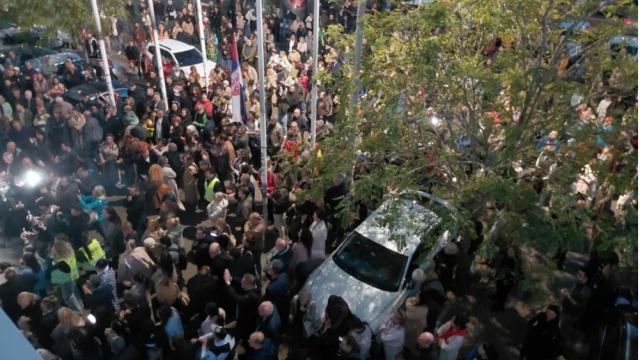
Caption: University students lead the blockade of the Brankova street bridge in Belgrade, Serbia, 01 June 2025. University students are rallying to demand accountability and call for early elections after sixteen people died when the canopy of the newly renovated Novi Sad Railway Station collapsed on 01 November 2024. The station, which had been reopened on 5 July 2024 following renovations, was undergoing additional work shortly before the incident. [EPA-EFE/ANDREJ CUKIC]
Updated: June 6, 2025 - 06:34