Edit
EditVon der Leyen dismisses criticism over Pfizergate as attack from ‘Putin apologists’
The Commission President’s combative stance may shore up her base but risks alienating key allies
On Monday (7 July) European Commission President Ursula von der Leyen faced a heated debate in the European Parliament in Strasbourg, defending her leadership against a no-confidence motion led by Romanian MEP Gheorghe Piperea of the European Conservatives and Reformists (ECR) group.
The motion, sparked by the so-called “Pfizergate” scandal involving undisclosed text messages with Pfizer CEO Albert Bourla during COVID-19 vaccine negotiations, exposed deep divisions within the EU’s political landscape.
Von der Leyen faces no-confidence vote in European Parliament amid Pfizergate
While the motion is unlikely to pass the required two-thirds majority vote scheduled for Thursday, the debate revealed tensions in von der Leyen’s centrist coalition, criticism of her alignment with far-right groups, and persistent questions about transparency.
Pfizergate and transparency woes
The no-confidence motion, backed by 77 MEPs, centers on von der Leyen’s refusal to disclose text messages exchanged with Bourla in 2021, during negotiations for a €35 billion deal for 900 million doses of the Pfizer-BioNTech COVID-19 vaccine.
A May 2025 EU Court of Justice ruling found the Commission’s failure to provide a credible justification for withholding the texts constituted “maladministration,” fuelling accusations of secrecy. In the debate, von der Leyen addressed Pfizergate more extensively than ever before, but offered no new details, reiterating the Commission’s stance that the messages were “short-lived” and not part of the public record.
EU court rules against von der Leyen in Pfizer case, exposing her fragility amid mounting challenges
She dismissed accusations that national governments were unaware of the vaccine contracts’ terms as “dishonest” and “simply a lie,” branding critics as “conspiracy theorists,” “anti-vaxxers,” and “Putin apologists.”
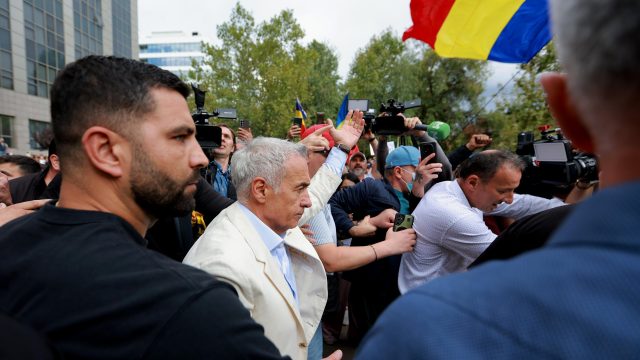
Romanian MEP Piperea (AUR, ECR), who initiated the motion, framed it as a call for transparency against a “Brussels bureaucracy” eroding Parliament’s power. He argued the vote, though symbolic, serves as a “wake-up call” for European citizens to reflect on the Commission’s actions.
Centrist coalition in crisis
The debate exposed fractures in the informal centrist coalition – comprising von der Leyen’s European People’s Party (EPP), the Socialists and Democrats (S&D), Renew Europe, and the Greens – that has supported her presidency since 2019.
Socialists, led by Iratxe García, and Renew’s Valérie Hayer lambasted von der Leyen for sidelining them in favor of far-right alliances, particularly with the ECR. García warned that if von der Leyen “betrays” the pro-European coalition again, “social democracy will lead the resistance against your drift.” Despite this, both S&D and Renew confirmed they will vote against the motion, ensuring its likely failure.
However, the German S&D delegation, led by René Repasi, is considering abstaining, signalling deep discontent with von der Leyen’s leadership. Repasi criticised her for bypassing Parliament on measures like defence spending loans and for aligning with the EPP’s rightward shift, including the withdrawal of a key anti-greenwashing law in June 2025.
Renew’s Hayer pointedly asked von der Leyen, “Who are your real allies in this Parliament?” accusing the EPP of pursuing “opportunistic alliances” with the far right.
EPP’s far-right flirtations under fire
The debate turned into a broader critique of EPP chief Manfred Weber’s strategy of courting the ECR, led by Italian Prime Minister Giorgia Meloni’s Brothers of Italy and Poland’s Law & Justice. Critics, including Green chair Bas Eickhout, called the motion a “big political show of the far right,” while García accused Weber of causing “more problems” for von der Leyen through his “misguided strategy.”
The EPP’s recent moves, such as handing the ECR a key migration file in the Civil Liberties committee, have broken the traditional cordon sanitaire against far-right groups, infuriating centrists.
Weber defended von der Leyen, arguing the motion was an attempt by far-right parties like Romania’s AUR and Germany’s Alternative for Germany (AfD) to destabilize the EU, calling them “Putin’s puppets.” He emphasized that the EPP votes with pro-European forces in 90% of roll-call votes, downplaying far-right cooperation.
Von der Leyen echoed this, warning of “extremist parties” polarizing societies with disinformation, citing Russian interference.
Splits within the right
The ECR itself is divided. While Piperea and Polish co-chair Patryk Jaki support the motion, Italy’s Nicola Procaccini, representing Meloni’s faction, rejected it as a “strategic blunder” that strengthens the centrist “Ursula majority.”
Procaccini argued the current Commission, with an ECR executive vice president, is the most right-wing in history, achieving victories in deregulation and migration. He warned that the motion hands leverage to Socialists and Greens, undermining the ECR’s growing influence.
The debate unfolded amid global trade tensions, with von der Leyen negotiating a potential U.S. trade deal to avoid President Donald Trump’s threatened tariffs, set to take effect on 1 August. Weber highlighted her role in these talks, arguing that destabilizing her leadership risks the interests of 450 million Europeans. The motion also reflects broader frustrations with von der Leyen’s leadership, including her deregulation agenda targeting the Green Deal and her unilateral foreign policy moves, such as her 2023 Gaza stance.
With agencies, edited by g.g.
Caption: European Commission President Ursula von der Leyen reacts after delivering a speech during the motion of censure of the Commission at the European Parliament in Strasbourg, France, 7 July 2025. EPA/GUILLAUME HORCAJUELO
Updated: July 8, 2025 - 06:35