 Edit
EditUkrainian drones going astray put allies to the test
Kyiv’s closest northern allies are facing an increasingly uncomfortable reality - Ukrainian drones are beginning to fall on NATO territory
As Ukraine intensifies long-range strikes against Russia’s oil infrastructure near the Baltic region, Kyiv’s closest northern allies are facing an increasingly uncomfortable reality – Ukrainian drones are beginning to fall on NATO territory.
While Finland, Latvia, Estonia and Lithuania continue to back Ukraine’s right to defend itself against the Russian invasion, a growing number of incidents involving stray UAVs has triggered security concerns, political pressure and fears that Russia could exploit the situation through hybrid operations designed to fracture European solidarity with Kyiv.
On 3 May, Ukrainian President Volodymyr Zelenskyy met Finnish Prime Minister Petteri Orpo in Yerevan. During the meeting, Orpo reiterated Helsinki’s support for Ukraine but issued a pointed warning.
“Finland supports Ukraine and understands its need to defend itself. However, it is unacceptable that Finnish airspace is violated and drones fly there,” he said.
His remarks came after two Ukrainian drones crashed in Finland earlier that same morning – the latest in a series of similar incidents that have steadily increased since March 2026.
Ukraine has dramatically expanded attacks on Russian energy infrastructure in recent months, particularly targeting oil terminals and ports near the Baltic Sea, including Primorsk and Ust-Luga in Russia’s Leningrad region.
Images of burning fuel facilities in Primorsk, formerly the Finnish town of Koivisto before Soviet annexation, and Ust-Luga have been celebrated in Ukraine and among Kyiv’s supporters, especially as Moscow continues to benefit financially from higher global oil prices driven by instability in the Middle East.
Yet these successful long-range attacks have exposed an increasingly sensitive problem for Ukraine’s allies.
The shortest flight paths from Ukraine to Russia’s Baltic oil terminals run close to the eastern borders of Estonia and Latvia, while some targets are located only a short distance from Finland and Estonia. In several cases, smoke from Russian fuel depots under attack was visible from neighbouring NATO states.
At the same time, Russian electronic warfare systems are believed to be disrupting Ukrainian drones by jamming GPS signals and navigation channels. Disoriented UAVs can then drift off course and unintentionally enter allied airspace.
Kyiv has consistently presented this explanation to its partners. But officials across the Baltic region are also increasingly aware of another risk: that Russia could deliberately exploit the situation by launching disguised attacks using drones made to resemble Ukrainian systems, or even captured Ukrainian UAVs, in an effort to destabilise pro-Ukrainian governments inside the EU and NATO.
March saw the highest concentration of incidents
Although the issue has only recently become a major political topic, most incidents actually occurred in late March. On the night of 23 March, Ukrainian drones reportedly crashed onto a frozen lake in Lithuania’s Varėna district near the Belarusian border.
Two days later, a drone struck the chimney of a power plant in Auvere, Estonia, while another exploded in Latvia’s Krāslava district after entering from Russian airspace.
Between 28 and 29 March, Finnish authorities discovered several drones near the Russian border, including near Kouvola, Parikkala and Iitti. On 31 March, up to a dozen drones reportedly entered Estonian airspace during another wave of Ukrainian strikes against Russian oil infrastructure.
The incidents coincided with some of Ukraine’s heaviest attacks on Primorsk and Ust-Luga.
During another Ukrainian strike on Primorsk during the first weekend of May, two more UAVs crossed into Finnish territory.
Latvia incident triggers political seism
Latvian Prime Minister Evika Siliņa resigned on Thursday after the collapse of her coalition government, following a political crisis triggered by the entry of Ukrainian drones into Latvian airspace and growing criticism over the country’s preparedness against aerial threats. The immediate trigger for the collapse was Siliņa’s dismissal of Defence Minister Andris Sprūds after the drones penetrated Latvian airspace undetected and exploded at an oil depot. Although the tanks hit in the incident were reportedly empty, the episode caused alarm in the Baltic state and raised fears over the vulnerability of NATO territory to spillover from the war in Ukraine.
Latvian government collapses after Ukrainian drones trigger security crisis
Zelenskyy acknowledged that the drones belonged to Ukraine and offered assistance to Latvia in strengthening its air defence capabilities. Ukrainian officials argued that Russian electronic warfare systems had diverted the drones off course and accused Moscow of attempting to manipulate public opinion inside NATO member states by redirecting Ukrainian UAVs toward neighbouring countries.
Russia pushes disinformation narrative
Moscow has moved quickly to weaponise the incidents politically. Russian officials and pro-Kremlin networks have promoted claims that Baltic states and Finland are secretly allowing Ukraine to use their territory for attacks against Russia.
The accusations have been repeated by senior Russian figures including Security Council Secretary Sergey Shoigu and Foreign Minister Sergey Lavrov. But the tone in Northern Europe has nevertheless hardened in recent weeks.
Finnish Defence Minister Antti Häkkänen said Helsinki had made clear to Kyiv that such incidents are “unacceptable”, even when caused by Russian interference.
“Ukraine is allowed to defend itself,” Häkkänen said. “But operations must be planned in a way that minimises the risk of drones deviating into Finnish airspace.”
The shift contrasts sharply with earlier Finnish statements in March, when President Alexander Stubb and Foreign Minister Elina Valtonen adopted a far more restrained tone and explicitly rejected demands for Ukraine to reduce attacks near the Finnish border.
Similar positions were voiced by Baltic leaders at the time. Lithuanian President Gitanas Nausėda warned in March that neither Lithuania nor other regional states could guarantee such incidents would not happen again.
Kyiv seeks to reassure partners
Ukraine has publicly apologised for the incidents while insisting they are unintentional.
Foreign Ministry spokesperson Heorhii Tykhyi said in March that Ukraine “did not direct and could not direct drones towards the Baltic countries”, adding that Kyiv remained in constant contact with Helsinki and other allies.
Ukrainian Foreign Minister Andrii Sybiha has argued that Russia’s electronic warfare systems are the root cause of the problem.
“It was Russia’s war that created all these threats,” Sybiha said, thanking Baltic and Finnish partners for recognising Moscow’s role in the incidents.
Behind the scenes, however, NATO allies are pressing Kyiv to improve coordination. Lithuanian Defence Minister Robertas Kaščiūnas said cooperation with Ukraine was necessary to minimise future risks, while Estonian officials have reportedly urged Kyiv to modify flight corridors for strikes on Russian targets near the Baltic region.
Source: European pravda
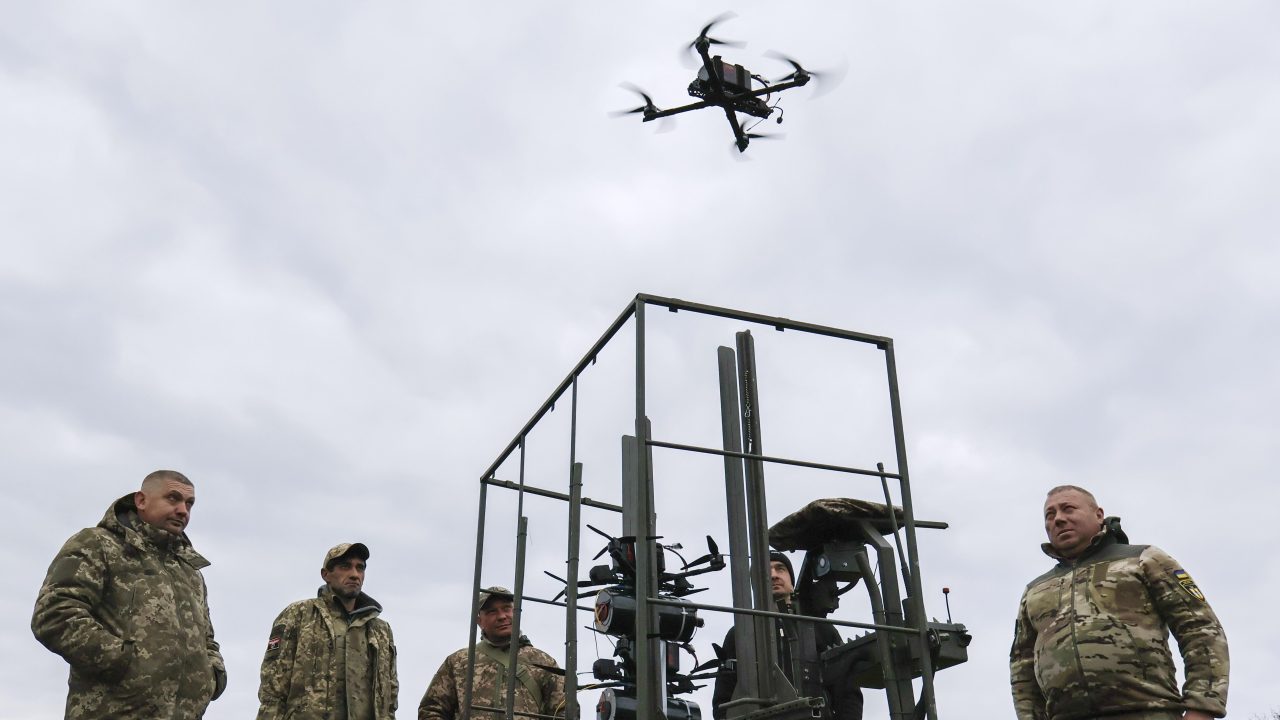
Caption: A handout photo made available by the press service of the 65th Separate Mechanised Brigade of the Ukrainian Armed Forces shows servicemen testing combat drones deployed from an FPV drone carrier on the ‘Gnome’ multifunctional platform at an undisclosed location in the Zaporizhzhia region, Ukraine, 10 April 2026, amid the ongoing Russian invasion. EPA/65TH MECHANIZED BRIGADE PRESS SERVICE / HANDOUT
Updated: May 15, 2026 - 17:13