 Edit
U.S. blockade threat deepens Hormuz crisis
Trump turns to maritime leverage after Islamabad negotiations collapse, as Tehran vows it will not bow to U.S. threats
The collapse of U.S.-Iran peace talks has sharply raised the risk of a new maritime and energy crisis in the Gulf, after President Donald Trump responded by ordering a blockade of the Strait of Hormuz and Tehran vowed it would not yield to threats.
What had begun as a diplomatic effort in Islamabad to halt the widening Middle East war ended without agreement after nearly a full day of negotiations, leaving Washington and Tehran divided over the nuclear file, sanctions relief and regional de-escalation.
Within hours, on Sunday Trump signalled a tougher turn, saying the United States would move to block the strategic waterway and target vessels linked to Iranian toll payments, pushing the conflict into what increasingly looks like a sustained pressure phase centred on maritime leverage.
The Strait of Hormuz, through which roughly a fifth of global oil supplies transit, now risks becoming the first arena of direct contestation between the two sides. Even before any formal implementation, the threat alone is already feeding into higher shipping risk, insurance costs and energy market volatility.
The White House has made clear that the nuclear issue remains the central priority. Vice-President J.D. Vance said the talks failed because Iran would not accept what Washington considers a credible commitment on its nuclear programme. The U.S. position, according to Vance, is that Tehran must step back not only from weaponisation but from the capability to move rapidly in that direction.
Iranian officials rejected that framing, insisting that sanctions relief and access to frozen assets must come first. Tehran also continued to link progress in the negotiations to wider regional de-escalation, including developments in Lebanon.
This divergence has left the two sides pursuing fundamentally different tracks: Washington is attempting to narrow the process to the nuclear file and maritime security, while Iran is widening it to include sanctions, frozen assets and the broader regional battlefield.
Rather than immediate escalation, the breakdown of talks appears to be opening a contest of leverage. Trump’s Hormuz signal has given that next phase a clear direction, with markets and shipping operators already moving ahead of formal politics.
For Europe and the Eastern Mediterranean, the consequences are far from distant. Any sustained disruption around Hormuz would feed directly into energy pricing, freight routes and wider market confidence at a time when fuel costs are already politically sensitive in the United States ahead of the midterm elections.
Jet fuel shortage looms as U.S.-Iran talks collapse and Hormuz remains blocked
Analysts quoted by AFP warned that the blockade order could complicate Washington’s next move rather than strengthen it. Prolonged negotiations would undermine Trump’s repeated claim that Iran holds “no cards”, while deeper military escalation would expose U.S. forces to greater risk and could further alienate voters angered by rising petrol prices.
Brian Katulis, a senior fellow at the Middle East Institute, described the approach as a “military-centric approach without strategy”, suggesting the administration may be buying time either to reposition assets or because it lacks a clearer political pathway. Shibley Telhami of the University of Maryland and the Brookings Institution called the blockade threat “bewildering and seemingly self-destructive”, warning that it risks further weakening Washington’s global credibility.
In Tehran, the response was swift and openly defiant.
Iranian parliament speaker Mohammad Bagher Ghalibaf said on Sunday that Iran would not yield to U.S. threats following Trump’s blockade order. Speaking after returning from Islamabad, where he led the peace negotiations with the American side, Ghalibaf said Tehran would respond in kind if confronted.
“If they fight, we will fight too, and if they proceed with logic, we will answer with logic. We will not bow to any threats,” he told reporters, according to several Iranian news agencies.
The rhetoric was reinforced by the Islamic Revolutionary Guard Corps, which warned that Tehran’s enemies would be trapped in a “deadly vortex” if they made a wrong move in the Strait.
Trump later said NATO had offered to help “clear” the Strait of Hormuz, telling Fox News that the alliance, alongside Britain and other partners, was prepared to support mine-clearing operations.
“We’ll clear the Strait,” Trump said, adding that U.S. minesweepers were already being deployed and that Britain would send similar assets.
Despite the hardened rhetoric, diplomatic channels remain open. Pakistan and other mediators are expected to continue efforts to bring both sides back to the table.
Sources: LevantIntel, BGNES, AFP
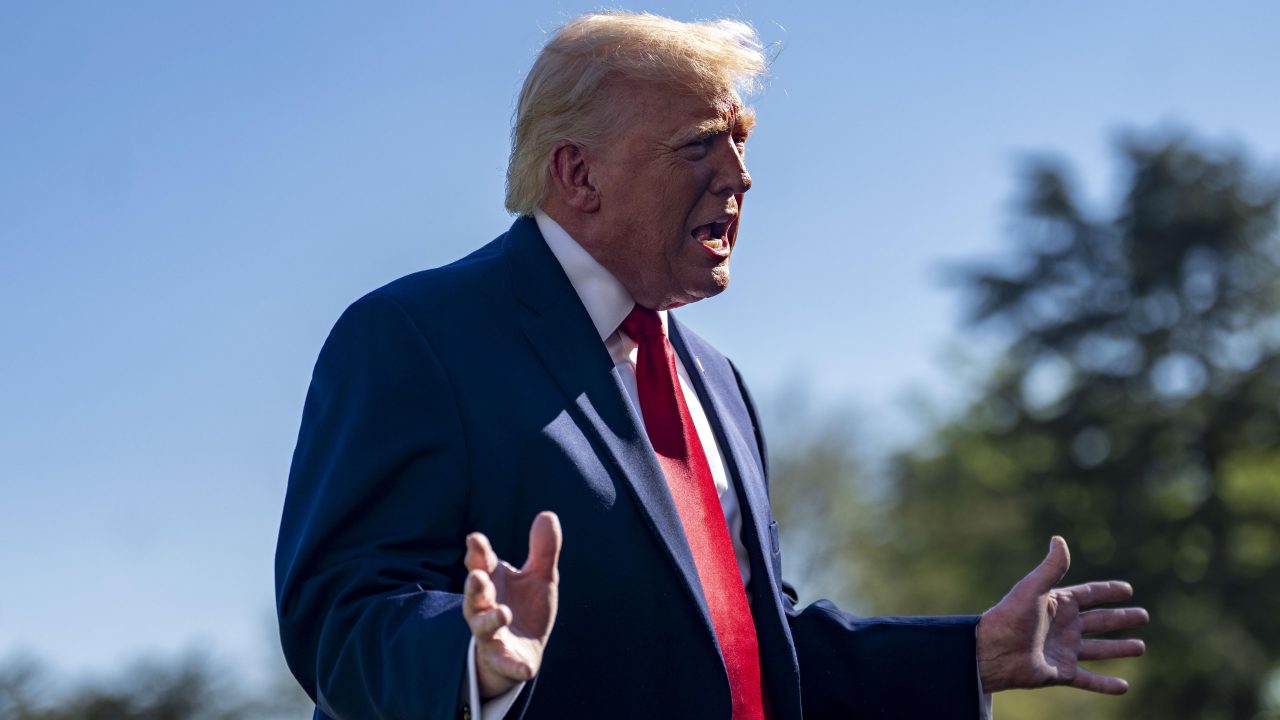
Caption: US President Donald Trump speaks to the media before departing the White House en route to Miami, Florida, in Washington, DC, USA, 11 April 2026. EPA/BONNIE CASH / POOL
Updated: April 12, 2026 - 22:06


