Edit
Turkic states prepare for Ankara summit, Europol-style agency to be discussed
Policing, digital trade and education are moving at different speeds ahead of the 30 October summit
The Organisation of Turkic States will hold a 30 October summit in Ankara with a crowded agenda and uneven progress. Some files already have signed agreements or money behind them. Others, including a proposed regional police agency known as TURKPOL, remain political proposals.
That distinction matters. Coverage of the Astana interior ministers’ meeting on 10 September often collapsed two steps into one: a Crime Fighting Council that Turkey wants signed in Ankara, and TURKPOL, which Interior Minister Mustafa Çiftçi described as a later executive body modelled on Europol and ASEANAPOL. The council is the near-term item. TURKPOL has not been established.
OTS members are Turkey, Azerbaijan, Kazakhstan, Kyrgyzstan and Uzbekistan. Hungary, Turkmenistan and the so-called Turkish Republic of Northern Cyprus, internationally recognised only by Turkey, take part as observers. Turkey is due to take the rotating chairmanship at the Ankara summit, after the foreign ministers meet on 29 October.
Policing first, TURKPOL later
Çiftçi said the Crime Fighting Council proposal was written into the Astana joint declaration. The council would coordinate work against organised crime, terrorism, narcotics, irregular migration and illegal betting. He said the first talks on a founding agreement were held in July and that Turkey wants the text signed when leaders meet in Ankara. Officials from Kazakhstan, Azerbaijan, Kyrgyzstan and Uzbekistan responded positively to the broader TURKPOL idea, according to Turkish reporting.
The sequence is deliberate. Once a council exists, Ankara wants to keep working toward TURKPOL as a standing law-enforcement cooperation agency. That would be closer to information-sharing and joint targeting of wanted suspects than to a single Turkic police force. No statute, headquarters or budget for TURKPOL has been announced.
Kazakh President Kassym-Jomart Tokayev told the interior ministers that cross-border security problems required closer coordination. That support is for operational police work. It is not the same as turning the OTS into a military bloc. Tokayev told the informal Turkistan summit in May that the organisation is “not a geopolitical project and not a military organization.”
Travel talk is also unfinished
The same Astana meeting returned to easier movement among member states, including travel on national identity cards and possible shared passport-control points at airports. OTS Secretary General Kubanychbek Omuraliev said in May that the organization was working on a “Turkic ID” concept under which national cards could eventually replace passports for travel among participating countries.
Some bilateral ID-travel arrangements already exist. The OTS has not adopted a bloc-wide passport-free system and has published no implementation timetable. A wider scheme would need compatible border databases and document-security standards.
The files that are further along
Digital trade is the most concrete economic track. The five members signed the Digital Economy Partnership Agreement in Bishkek on 6 November 2025. It covers paperless trade, electronic invoicing and payments, electronic signatures, logistics, consumer and data protection, and cybersecurity. Turkey, Azerbaijan, Uzbekistan and Kyrgyzstan have completed domestic ratification. As of mid-September, Kazakhstan was still moving the measure through its parliament.
Education has institutions and funding. The Turkic Universities Union, TURKUNIB, now includes 170 universities. Education ministers meeting in Turkistan on 8 June backed a permanent secretariat and a dedicated fund for the Orhun exchange program. The OTS Secretariat allocated $1 million to support exchanges. Turkey also proposed an education information network to collect comparable data from member and observer states. Ministers accepted that proposal.
A common Turkic alphabet remains advisory. A commission agreed in Baku in 2024 on a 34-letter Latin proposal. Each state still controls its own script. Uzbekistan changed part of its Latin alphabet in September, a national reform rather than full adoption of the common system.
Technology sits between ambition and hardware. Artificial intelligence and cybersecurity were the theme of the informal summit in Turkistan in May. Uzbek President Shavkat Mirziyoyev proposed an AI cooperation network, a “Digital Turkic Corridor” linking data centers, and a cybersecurity alliance. The joint satellite project OTS-SAT has an engineering model assembled in Astana. Launch is now discussed for 2027, later than the 2026 target set in last year’s Gabala Declaration.
Digital dawn in the spiritual capital: key takeaways from the informal OTS summit in Turkistan
Omuraliev told an analytical-centers meeting in Baku this week that economic integration already spans 66 mechanisms, from trade and energy to digitalization and space research. He put the combined GDP of Turkic states, including observers, at $2.4 trillion and total trade at $1.27 trillion. Those figures describe potential. They do not mean the October summit will create a single market.
Defence and foreign policy have clearer limits
Azerbaijan has pushed military cooperation harder than most members. At the Gabala summit in October 2025, President Ilham Aliyev called for deeper defence-industry ties and proposed an OTS joint exercise in Azerbaijan in 2026. That exercise does not appear on the remaining official 2026 events calendar.
Baku is preparing a separate “Power of Unity – 2026” exercise with Turkey, Iran, Kyrgyzstan, Pakistan and Uzbekistan. Because Iran and Pakistan are involved, the format is wider than OTS membership and has not been presented as the Gabala OTS drill.
Foreign ministers have started issuing joint political language. A 7 March meeting in Istanbul produced a statement that “any threats to the security of the member states of the OTS are a matter of concern for the entire Organization.” That created no mutual defence obligation. It put attacks on one member onto the organization’s political agenda.
This week’s calendar shows how much security work now runs in parallel. OTS security-council secretaries are meeting in Baku. Intelligence chiefs from the five members met in Burabay, Kazakhstan, with guests from Tajikistan, Turkmenistan and Hungary. Those sessions sit outside the crime-council file and do not amount to TURKPOL.
What Ankara can actually decide
Leaders will not be asked to launch a Turkic European Union or a Turkic NATO. The practical test is narrower: which proposals get a signed text, a budget or a permanent body.
The Crime Fighting Council is the policing item most likely to move if members agree on a founding agreement. Digital trade depends in part on Kazakhstan finishing ratification. Education already has a network and funding. TURKPOL, bloc-wide ID travel and a common defence structure remain earlier-stage ideas.
This article draws on reporting from EUalive’s partner Bosphorus News
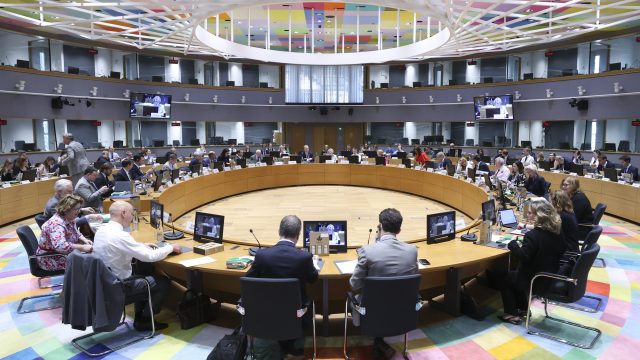
Caption: File photo. Informal summit of the Turkic states in Budapest, 21 May 2025 [Press Office of the President of Kazakhstan on X]
Updated: September 17, 2026 - 07:54