 Edit
Turkey seeks mediator role as Iran ceasefire opens diplomatic window
The approach fits into Ankara’s doctrine of “strategic autonomy”, which has sought to preserve bridges with major actors without fully aligning with any single one
The ceasefire announced on the Iran conflict front has given Ankara a fresh opportunity to showcase its diplomatic agility in an exceptionally volatile regional environment, as President Recep Tayyip Erdoğan moved quickly to position Turkey at the centre of de-escalation efforts.
According to Turkey’s press services, Erdoğan discussed the latest regional developments in a phone call with U.S. President Donald Trump, with the ceasefire at the heart of the conversation. The Turkish president welcomed the truce and stressed that the opening should be used carefully to build conditions for a more stable arrangement and avoid moves that could derail the process.
Turkish diplomatic sources said Ankara would continue supporting efforts aimed at de-escalation and a more permanent settlement, framing the current moment as a rare diplomatic opening in a crisis still shaped by multiple unstable power centres.
The Turkish side also links this phase to a broader web of contacts that, according to the same sources, involved countries including Pakistan and Egypt in efforts to maintain communication between the parties. In parallel, Ankara has highlighted the role of its National Intelligence Service, which Turkish officials say worked behind the scenes in multiple directions to help prevent a wider regional conflagration.
Still, much of this narrative comes from official Turkish and intelligence-linked sources, making the real scale and effectiveness of the intervention difficult to independently assess.
This ambiguity lies at the core of the geopolitical reading of Turkey’s current stance. Ankara is not presenting itself as a neutral mediator in the narrow sense, but rather as a regional power able to maintain simultaneous channels with competing camps, leveraging its position between the West, the Middle East and the broader Muslim world.
The approach fits squarely into Turkey’s broader doctrine of “strategic autonomy”, which in recent years has sought to preserve working bridges with all major actors without fully aligning with any single one.
Within this framework, Ankara appears determined to turn the crisis into an opportunity for diplomatic elevation. Its objective is not only to help prevent renewed military escalation, but also to strengthen its standing as a useful interlocutor in what could become a critical new phase of regional negotiations.
Trump announces two-week ceasefire with Iran as Tehran claims victory
At the same time, Turkish officials remain aware that the real outcome depends less on Ankara than on decisions taken in Washington and Tehran, on whether Israel remains within the ceasefire framework, and on whether parallel military incidents emerge elsewhere that could rapidly upset the fragile balance.
For Turkey’s political leadership and public opinion, Israel bears the main responsibility for this war.
For now, the truce appears less a definitive settlement than a temporary pause in escalation.
That is why Turkey’s current diplomatic mobility needs to be read on two levels: first, as a genuine effort to keep communication channels open; second, as an attempt to politically capitalise on a crisis that is reshaping regional balances.
Ankara understands that in such moments the value of a state is measured not only by military weight, but by its usefulness as a communication channel, mediator and political stabilisation hub.
In this sense, Turkey’s role fits a broader trend in which middle powers seek greater relevance during crises where larger capitals pursue controlled de-escalation without surrendering strategic leverage.
Turkey wants to be present in this phase not simply as a neighbouring country affected by events, but as a state able to offer communication, stabilisation and political management services.
Ankara has its own interests, as it doesn’t want Kurds in the region to seek greater autonomy.
Trump courts Kurds for ground operations in Iran as Turkey fumes
Whether Turkish mediation could prove useful will depend on the durability of the ceasefire, the progress of any follow-up negotiations and, crucially, whether the principal actors themselves continue to regard Turkish mediation as useful.
For now, Ankara is clearly attempting to place itself at the centre of a highly complex equation, even if the boundaries and tangible outcomes of this diplomatic activism remain undefined.
Economic pressure builds beneath diplomacy
The geopolitical opportunity, however, comes at a difficult time in terms of finances.
Turkey’s central bank has spent tens of billions of dollars from its foreign exchange and gold reserves in recent weeks to stabilise the lira under market pressure triggered by the war involving Iran.
The bank sold 52 tonnes of gold and carried out gold swap operations worth around $20 billion in order to boost dollar liquidity and support the national currency. Parallel foreign exchange interventions have added to the pressure, with more than $30 billion reportedly spent since the start of the war, while some estimates in Turkish media place total currency sales closer to $49 billion.
The measures underline the scale of Ankara’s effort to shield the lira from geopolitical shockwaves that have weakened investor confidence and accelerated capital outflows.
Turkey’s vulnerability is particularly acute because of its heavy dependence on imported energy. Rising oil and gas prices linked to the conflict have increased inflationary pressures and deepened external imbalances, forcing the authorities to prioritise currency stability as part of their broader anti-inflation strategy.
Official figures show inflation stood at 30.87% in March, underscoring how the regional conflict is feeding directly into Turkey’s already fragile macroeconomic environment.
Sources: IBNA, BGNES
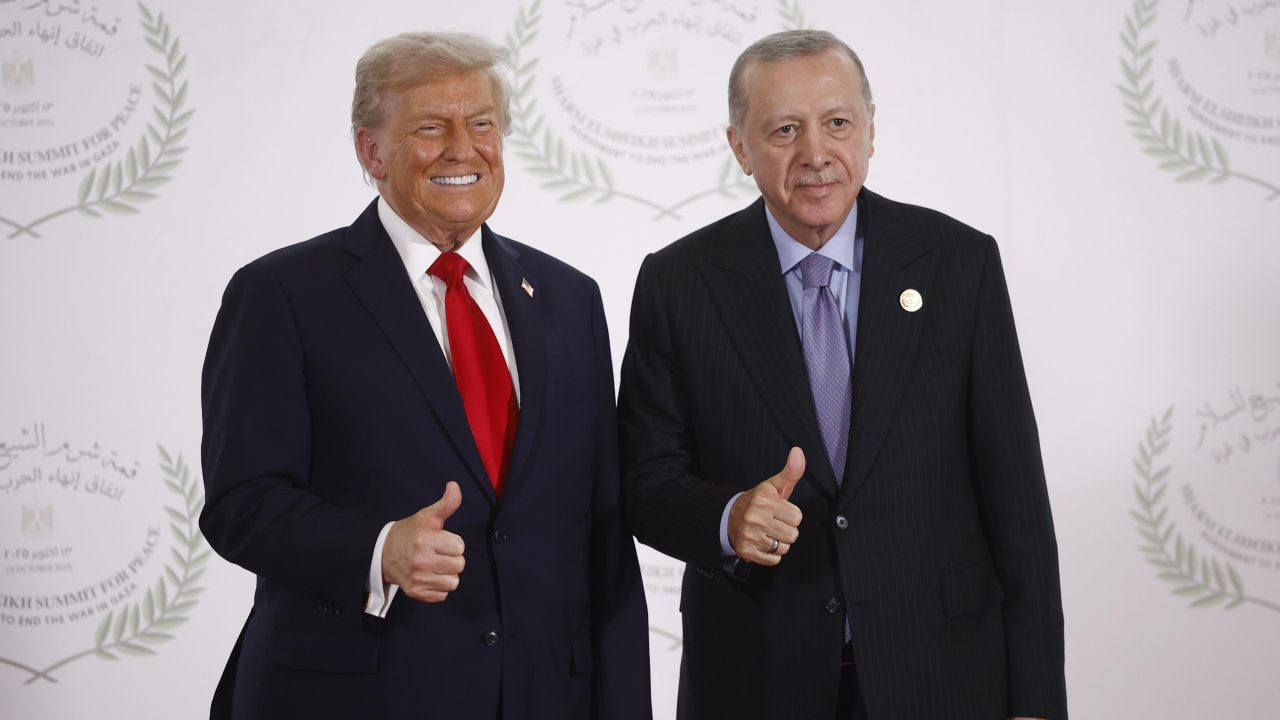
Caption: Turkish President Recep Tayyip Erdogan (R) and US President Donald Trump (L) pose during the greetings ceremony before the family picture at the Gaza Peace Summit in Sharm El-Sheikh, Egypt, 13 October 2025. EPA/YOAN VALAT / POOL
Updated: April 9, 2026 - 05:35


