Edit
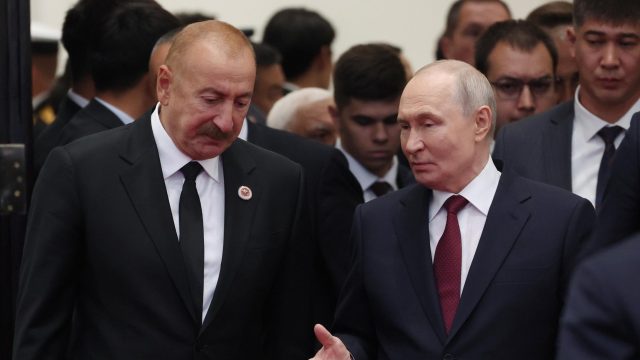
The leaders of Armenia and Azerbaijan met in Abu Dhabi amid strained relations with Moscow
Armenian police detained seven pro-Russian opposition figures on suspicion of terrorism
Police in Armenia arrested seven people associated with a pro-Russian opposition party on suspicion of terrorism following a slew of raids on their homes on Thursday (10 July) amid a wider government crackdown ahead of parliamentary elections.
The people are affiliated with the Armenian Revolutionary Federation (ARF), also known as Dashnaktsutyun, a group part of the pro-Russian parliamentary coalition headed by Robert Kocharyan, a former president of the South Caucasus country.
Armenia’s Investigative Committee said police had arrested seven individuals and charged one of them with preparing a terrorist act. The identities of all seven of the people could not be verified.
ARF said in a statement that raids were ongoing at several MPs’ homes as of early Thursday morning and that at least one politician and the son of another had been arrested.
Thursday’s arrests follow criminal indictments levied earlier this week against three politicians of the Armenia Alliance, the larger umbrella coalition of which the Armenian Revolutionary Federation is a part.
On 25 June Armenia’s political landscape erupted with the arrests of 14 individuals, including Archbishop Bagrat Galstanyan and other Armenian Apostolic Church (AAC) clerics, accused of plotting a “forcible seizure of power.”
These events, coupled with the detention of Russian-Armenian billionaire Samvel Karapetyan and Pashinyan’s public feud with Catholicos Karekin II, reveal a complex struggle involving domestic power dynamics, the AAC’s influence, and Russia’s shadow ahead of the June 2026 parliamentary elections.
Analysis: Unpacking Armenia’s political turmoil – Church, Russia, and Pashinyan’s power play
Opposition groups have decried the investigations as politically motivated.
The arrests come on the same day as a meeting between Armenian Prime Minister Nikol Pashinyan and Azerbaijani President Ilham Aliyev in Abu Dhabi, where the two are working to finalise a peace agreement to end nearly four decades of conflict.
Armenian Prime Minister Nikol Pashinyan, who swept to power during street protests in 2018, has brought Armenia closer to the West and distanced the country from traditional ally Russia.
But recent weeks have seen a widespread clampdown on Pashinyan’s political rivals and critics, including opposition figures, a leading Christian cleric and a former president.
Several prominent figures in Armenia, including the cleric, Archbishop Bagrat Galstanyan, are accused of orchestrating a coup to usurp power, something they deny.
Armenia-Azerbaijan talks
The arrests come on the same day as a meeting between Pashinyan and Azerbaijani President Ilham Aliyev in Abu Dhabi, where the two are working to finalise a peace agreement to end nearly four decades of conflict.
The two sides said in March they had agreed on the text of a draft peace agreement, but progress since then has been sporadic and slow.
The talks between Pashinyan and Aliyev in the capital of the United Arab Emirates were the leaders’ first formal meeting since they approved the draft.
In statements, the countries’ two foreign ministries said Pashinyan and Aliyev had discussed items including the delimitation of their shared 1,000-km (621-mile) border and agreed to continue dialogue at various levels.
A senior Azerbaijani government source said the talks took place in a “highly constructive atmosphere.”
Armenia said the sides had agreed to continue talks on a bilateral basis and that the dialogue had been “result-oriented”.
A peace deal could transform the South Caucasus, an energy-producing region neighbouring Russia, Europe, Turkey and Iran that is criss-crossed by oil and gas pipelines but riven by closed borders and longstanding ethnic conflicts.
Armenia and Azerbaijan, which both won independence from the Soviet Union in 1991, have been at loggerheads since the late 1980s when Nagorno-Karabakh – an Azerbaijani region that had a mostly ethnic-Armenian population – broke away from Azerbaijan with support from Armenia.
In 2023, Azerbaijan retook Karabakh, prompting about 100,000 ethnic Armenians to flee to Armenia. Both sides have since said they want to sign a treaty on a formal end to the conflict.
Some issues, including Azerbaijan’s demand that Armenia change its constitution to remove an indirect reference to Karabakh, are yet to be resolved.
Russia’s role as a mediator in the Armenia-Azerbaijan conflict of Nagorno-Karabakh, particularly its 2020 ceasefire brokering, frustrated Baku, which viewed Moscow as favouring Armenia through the CSTO alliance. Azerbaijan’s 2023 recapture of Nagorno-Karabakh, without Russian intervention, emboldened Baku to assert greater autonomy.
The arrests in Russia’s Yekaterinburg on 27 June of approximately 50 ethnic Azerbaijanis, with six detained and two reported dead, have strained the relations between Baku and Moscow. As the two leaders met in Abu Dhabi, what unites them most is their strained relations with Russia.
Azerbaijan’s raid on Sputnik journalists escalates tensions with Russia amid strained ties
Edited by g.g.
Caption: A handout photo made available by Azerbaijan President Press Service shows Armenian Prime Minister Nikol Pashinyan (L) meeting with Azerbaijani President Ilham Aliyev (R) in Abu Dhabi, United Arab Emirates, 10 July 2025. EPA/AZERBAIJAN PRESIDENT PRESS SERVICE
Updated: July 11, 2025 - 06:12